Satya Nadella warns enterprises of the Reverse Information Paradox
TECH

Satya Nadella warns enterprises of the Reverse Information Paradox

28+
Signals

Strategic Overview

  • 01.
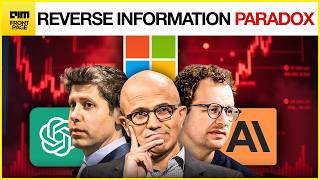
    Microsoft CEO Satya Nadella published an essay on July 12, 2026 coining a Reverse Information Paradox, warning that enterprises using AI pay twice - once with money and again with the proprietary knowledge they must reveal to make the model useful.
  • 02.
    Nadella named OpenAI and Anthropic directly, calling it ironic that frontier labs claim fair-use rights to train on public data while imposing restrictive distillation terms on everyone else.
  • 03.
    His proposed remedy is a real trust boundary inside the enterprise tenant plus decoupled orchestration, packaged as a five C's framework: Control, Capability, Choice, Cost, and Compound.

Your Corrections Are the Product

Nadella's argument turns on a mechanism most enterprise security teams never audit. Models improve from what he calls exhaust - the prompts employees write, the tools an agent reaches for, and above all the corrections people make when the model gets something wrong [1]. Each of those corrections quietly encodes something proprietary: what your organization measures, where its processes break, and how it defines good. That is knowledge a competitor could never buy off a shelf, and Nadella's point is that it leaks trace by trace, correction by correction, eval by eval [1].

The asymmetry is the sharp part. As The Register summarized it, the seller learns more and more about you as you use what you purchased, while you learn very little about what the seller is learning in return [2]. Because the leakage happens at the level of model exhaust rather than a database export, it sits below the layer most legal and security reviews are built to inspect - which is why Nadella frames it as a risk hiding in plain sight rather than a headline breach.

The Messenger Is Talking His Book

The most-cited caveat is that the person raising the alarm also sells the cure. Nadella's prescribed fix - keep the learning loop inside your own tenant and decouple orchestration from any single model - maps almost exactly onto Microsoft's Copilot and Azure AI Foundry, which are pitched as separating context, memory, and agent harnesses from the underlying model [2]. It is also a striking reversal against a historic partner: Microsoft poured billions into OpenAI and hosts its models on Azure, yet Nadella now names OpenAI and Anthropic directly, calling it ironic that frontier labs claim fair-use rights to train on public data while imposing restrictive distillation terms on everyone else [3].

Independent analysts have been blunt about the incentive. The newsletter MBI Deep Dives read the post as enterprise-software chiefs defending their castle against a model layer that captures value, granting the argument real merit while doubting most enterprises can actually execute the defense [5]. The takeaway is not that Nadella is wrong - it is that the framework is strategically useful to Microsoft whether or not it is true, and it should be read that way.

Inverting a 1962 Paradox, and Why the Timing Lands

The label is a deliberate inversion. Economist Kenneth Arrow's original 1962 information paradox described the seller's problem: you cannot prove the value of information without revealing it, and once revealed the buyer has it for free [6]. Nadella flips the risk onto the buyer - in the AI era, the enterprise is the one forced to disclose its most valuable knowledge just to make the tool useful [1].

What makes the argument land now rather than a year ago is the surrounding shift toward optionality. Nadella points to open-weight models reaching roughly 29 percent of traffic through Vercel's AI gateway last month as evidence that Choice - swapping models without re-teaching them everything - is becoming practical [1]. He packages the prescription as a five C's framework: Control, Capability, Choice, Cost, and Compound [4]. The through-line is that owning the compounding learning loop, not any single model, is where durable advantage now sits.

What the Skeptics Are Missing, and What They Get Right

Not everyone buys the urgency. A recurring pushback, loudest in developer and enthusiast communities, is that for the overwhelming majority of buyers the risk is academic: a shop building small-business websites has no institutional alpha to protect and gains enormous leverage from public models. That is fair for the long tail, but it sidesteps Nadella's actual target - the enterprise whose workflows and evals are the moat.

A sharper strain of skepticism questions the messenger's credibility given Copilot's own uneven enterprise traction, and warns that owning your learning loop can be a route to concentrating value in a few infrastructure owners rather than dispersing it. Yet the most constructive community framing collapses the debate into an architecture question: if your entire stack depends on APIs controlled by a handful of providers, the real advantage is building systems where you can swap models without losing your data, workflows, and institutional memory. Even critics who distrust Microsoft tend to land on the same practical hedge - keep the portable assets portable - which is, tellingly, the core of what Nadella is selling.

Historical Context

1962
Nobel laureate economist Kenneth Arrow formalized the original information paradox: a buyer cannot value information until it is revealed, but once revealed it is effectively acquired for free, leaving the risk with the seller.
2023-11
Microsoft helped restore Sam Altman at OpenAI, a partnership that press reports say had grown strained by 2026, contextualizing Nadella's now-hostile tone toward frontier labs.
2026-07-12
Nadella published the Reverse Information Paradox essay on X, inverting Arrow's paradox so the buyer, not the seller, is the one forced to disclose valuable knowledge.

Power Map

Key Players
Subject

Satya Nadella warns enterprises of the Reverse Information Paradox

SA

Satya Nadella / Microsoft

Author of the warning. Microsoft has a commercial stake in the fix: Copilot and Azure AI Foundry are positioned as tools that separate context, memory, and agent harnesses from the underlying model, keeping data inside the tenant boundary.

OP

OpenAI

Named target of the critique. Notable given Microsoft's multibillion-dollar investment and Azure hosting, making the essay a reversal against a historic partner.

AN

Anthropic

Named target, cited for banning distillation by others while learning from customer interactions - the asymmetry Nadella calls ironic.

EN

Enterprises and chief data officers

The buyers at risk. Roughly half of surveyed CDOs had reportedly paused or restricted Copilot deployments over data-governance concerns, showing pre-existing anxiety about exactly this exposure.

Fact Check

7 cited
  1. [1] Satya Nadella has issued a shocking warning to companies using AI
  2. [2] Microsoft chief turns hostile on frontier AI labs, warns companies to guard their IP
  3. [3] Nadella calls out AI labs like OpenAI and Anthropic for banning distillation while training on everyone else's data
  4. [4] Reverse Information Paradox: Microsoft CEO Satya Nadella offers tips on how firms can preserve competitive edge in AI era
  5. [5] Defending the Enterprise Castle From the Model Layer
  6. [6] Arrow information paradox
  7. [7] A company should be able to use a model without giving up the knowledge that makes it unique, Microsoft CEO Satya Nadella says

Source Articles

Top 5

THE SIGNAL.

Analysts

"Argues enterprises pay for intelligence twice and that a company should be able to use a model without giving up the knowledge that makes it unique."

Satya Nadella
CEO, Microsoft

"Reads the post as enterprise-software chiefs defending their castle against the model layer capturing value, and warns that if learning flows only one direction, economic value converges toward the owners of the learning infrastructure rather than the creators of the knowledge - while doubting most enterprises can execute the defense."

MBI Deep Dives
Independent technology and equity analyst, Substack

"Highlights the double standard - Microsoft funded OpenAI and Copilot itself ingests business data - yet credits Nadella for naming his own side's contradiction."

The Register
Technology publication (analysis)
The Crowd

"The Reverse Information Paradox — Satya Nadella's essay warning enterprises they pay for AI twice: once with money, and again with the proprietary knowledge they must reveal to make the model useful."

@@satyanadella15093

"Satya Nadella just warned every company using AI: you are paying twice. Once with money. Again with something far more valuable. He published an article introducing something called the Reverse Information Paradox. And it changes how you think about every AI tool your company"

@@VaibhavSisinty2698

"One of the key architectural questions of the 21st century in business will be how you maximize your corporate IP in the form of decisions, insights, workflow patterns, and best practices in a world where so much intelligence is packed into AI models."

@@levie534

"Satya Nadella just warned every company using AI: you are paying twice. Once with money."

@user130
Broadcast
REPORT: Nadella's Reverse Information Paradox -- The AI Trap No One Is Talking About

REPORT: Nadella's Reverse Information Paradox -- The AI Trap No One Is Talking About

Satya Nadella Raises Alarm: AI Power Could Be Concentrated in Few Big Models | WION

Satya Nadella Raises Alarm: AI Power Could Be Concentrated in Few Big Models | WION

Satya Nadella's AI Warning Explained | Reverse Information Paradox | ChatGPT & Copilot Risks

Satya Nadella's AI Warning Explained | Reverse Information Paradox | ChatGPT & Copilot Risks