NVIDIA's $500 billion AI infrastructure financing deal
TECH

NVIDIA's $500 billion AI infrastructure financing deal

58+
Signals

Strategic Overview

  • 01.
    Nvidia signed memorandums of understanding with Apollo, BlackRock, Blackstone, Brookfield, Goldman Sachs and KKR to establish AI compute infrastructure financing platforms designed to mobilize over $500 billion of third-party capital.
  • 02.
    The agreements are structured as MOUs, not final commitments, and remain subject to execution of definitive agreements; each firm independently judges its own participation level.
  • 03.
    Jensen Huang told CNBC he personally approached only these six firms for the commitment, and none turned him down.
  • 04.
    Nvidia may provide a residual-value support mechanism for up to 25% of a given transaction, reviewed project by project, to reduce lenders' perceived risk.
  • 05.
    Nvidia's stock fell after the announcement - reports range from roughly 1.4% to roughly 2.9% - erasing tens of billions of dollars in market capitalization despite the deal's intent to calm credit markets.

Deep Analysis

How Nvidia's residual-value guarantee actually works

Nvidia signed memorandums of understanding with Apollo, BlackRock, Blackstone, Brookfield, Goldman Sachs and KKR to build financing platforms meant to mobilize over $500 billion in third-party capital for AI data centers and compute[1]. The agreements are not final commitments - each firm will independently decide how much capital it puts into individual deals, and the structures remain subject to definitive agreements[3]. The core innovation is a residual-value support mechanism: Nvidia may cover up to 25% of the gap on a given transaction, assessed project by project, to reassure lenders who have historically been wary of financing GPUs directly because chip depreciation is unpredictable - a new architecture generation can make the prior one obsolete almost overnight[2]. Jensen Huang has defended the arrangement by pointing to chip longevity rather than obsolescence, noting the 2020-era A100 is still in commercial use six years later and arguing GPUs have an economic life stretching toward a decade[2]. He also said, in a CNBC interview cited by Bloomberg's reporting, that he personally approached only these six firms for the commitment, and none turned him down[3][4]. The guarantee is designed to do one specific job: convert an asset lenders see as fast-decaying collateral into something bankable enough to underwrite hundreds of billions in credit - part of a broader shift in how tech companies are financing AI buildouts, with more of them turning to debt rather than equity to fund infrastructure.
Wall Street's pitch: GPU revenue as a new securitized asset class

BlackRock's Larry Fink has cast the platform as the 'next future for financial engineering,' explicitly comparing it to the 1970s creation of mortgage-backed securities - treating AI chips and data centers as collateralized, revenue-generating infrastructure rather than depreciating equipment[5]. KKR's Waldemar Szlezak, who has been negotiating with Nvidia on this structure for over a year, explained the mechanics more bluntly: GPU revenue is a stream that can be securitized, sliced up, and sold off to insurers, pension systems and sovereign wealth funds hunting for long-duration yield, with KKR and Goldman Sachs together absorbing roughly 75% of the financing risk on deals where Nvidia backstops only 25%[6]. Goldman Sachs, for its part, wants to build an entire credit market backed by Nvidia compute[1]. It also estimates AI-related financing already accounts for nearly one-quarter of all US investment-grade debt issuance[7]. The pitch to institutional investors is that AI compute behaves like essential infrastructure - Brookfield's Bruce Flatt called it 'fast becoming the essential layer of infrastructure' - which is what makes it fundable at pension-fund scale rather than only venture-capital scale[1]. Public commentary on the deal has also framed it as a market-expansion play for Nvidia itself: by making GPUs financeable for smaller neocloud operators who cannot self-fund purchases the way Amazon, Microsoft and Google can, the arrangement widens Nvidia's addressable customer base and deepens its competitive lock-in against AMD, reinforcing pricing power even as cheaper Chinese chips and open-weight models offer alternatives.

The circular financing critique: Burry, the Bank of England, and an Enron echo

Not everyone reads the deal as a stabilizing innovation. Michael Burry, known for shorting mortgage-backed securities before 2008, is shorting Nvidia and Micron and sees 'shades of Enron's effort to make wholesale power an investable class' in the structure, arguing that Nvidia's chip-value guarantees keep much of the real financing risk off-balance-sheet and undisclosed, and pointing to a Bank for International Settlements finding that private credit lending to AI and IT sectors has quadrupled in five years[8]. The Bank of England's July 2026 Financial Stability Report independently flagged the same dynamic from a systemic-risk angle, warning that a reassessment of AI prospects could trigger an equity sell-off 'amplified by high concentration, correlated momentum-driven positions and increased leverage,' and separately called the pace of GPU-backed lending growth 'historically unprecedented'[9]. Moody's Analytics frames the deeper problem as structural: the web of interdependence among AI labs, hyperscalers, chipmakers and financial sponsors is now tighter than in traditional venture relationships, creating a circular system that can mask whether underlying demand is real[10]. Investment strategist David Bahnsen raised a related concern - that funneling Blackstone and BlackRock capital toward earnings-poor tech customers sharply raises volatility exposure[11]. The single most-watched piece of independent commentary on the deal, a hardware-focused YouTube teardown, traced money moving from Nvidia into CoreWeave (in which Nvidia holds an equity stake) and back to Nvidia through GPU leasing, plus a Huang family foundation payment to CoreWeave for donated university compute - and crossed 376,000 views, an unusually large audience for a financing-structure story. Reddit's reaction split across communities: r/wallstreetbets settled on 'Collateralized GPU Obligations' as its dominant framing for the deal, r/news debated the 2008 subprime-lending parallel alongside pension-fund exposure and speculation about a future bailout, and r/singularity split between bubble skepticism and pro-AI-scaling optimism, with some citing Anthropic's profitability claims and next-generation chip roadmaps like Vera Rubin and Feynman as reasons the buildout still has room to run.

Depreciation math and the China wildcard threatening the collateral

Depreciation math and the China wildcard threatening the collateral
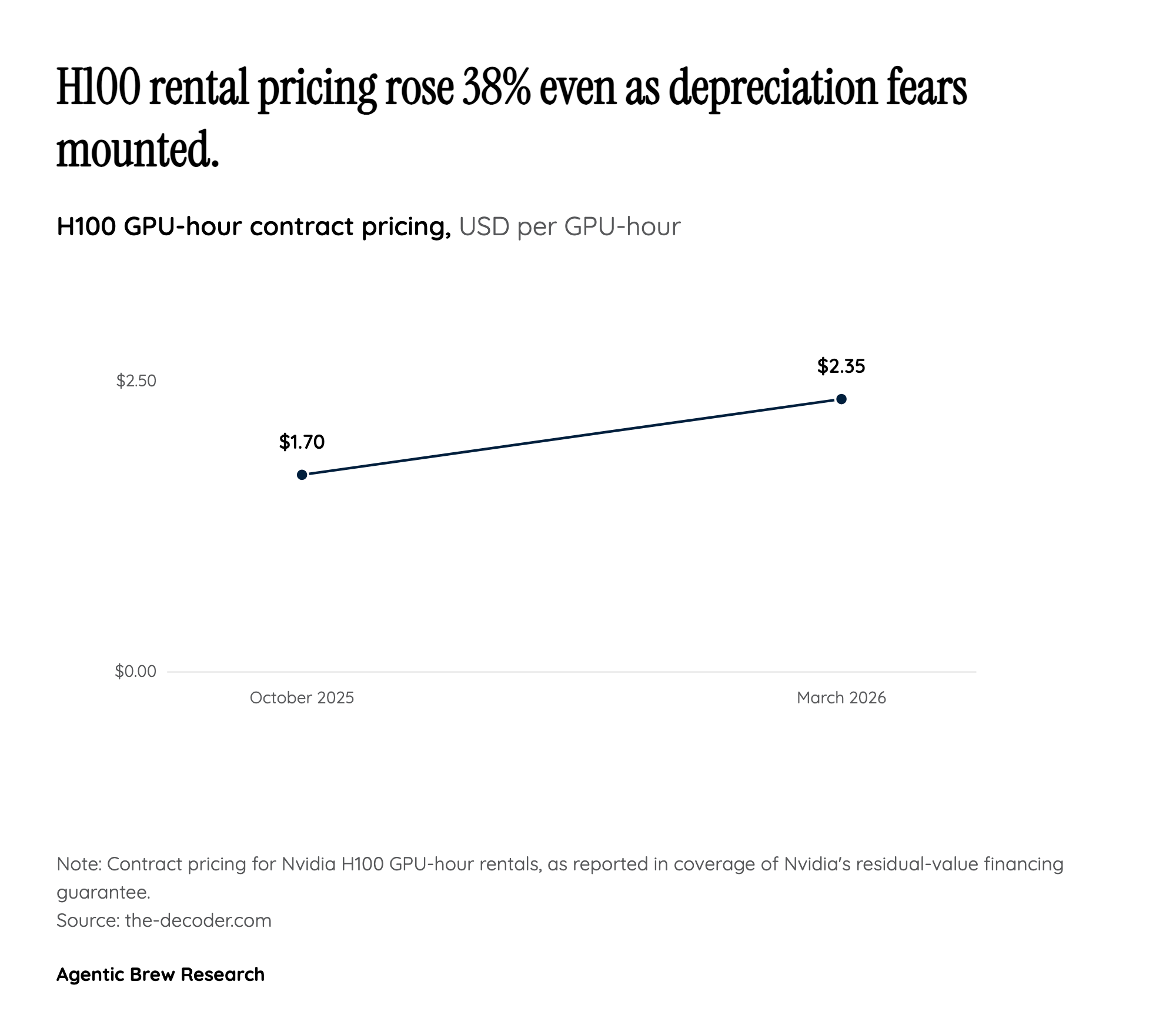
H100 GPU-hour contract pricing rose from $1.70 to $2.35 between October 2025 and March 2026.

The financing structure's entire premise depends on GPUs holding their value long enough to repay the debt backing them, and that assumption is contested on two fronts. On pricing, H100 GPU-hour contract rates actually rose from $1.70 in October 2025 to $2.35 by March 2026, which Nvidia and its partners can point to as evidence of durable demand and rental yield rather than collapsing value[2]. But investors reacted to the announcement with unease rather than confidence - Nvidia shares fell between roughly 1.4% and 2.9% depending on the report, erasing tens of billions of dollars in market capitalization even as the deal was intended to calm credit markets[5]. The second, newer threat to collateral value is geographic: China's domestic AI chip production, led by Huawei's Ascend 910B, is expanding fast enough that a wave of cheaper Chinese chips could trigger a price war and erode the resale value of the Nvidia GPUs underpinning hundreds of billions in loans - faster than the debt terms assume - even though Nvidia still holds an estimated 75% of the global AI chip market outside China[12]. That combination - contested depreciation assumptions plus an external competitive shock to collateral value - is the mechanism by which a financing structure built to look like infrastructure debt could behave more like equity risk if conditions turn.

Historical Context

2026-07-27
Before the six-firm Wall Street deal, Nvidia was already drawing circular-financing scrutiny over talks to back a large OpenAI data-center lease and other deals totaling roughly $750 billion.
2026-08-10
Nvidia and the six firms announced MOUs to mobilize over $500 billion in third-party capital for AI compute infrastructure financing platforms.
2026-08-11
Nvidia's show of financial force calmed jittery credit markets even as its equity price dipped.
2026-08-12
Reporting emerged that China's expanding domestic AI chip production, including Huawei's Ascend 910B, could flood the market with lower-cost chips, threatening to erode the collateral value of Nvidia GPUs underpinning the financing deals.

Power Map

Key Players
Subject

NVIDIA's $500 billion AI infrastructure financing deal

NV

NVIDIA (Jensen Huang, CEO)

Chipmaker providing GPUs and residual-value guarantees as collateral; architect of the 'AI factories as investable asset class' framing

BL

BlackRock (Larry Fink, Chairman/CEO)

Asset manager connecting long-term institutional capital to AI infrastructure; compares the effort to the birth of mortgage-backed securities

AP

Apollo Global Management (Jim Zelter, President)

Private capital partner framing compute as a scarce, mission-critical asset class

BL

Blackstone (Jon Gray, President/COO)

Existing large investor across the Nvidia ecosystem; draws parallels to residential mortgage lending

BR

Brookfield Asset Management (Bruce Flatt, CEO)

Infrastructure investor framing compute as 'fast becoming the essential layer of infrastructure'

GO

Goldman Sachs (David Solomon, Chairman/CEO)

Investment bank aiming to build a credit market backed by Nvidia compute; estimates AI-related financing is nearly one-quarter of all US investment-grade debt issuance

KK

KKR (Waldemar Szlezak, head of digital infrastructure)

Has negotiated with Nvidia on AI financing for over a year; explains how GPU revenue can be securitized and risk sold to institutional investors; together with Goldman Sachs absorbs the majority of financing risk on deals where Nvidia backstops only 25%

MI

Michael Burry (Scion Asset Management)

Critic shorting Nvidia and Micron; compares the structure to Enron's effort to make wholesale power an investable asset class

BA

Bank of England

UK central bank warning about AI-related financial stability risk and leverage buildup

BE

Ben Thompson (Stratechery analyst)

Frames the deal as effectively a price cut for Nvidia's customers, while warning about tapping safety-seeking institutional capital for AI risk

MO

Morgan Stanley (Joseph Moore, analyst)

Analyst view that third-party investor participation in the structure helps alleviate circular financing concerns

DA

David Bahnsen (investment strategist)

Warns that partnering with Blackstone and BlackRock to fund earnings-poor tech customers heightens circular-credit volatility

Fact Check

12 cited
  1. [1] NVIDIA Partners with Apollo, BlackRock, Blackstone, Brookfield, Goldman Sachs and KKR to Establish AI Compute Infrastructure Financing Platforms to Mobilize Over $500 Billion of Third-Party Capital
  2. [2] Nvidia Guarantees Its Own Chips' Value to Unlock $500 Billion in AI Infrastructure Financing
  3. [3] Nvidia to Team With Wall Street on $500 Billion Package, FT Says
  4. [4] Nvidia Teams Up With Wall Street Asset Managers on $500 Billion AI Push
  5. [5] Nvidia AI Chips Are Now an Asset Class: BlackRock CEO Larry Fink Just Compared Them to Mortgage-Backed Securities
  6. [6] Nvidia's Chip Securitization Play on Wall Street
  7. [7] Nvidia's Private Capital Deal Stokes Circular Financing Fears in the AI Boom
  8. [8] Michael Burry Shorts Nvidia, Micron Again, Questions OpenAI's $250B Backing
  9. [9] Financial Stability Report, July 2026
  10. [10] Circular Financing in the AI Boom
  11. [11] David Bahnsen on Nvidia's AI Financing Deal and Circular Credit Risk
  12. [12] China's AI Chip Boom Threatens GPU Collateral Behind Nvidia's $500B Wall Street Deal

Source Articles

Top 5

THE SIGNAL.

Analysts

Frames the financing platform as the 'next future for financial engineering,' comparable to the creation of mortgage-backed securities in the 1970s, treating AI chips and data centers as collateralized, revenue-generating infrastructure.

Larry Fink, BlackRock Chairman/CEO
Bullish proponent

Argues AI compute is moving from project-by-project capital expense to financeable, revenue-generating productive infrastructure akin to electricity or the internet, and defends chip longevity by citing the still-in-use A100.

Jensen Huang, NVIDIA CEO
Proponent

Sees 'shades of Enron's effort to make wholesale power an investable class' in the structure, arguing financing risk is being pushed off-balance-sheet, citing a BIS report that private credit to AI and IT sectors has quadrupled in five years.

Michael Burry
Critic / short seller

Calls the arrangement 'in a certain sense, a price cut' for Nvidia's customers, but warns that bringing traditionally safety-seeking capital like pensions and insurance into AI infrastructure risk is a new and nerve-racking development.

Ben Thompson, Stratechery
Skeptical / cautionary

Notes that interdependence among AI labs, hyperscalers, chipmakers and sponsors is greater than in traditional venture relationships, representing a more circular system that could mask true demand.

Moody's Analytics
Cautionary

Explains that GPU revenue streams can be securitized, with risk divided and sold to institutional investors such as insurers, pension systems and sovereign wealth funds seeking long-duration yield.

Waldemar Szlezak, KKR head of digital infrastructure
Proponent

Warns that a reassessment of AI prospects could trigger an equity price fall amplified by high concentration, correlated positions and increased leverage, and describes the pace of GPU-backed lending growth as historically unprecedented.

Bank of England / Financial Policy Committee
Cautionary / regulatory
The Crowd

BREAKING: Nvidia, $NVDA, is set to announce a $500 billion AI financing effort in partnership with Apollo, Blackstone, BlackRock, Goldman Sachs, KKR, and Brookfield, per CNBC. Details include: 1. The move comes as tech companies are increasingly looking to raise debt to finance...

@@KobeissiLetter4235

Nvidia announced agreements yesterday with the six biggest names in private capital, Apollo, Blackstone, BlackRock, Brookfield, Goldman Sachs, and KKR, to raise over $500 billion so its own customers can buy Nvidia chips. These are memorandums of understanding, with final terms...

@@HedgieMarkets1518

Nvidia Stock Loses $130 Billion In Market Value As Firm Reportedly Enters $500 Billion AI Financing Deal

@@Forbes190

Nvidia lines up $500 billion in financing as CEO Jensen Huang tells CNBC his chips are 'investable asset'

@u/MoesOtherBar2600
Broadcast
How Nvidia's $500B financing deal will entrench its AI dominance

How Nvidia's $500B financing deal will entrench its AI dominance

Yes, This All Seems Very Legitimate | NVIDIA's AI Circular Funding

Yes, This All Seems Very Legitimate | NVIDIA's AI Circular Funding

Nvidia Sparks Renewed Circular Financing Concerns with New Deals | Bloomberg Tech 7/27/2026

Nvidia Sparks Renewed Circular Financing Concerns with New Deals | Bloomberg Tech 7/27/2026

NVIDIA's $500 billion AI infrastructure financing deal — AI News | Agentic Brew