Alibaba's $10.2 Billion Hong Kong Share Placement for AI
TECH

Alibaba's $10.2 Billion Hong Kong Share Placement for AI

30+
Signals

Strategic Overview

  • 01.
    Alibaba raised HK$80 billion (about $10.2 billion) by placing roughly 710 million new Class B shares at HK$112.70, a 3.6% discount to the prior close, in what was described as the largest Regulation S equity offering on record - meaning it was not registered under U.S. securities law and U.S. investors could not participate in the primary offering.
  • 02.
    The placement was executed under Alibaba's general share-issuance mandate, so under Hong Kong Listing Rule 13.36 it did not require a separate shareholder vote for approval.
  • 03.
    Alibaba's ADR shares fell roughly 8.6-9% following the announcement, and the company declined to break down how the $10.2 billion would be split across chips, cloud infrastructure and large language model development.
  • 04.
    All proceeds are earmarked for Alibaba's full-stack AI push - chips, cloud infrastructure and large language models - and the raise followed a quarter in which net profit fell 75% year-over-year even as Alibaba Cloud's revenue grew 45%.

Deep Analysis

A Record Raise Engineered to Keep U.S. Money Out

Alibaba's HK$80 billion (about $10.2 billion) placement was structured as a Regulation S offshore transaction - unregistered under U.S. securities law - making it the largest Reg S equity offering on record [1]. That structure does real work: it lets Alibaba raise capital quickly from non-U.S. institutional buyers without the disclosure and timeline burdens of a U.S.-registered offering, at the cost of shutting American investors out of the primary sale entirely.

The mechanics reinforced the speed. Because the deal was placed under Alibaba's general share-issuance mandate, Hong Kong Listing Rule 13.36 meant no separate shareholder vote was required [2]- the placement could be launched and priced within days rather than months. Demand came in strong enough, anchored by sovereign wealth funds among the institutional buyers, that the offering was oversubscribed at only a 3.6% discount to the prior close [3]. Notably, the 90-day lockup attached to this deal binds Alibaba itself as the issuer - a standstill on further share issuance - rather than the placee investors [4]; the sovereign funds and other buyers face no disclosed resale restriction of their own.

On r/baba, the reaction split along familiar lines: bulls read the thin discount and oversubscription as the market voting confidence in Alibaba's stated 2-3 year AI payback thesis, while skeptics pointed out that Alibaba could have borrowed at China's roughly 3% loan prime rate instead of diluting existing shareholders - an unresolved tension between reading the raise as an AI-conviction signal and reading it as an expensive way to raise cash.
The Real Payback Math Behind a 75% Profit Drop

The Real Payback Math Behind a 75% Profit Drop
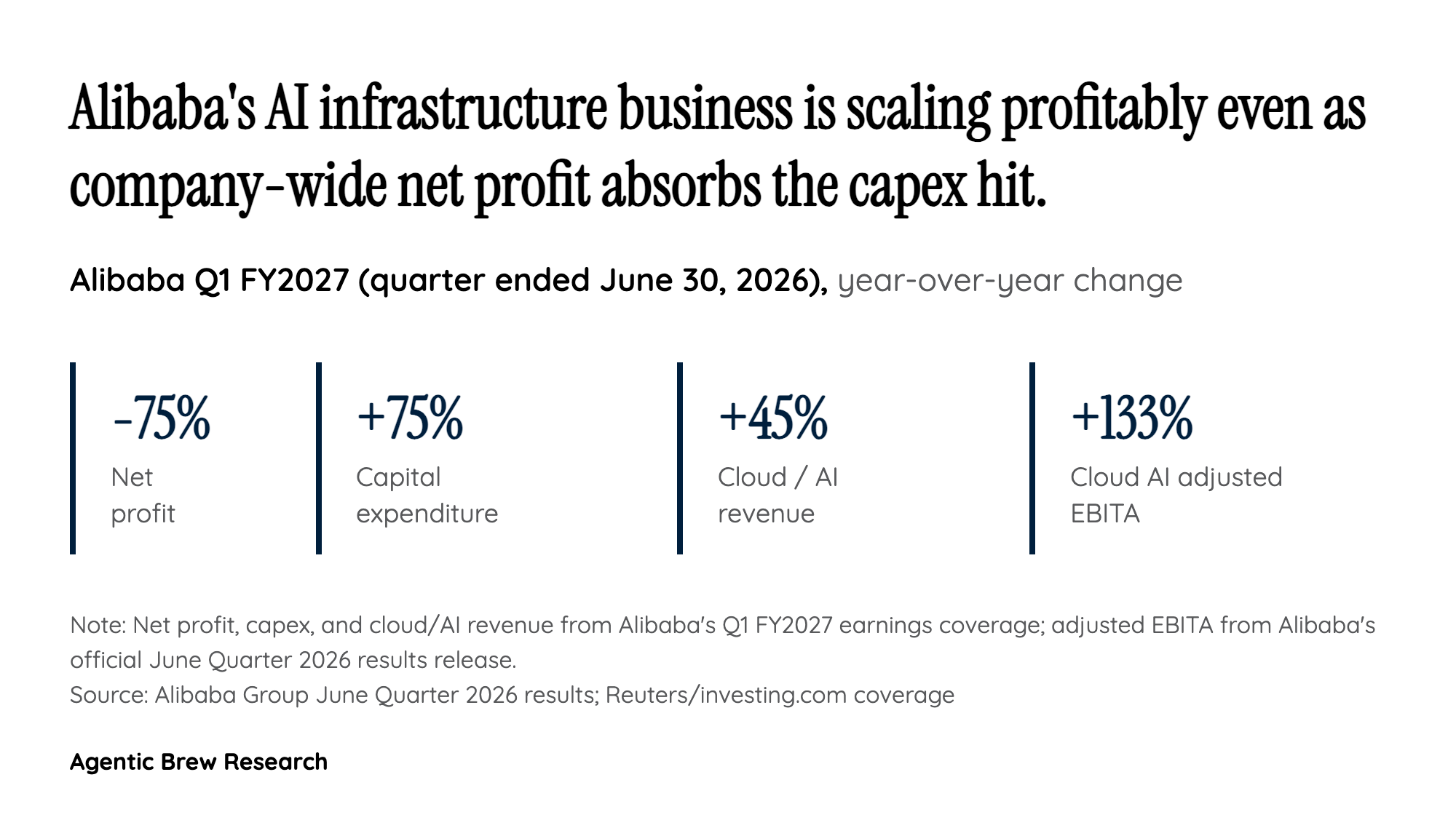
Alibaba Q1 FY2027 year-over-year change: net profit, capex, cloud/AI revenue, and cloud AI adjusted EBITA.

The raise followed a rough quarter on paper: net profit for the three months through June fell 75% year-over-year to about $1.6 billion, even as revenue grew 9% and Alibaba Cloud's revenue rose 45% [5]. Capex jumped 75% year-over-year to roughly 67.7 billion yuan, and against that backdrop the market's first read was that the placement existed to cover a profitability shortfall.

But the segment-level number that actually matters for the AI thesis is adjusted EBITA for Cloud and AI Compute Services, which rose 133% year-over-year to RMB5.63 billion (about $830 million) in the quarter, per Alibaba's own June Quarter 2026 results release [6]- evidence the AI infrastructure business is scaling profitably even as headline net income absorbs the capex hit. CEO Eddie Wu addressed the tradeoff directly in the Q1 FY2027 earnings call Q&A, stating that as gross margins continue to rise, Alibaba expects to shorten the AI capex payback period from roughly three years to 2.5 years [7]. The two levers he named were rising product margins and growing deployment of Alibaba's own T-Head chips (the Zhenwu lineage) in place of externally procured hardware - a shift explicitly aimed at reducing dependence on Nvidia chips subject to U.S. export controls, since those external purchases currently squeeze cloud-segment margins [8]. Alibaba's own committed capex framework - a pledged 380 billion yuan (about $56 billion) through 2028 that reports suggest could rise to as much as 480 billion yuan [9]- was already roughly half spent heading into the placement.

Financial YouTube coverage from Schwab Network framed the results as an AI growth story rather than a pure earnings story, pointing to a twelfth straight quarter of triple-digit AI revenue growth alongside a wider negative free-cash-flow outflow than a year earlier, and drew a parallel to BYD's own investment-versus-profitability tension. On r/technology, the more skeptical read was structural: dilution via an equity raise sits quietly in a footnote, while a profit miss makes the headline - a sign, in that framing, that AI capex is now large enough to visibly dent earnings rather than being absorbed quietly.

Locked Out: What U.S. Investors Can and Can't Buy

Because the placement is an unregistered Reg S offshore transaction, U.S. investors cannot participate in the primary sale - and the deal's size makes that exclusion consequential: at $10.2 billion it ranks as the world's third-largest primary follow-on equity offering of 2026, trailing only Alphabet and Intel [9]. For a U.S.-based reader the practical implication is straightforward if unglamorous: this placement itself isn't investable domestically, and anyone wanting exposure to Alibaba's AI build-out is left with existing secondary-market instruments like Alibaba's U.S.-listed ADRs rather than any stake in the new shares - that's a reasonable inference from how the deal is structured, not something the reporting states outright.

Reddit's r/singularity thread read the exclusion through a broader US-China compute-race lens, framing raises like this as part of a wider contest over global AI compute capacity and debating whether capital at this scale can meaningfully close the gap with U.S.-based hyperscalers. A more contrarian voice in the same thread dismissed the comparison altogether, arguing Alibaba's relevance rests more on legacy e-commerce and older investment stakes than on being a frontier AI lab - a minority view, but one that captures the skepticism sitting alongside the compute-race framing.

The Qwen Flywheel Meets a Sovereignty Wall

The financial engineering aside, the strategic case for the raise traces back to a specific pivot. CNBC's Arjun Kharpal has reported that Alibaba's DAMO Academy research lab, running since 2016, became the company's center of gravity after ChatGPT's debut, when CEO Eddie Wu's 2023 mandate pushed Alibaba to more than double capex and sell off non-core businesses to fund the shift. According to that same reporting, after DeepSeek's R1 model landed, Alibaba's Qwen team shipped Qwen 2.5 within days and then Qwen 3 by April 2025 - a compressed release cadence that now underpins consumer and developer products cited in the coverage, including the Quark AI assistant app and the ModelScope developer platform. The strategic bet embedded in this capex isn't just about training bigger models - per the same CNBC reporting, it's about AliYun positioning itself as an AI distribution hub competing with AWS and Azure on adoption and scale rather than benchmark performance alone.

That global ambition runs into a geopolitical constraint the capex can't simply buy its way past. Alibaba Cloud opened two new availability zones in Paris in June 2026, its third European hub after Germany and the UK [9], just as the EU's proposed Cloud and AI Development Act introduces a four-tier sovereignty framework in which the strictest levels require EU ownership and operational independence that a Chinese-headquartered cloud provider cannot easily satisfy [9]. Even at $10.2 billion, Alibaba's raise is roughly half the size of the EU's own flagship AI gigafactory compute budget of about 20 billion euros [9]- a reminder that the fight for AI infrastructure dominance is being fought with public and private capital simultaneously, and that money alone doesn't resolve questions of data sovereignty and market access.

Historical Context

2025
Pledged at least 380 billion yuan (about $56 billion) in AI/cloud infrastructure investment over three years (2025-2028); by the time of the placement, reports suggested this could rise to 480 billion yuan, with roughly half already spent.
2026-06
Opened two new availability zones in Paris, its third European hub after Germany and the UK, expanding just as the EU's Cloud and AI Development Act introduces stricter sovereignty tiers for non-EU cloud providers.

Power Map

Key Players
Subject

Alibaba's $10.2 Billion Hong Kong Share Placement for AI

MO

Morgan Stanley, HSBC, UBS, CICC (China International Capital Corp)

Joint bookrunners who structured and marketed the HK$80 billion placement to institutional buyers, effectively setting the deal's pricing and distribution.

SO

Sovereign wealth funds (unnamed anchor investors)

Anchored the placement as institutional buyers, driving strong oversubscription of the offering. Separately, it is Alibaba itself - not the placee investors - that agreed to a 90-day lockup as issuer, a standstill on further share issuance; no source describes a matching resale lockup on the buyers.

ED

Eddie Wu, CEO, Alibaba Group

Publicly justified the AI capex ramp behind the raise, and in the Q1 FY2027 earnings call Q&A directly attributed a shortening AI capex payback period (from about 3 years to 2.5 years) to rising gross margins and increased deployment of Alibaba's own T-Head chips.

AL

Alibaba's T-Head chip unit (Zhenwu lineage)

Developing the proprietary AI chips the capex build-out is meant to scale; the stated rationale is reducing Alibaba Cloud's dependence on Nvidia chips subject to U.S. export controls while improving cloud-segment margins, since externally procured chips currently carry thinner margins for the cloud business.

AL

Alphabet, Intel

Comparators - Alibaba's raise ranks as the world's third-largest primary follow-on equity offering in 2026, behind these two, underscoring the scale of capital now being raised industry-wide for AI infrastructure.

Fact Check

9 cited
  1. [1] Alibaba Plans Record $10.2 Billion Hong Kong Share Sale To Fund AI
  2. [2] Alibaba Raises HK$80 Billion Via Share Placement for AI Infrastructure
  3. [3] Alibaba (BABA) Stock Plunges 9% on $10.2B Capital Raise for AI Expansion
  4. [4] Alibaba Seeks $10 Billion Share Placement
  5. [5] Alibaba Shares Fall Despite 45% Cloud Growth as AI Spending Weighs
  6. [6] Alibaba Group Announces June Quarter 2026 Results
  7. [7] Alibaba Q1 FY2027 Earnings Call Q&A Recap
  8. [8] Alibaba's Zhenwu AI Chip Reshapes Its Cloud Strategy
  9. [9] Alibaba's $10.2bn Share Placement for AI Infrastructure

Source Articles

Top 5

THE SIGNAL.

Analysts

Framed the AI capex ramp underlying the placement as a precondition for capturing future demand growth: "In order to be able to capture that future growth, we first need to make these capex investments to build out the necessary compute capacity."

Eddie Wu
CEO, Alibaba Group

In the Q1 FY2027 earnings call Q&A, attributed the shrinking AI capex payback timeline directly to rising gross margins and growing deployment of Alibaba's proprietary T-Head chips: "As average gross margins continue to rise, we expect to shorten that payback period to 2.5 years."

Eddie Wu
CEO, Alibaba Group
The Crowd

Alibaba Group announced on Sunday that it is raising 80 billion Hong Kong dollars ($10.2 billion) through a new share placement to investors outside the U.S., with all the proceeds to be invested in the company's full-stack AI capabilities.

@@NikkeiAsia66

BREAKING: Alibaba is raising $10.2 BILLION in a share placement and putting 100% of it into AI, per FT. The move comes weeks after Alibaba released its Qwen 3.8-Max model and as its net profit fell 75% to $1.5 BILLION due to surging AI spending.

@@coinbureau82

Alibaba is seeking $10.2B from a share sale after quarterly capex reached almost $10B amid its AI buildout. Says 100% of net proceeds from the proposed HK$80B placement will fund AI capabilities, including infrastructure expansion. Will make it the largest primary follow-on

@@rohanpaul_ai23

SOVEREIGN LONG ONLY WEALTH FUNDS TOOK UP THE MAJORITY OF THE NEW PLACEMENT SHARES VALIDATING ALIBABA AI DRIVEN STRATEGY

@u/ilikeelks17
Broadcast
[8/23 06:00] Alibaba proposes HK$80B (US$10.2B) Hong Kong share placement, 100% of proceeds to fund AI

[8/23 06:00] Alibaba proposes HK$80B (US$10.2B) Hong Kong share placement, 100% of proceeds to fund AI

BABA Earnings Mixed Despite Cloud Growth: What's Next for AI Push?

BABA Earnings Mixed Despite Cloud Growth: What's Next for AI Push?

How Alibaba Quietly Became a Leader in AI

How Alibaba Quietly Became a Leader in AI