Cognition's $2B Series E at $48B valuation
TECH

Cognition's $2B Series E at $48B valuation

37+
Signals

Strategic Overview

  • 01.
    Cognition, the startup behind the Devin AI coding agent, closed a Series E of more than $2 billion at a $48 billion valuation, announced September 8, 2026.
  • 02.
    The round was led by new investors Andreessen Horowitz and Accel, with existing backers Founders Fund, General Catalyst, and Avenir returning, alongside a wide syndicate that included Nvidia, Benchmark, Bessemer, and T. Rowe Price.
  • 03.
    Cognition's annualized run-rate revenue nearly doubled in about four months, climbing from $492 million in May 2026 to almost $900 million by the September announcement.
  • 04.
    The new valuation is nearly double the $26 billion mark Cognition set in its Series D just four months earlier, and its enterprise customer roster now spans NASA, Goldman Sachs, Nvidia, Mercedes-Benz, and Citi.

Deep Analysis

The Math Behind a $48 Billion Bet
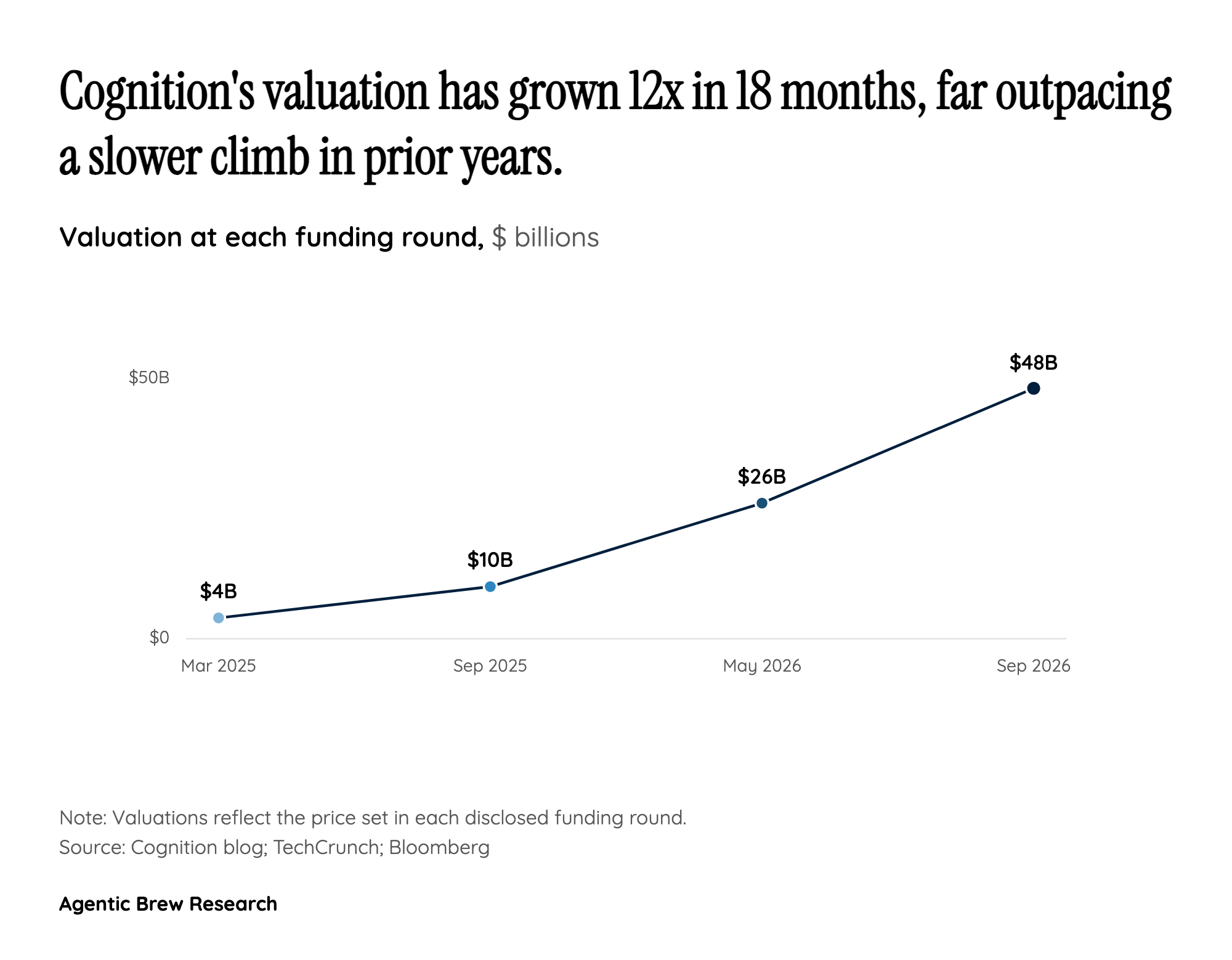
The Math Behind a $48 Billion Bet
Cognition's valuation climbed from $4 billion in March 2025 to $48 billion in September 2026, an accelerating trajectory across four disclosed funding rounds.

Cognition's Series E prices the company at $48 billion, nearly double the $26 billion valuation it carried just four months earlier [2], and ties that jump to run-rate revenue climbing from $492 million to almost $900 million over the same stretch [1]. Against roughly $900 million in revenue, a $48 billion price tag implies a rich multiple, and Forkast News flags real execution risk behind the number: Cognition reportedly spends close to $800 million a year on compute, mostly leasing Nvidia's server clusters, an amount that eats nearly as much cash as the company currently brings in [3]. A companion Forkast analysis frames the valuation as treating coding agents like infrastructure rather than a software subscription, pointing to large-scale deployments like Citi's as evidence the technology has moved past pilot status into infrastructure-grade adoption [4]. TechCrunch, meanwhile, estimates Cognition could exit 2026 with $4-5 billion in annualized revenue [2]- a projection that only justifies today's price if the growth curve of the last four months continues rather than reflecting a one-time wave of enterprise land-grabs.


From a Discredited Demo to Enterprise Rails

Cognition's rise looks smoother in this week's press coverage than it has looked in practice. Devin's original 2024 launch demo was publicly picked apart by a YouTuber who showed the agent largely fixing errors in code it had written itself rather than completing the advertised task, and a later third-party evaluation from Answer.ai found Devin succeeding on only a handful of real-world coding tasks out of twenty attempted. What has visibly changed since is the deployment evidence behind this raise: Goldman Sachs has moved from a pilot to scaling thousands of Devin instances, targeting a three-to-four-times productivity gain over its prior AI tooling [3], and Citi is reported to run roughly 40,000 developers on Devin generating over 100,000 agentic coding hours a week - described as the largest measured enterprise agent deployment in financial services [4]. Cognition's customer list now spans NASA, Nvidia, Mercedes-Benz, GE Aerospace, Dell, Cisco, Palantir, and multiple global banks [5], and the company used the raise to ship Devin Auto-Triage for incident investigation and Devin Security Swarm for vulnerability discovery [8]- product moves aimed squarely at the kind of regulated, high-stakes engineering environments where a shaky 2024 demo would once have been disqualifying.

The Windsurf Wreckage That Became Devin Desktop

Much of Cognition's current product and revenue base traces back to a chaotic stretch in mid-2025. OpenAI had been negotiating to acquire the Windsurf coding-agent startup for roughly $3 billion, but the deal collapsed just as Google moved in with a reverse-acquihire, hiring away Windsurf's CEO and co-founder [6]. Cognition acquired what remained of Windsurf days later [5], folding its editor and proprietary models into a product rebranded Devin Desktop in mid-2026 [7]. Separate retrospective coverage of that saga adds color worth noting: Anthropic reportedly cut Windsurf's access to its Claude API in the middle of the acquisition chaos, and Google's side of the deal was structured as a technology license plus the hiring of a small team into DeepMind rather than a full acquisition, leaving most of Windsurf's staff at the company Cognition ultimately absorbed. That messy provenance is now packaged as a unified IDE-plus-agent platform, which Cognition is using to argue Devin is a full development environment rather than a thin wrapper around someone else's model.

Wrapper or Moat? The Skepticism Money Can't Buy Away

Not everyone reading this week's headline number is convinced the valuation reflects durable differentiation. Public reaction skewed skeptical and bubble-cautious, with comparisons to dot-com-era excess and blunt questions about who actually uses Devin day to day, tempered by counter-anecdotes from engineers at both a small company running Devin as its primary coding tool with CI/CD integration and a larger public company with tens of thousands of employees. The core disagreement is whether Cognition and rivals like Cursor are meaningfully differentiated from the frontier models they're built on, or are simply resellers of Anthropic and OpenAI tokens whose margins may not survive real competition; one detailed rebuttal argued Devin's edge is dynamic model routing that shifts cheap models onto simple tasks and frontier models onto complex reasoning to control cost. A parallel subplot involving SpaceX's ownership of Cursor reportedly curbing Cursor's access to Anthropic and OpenAI models has some framing Devin as a more attractive alternative. TechCrunch's read on the raise leans toward the bullish side of that debate, framing it as a signal that venture capital sees room for several major AI coding companies to coexist rather than a single winner-take-all platform [2]- a framing that quietly concedes the wrapper question hasn't actually been settled either way.

Historical Context

2024
Cognition founded by Scott Wu.
2025-03-18
Cognition AI hit a $4 billion valuation in a funding deal led by Joe Lonsdale's firm.
2025-07-14
Cognition acquired Windsurf after a 72-hour period in which Google hired away Windsurf's CEO and co-founder in a reverse-acquihire and OpenAI's earlier $3 billion offer for Windsurf collapsed.
2025-09-08
Cognition AI reached a $10 billion valuation with new funding.
2026-04-23
Cognition was in funding talks at a $25 billion valuation.
2026-05-27
Cognition raised over $1 billion (Series D) at a $26 billion valuation, with run-rate revenue at $492 million.
2026-06-02
Windsurf was rebranded as Devin Desktop, described as the next generation of Windsurf with an integrated agent manager.
2026-08-12
Cognition was reported in new funding talks at a $40 billion valuation.
2026-09-02
Cognition was reported set to raise around $1 billion at a $47 billion valuation, shortly before final terms were announced.
2026-09-08
Cognition announced it closed its Series E, raising over $2 billion at a $48 billion valuation.

Power Map

Key Players
Subject

Cognition's $2B Series E at $48B valuation

CO

Cognition AI

Maker of the Devin AI coding agent; founded in 2024 by CEO Scott Wu, raised the $2B Series E that pushed its valuation from $26B to $48B in roughly four months.

AN

Andreessen Horowitz (a16z) and Accel

New lead investors in the Series E round.

FO

Founders Fund, General Catalyst, Avenir

Existing investors who returned to participate in the Series E.

GO

Goldman Sachs

Enterprise customer that moved from pilot to scaling thousands of Devin instances, targeting a three-to-four-times productivity gain over its prior AI tooling.

CI

Citi

Enterprise customer reported to run roughly 40,000 developers on Devin, generating over 100,000 agentic coding hours per week - described as the largest measured enterprise agent deployment in financial services.

NV

Nvidia

Both a participating investor in the Series E and the vendor whose server clusters Cognition leases at an estimated cost of hundreds of millions of dollars a year.

Fact Check

8 cited
  1. [1] Cognition Blog - Series E
  2. [2] Cognition hits $48B valuation, signaling investors believe AI coding is far from a winner-take-all market
  3. [3] Cognition AI hit $48B: the real story is who's already deploying
  4. [4] Cognition AI's $48B valuation treats coding agents like infrastructure, and the revenue multiple agrees
  5. [5] AI coding startup Cognition raises $2B at $48B valuation as revenue nears $900M
  6. [6] Cognition, maker of the AI coding agent Devin, acquires Windsurf
  7. [7] Cognition - Contrary Research
  8. [8] Cognition raises $2B Series E at $48B valuation to scale Devin

Source Articles

Top 5

THE SIGNAL.

Analysts

Cognition's soaring valuation signals investors believe AI coding is far from a winner-take-all market, with room for several major players to capture meaningful share.

TechCrunch
Reporting and analysis

The $48 billion valuation reflects that AI coding agents have moved past proof-of-concept demonstrations into real production deployment at major enterprises.

Forkast News
Reporting and analysis

Flags execution risk in the valuation: Cognition's compute costs, largely from leasing Nvidia server clusters, run close to the company's entire annual revenue.

Forkast News
Reporting and analysis
The Crowd

The world needs far more software than it can build. Cognition exists to change that. We've just raised over $2B at a $48B valuation, led by a16z, Accel, Founders Fund, General Catalyst, and Avenir. Since our round in May, run-rate revenue has grown from $492 M to almost $900M...

@@cognition2311

I've been at Cognition for only nine months. In that time, our valuation has gone from: $10B → $26B → $48B. And we've more than doubled in headcount. Absolutely crazy, man.

@@joshjnunez227

AI startup Cognition raised more than $2B at a valuation of $48 Billion

@@StockMKTNewz43

Cognition hits $48B valuation, signaling investors believe AI coding is far from a winner-take-all market | TechCrunch

@u/ZenX2250
Broadcast
How Did Cognition Go From A Debunked Demo To $48 Billion?

How Did Cognition Go From A Debunked Demo To $48 Billion?

OpenAI Claims Navier-Stokes Solve, Cognition Hits $48B, Meta Muse | AI News (Sep 09)

OpenAI Claims Navier-Stokes Solve, Cognition Hits $48B, Meta Muse | AI News (Sep 09)

How Cognition is Partnering with Mercedes Benz to Accelerate Software Engineering

How Cognition is Partnering with Mercedes Benz to Accelerate Software Engineering