Wall Street pays AI trainers $25K/day to teach bankers ChatGPT and Claude
TECH

Wall Street pays AI trainers $25K/day to teach bankers ChatGPT and Claude

29+
Signals

Strategic Overview

  • 01.
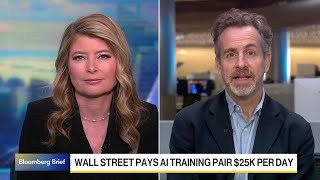
    Wall Street Prompt, founded in July 2025 by ex-SoftBank investors Felipe Sinisterra and Dave Wang, charges financial institutions $25,000 per day to train bankers and analysts on AI tools, and is booked two months out.
  • 02.
    Sessions seat 20-30 attendees and cover concrete workflows such as using Gemini to evaluate founders' pitch videos and using ChatGPT and Claude to surface market-moving language in earnings call transcripts.
  • 03.
    Disclosed clients include Citigroup, Bank of America, and asset manager T. Rowe Price, with another fund managing over $50 billion reportedly in final contract stages.
  • 04.
    The firm sells the same curriculum in two cheaper tiers: a ~$1,500-per-seat live webinar and a $1,999 self-serve six-course system on wallstreetprompt.com (or $500 per module).

The $25K Day Rate Is a Bill for the Gap Between Bought AI and Used AI

The headline number is a lagging indicator of a procurement mistake. JPMorgan has rolled an internal LLM Suite out to more than 200,000 employees and publicly projects $1.5-$2B in annual AI-generated business value [1]; Bank of America has spent 'several hundred million dollars' on 20+ AI projects and reports 20-25% productivity gains across its ~18,000 developers [2][3]. Yet two ex-bankers founded in July 2025 are booked two months out, charging $25,000 a day to walk 20-30 people through workflows like using Gemini on a pitch video and using ChatGPT and Claude on earnings call transcripts [3]. The price is not the curriculum; the price is the speed at which CFOs need to convert sunk platform spend into visible productivity.

Wall Street Prompt's pitch reads as a tacit admission that the bottleneck moved. "What people are really paying for is transformation, not just prompts or templates," co-founder Felipe Sinisterra told Yahoo Finance — meaning the deliverable is behavioral change inside a managing director's team, not a slide deck [3]. Banks aren't underweight tools; they're underweight habits. The trainers monetize the gap because internal L&D groups can't credibly walk a managing director through a real M&A workflow with the same ex-Goldman, ex-Morgan Stanley credibility.
The Headcount Paradox: Paying $25K a Day to Train Smaller Workforces

The economics only make sense when you read the training invoice next to the severance line. Citigroup, Wells Fargo, and Bank of America cut more than 5,000 jobs in Q1 2026 despite a record earnings season, and Standard Chartered is planning thousands more support-job cuts over four years [4]. Citi and Bank of America appear on Wall Street Prompt's client list at the same moment they appear on those layoff lists [3][4]. The bank that fires 1,000 people and then pays $25,000 to upskill the remaining team has made the ROI calculation explicit: one well-trained survivor running AI workflows is meant to do the work of several juniors who used to build pitchbooks from scratch.

That reframes who actually wins. The surviving senior bankers get leverage and tooling. The fired juniors and support staff get displaced. The picks-and-shovels layer — Wall Street Prompt at $25K/day, Multiverse training 15,000 AI apprentices over two years, Rogo Technologies raising a $160M Series D at a $2B valuation — captures a fast-growing services and tooling market sitting between deployed LLMs and productive bankers [4]. The Reddit community is reading the shift the same way: a r/FinancialCareers thread on JPMorgan's pivot to hire more for AI and fewer bankers drew the most engagement of any post in the dataset, and a separate thread from an ex-IB analyst who now sells AI training contracts framed the move as straightforwardly more lucrative per hour than the old job. The labor market is repricing the work.

The Contrarian Read: A Circular Banker-to-AI-to-Banker Labor Loop

Look at where the talent is flowing and the picture stops being a simple disruption story. OpenAI's 'Project Mercury' has enlisted more than 100 former JPMorgan, Morgan Stanley, and Goldman bankers to train models on financial modeling [5]. Anthropic embedded engineers inside Goldman Sachs to co-develop autonomous agents for trade reconciliation, accounting, and onboarding [6]. And ex-SoftBank fund managers Sinisterra and Wang — backgrounds at Goldman, Bank of America, and Morgan Stanley — are now selling that knowledge back to the same banks as a $25,000/day live curriculum [3][7]. The same scarce expertise is being monetized three ways: as labeled training data inside OpenAI, as deployed agents inside Goldman, and as instructor time inside Citi conference rooms.

This is not a coincidence; it is the structure of the market. Foundation-model labs need finance domain knowledge to make agents usable; banks need humans who understand the agents' outputs; the same small population of senior ex-bankers can sell to all three sides. Bloomberg's coverage frames Wall Street Prompt as pushing 'Wall Street's agentic shift,' but the more honest framing is that the agentic shift is being built and validated by the very bankers it is supposed to replace [8]. The arbitrage will close when training data saturates and credible alternative trainers emerge — but right now the loop is the moat.

The Skills-Gap Time Bomb: What Happens When Juniors Never Build the Model

Economist Shawn DuBravac estimates firms will move to automate 60-70% of analyst time on low-level tasks within a year [5]. JLL's Ram Srinivasan describes the shift as turning analysts from 'producers' into 'reviewers and customizers' — a productivity story [5]. But Disruption Banking flags the second-order cost most adopters are not pricing in: a cohort of juniors who can prompt a model fluently but have never actually built a discounted cash flow from a 10-K, never sat with a covenant package, never argued with a sector head about a wrong assumption. The trade publication's warning is blunt: bankers "highly proficient at using AI tools but lacking the underlying depth and judgment needed when deals get complicated or markets turn volatile" [9]. Their conclusion — that the winner will be "who ensures their people still truly understand the numbers, the deals, and the markets behind the technology" — directly contradicts the headcount-substitution thesis the layoff numbers imply [9].

The Bloomberg podcast 'The $10 Billion Startup Training AI to Do Your Job' frames the supply-side view; finance YouTube and r/Banking show the demand side, where practitioners are openly asking what they should actually learn to stay relevant. The tension between those voices and the productivity-first framing from CEOs is the real story underneath the $25K headline: every dollar spent automating foundational work is a bet that pattern-recognition built by reviewing AI output is a sufficient substitute for pattern-recognition built by producing the work yourself. That bet has not yet been tested by a downturn.

Historical Context

2025-07-01
Sinisterra and Wang leave SoftBank to found Wall Street Prompt and begin selling in-person AI training to banks.
2025-07-01
Anthropic launches Claude for Financial Services, the platform now deployed at JPMorgan, Goldman, Citi, AIG, and Visa.
2025-10-22
Fortune reports OpenAI has enlisted 100+ ex-investment-bankers under 'Project Mercury' to train models on financial modeling.
2026-05-05
Anthropic expands its Wall Street push with new agents, Microsoft 365 integration, a Moody's data partnership, and Claude Opus 4.7.
2026-05-25
Bloomberg publishes the feature spotlighting Wall Street Prompt's $25,000/day pricing and two-month backlog.

Power Map

Key Players
Subject

Wall Street pays AI trainers $25K/day to teach bankers ChatGPT and Claude

WA

Wall Street Prompt (Felipe Sinisterra & Dave Wang)

AI-training boutique selling on-site coaching to banks and asset managers at $25,000/day; founded July 2025 with a two-month backlog and a six-course curriculum spanning prompt engineering, due diligence, portfolio management, and macro positioning.

CI

Citigroup

Paying training client of Wall Street Prompt and simultaneously one of the banks that collectively cut 5,000+ jobs in Q1 2026.

BA

Bank of America

Paying client of Wall Street Prompt; reports 20-25% productivity gains across roughly 18,000 developers who adopted AI tools.

JP

JPMorgan Chase

Deployed an LLM Suite to 200,000+ employees via a model-agnostic gateway to OpenAI and Anthropic and projects $1.5-$2B in annual AI-generated business value — making it the archetype of a bank that needs frontline fluency to justify the spend.

OP

OpenAI (Project Mercury)

Hired 100+ ex-bankers from JPMorgan, Morgan Stanley, and Goldman to train models on financial modeling — automating the same junior-banker tasks Wall Street Prompt is teaching senior bankers to oversee.

AN

Anthropic

Launched Claude for Financial Services in July 2025 and Claude Opus 4.7 for finance work; now deployed at JPMorgan, Goldman, Citi, AIG, and Visa — building the agent layer the trainers' curriculum sits on top of.

Fact Check

11 cited
  1. [1] JPMorgan, OpenAI & Anthropic: Evolving Banking Operations
  2. [2] Big banks continue the hunt for AI-driven efficiencies
  3. [3] Ex-bankers charge $25,000 a day to teach Wall Street AI
  4. [4] Wall Street AI Trainers Charge $25,000 a Day as Banks Cut Jobs
  5. [5] Sam Altman's OpenAI is coming for Wall Street's junior bankers
  6. [6] Goldman equips AI agents to do trade accounting, onboarding
  7. [7] Wall Street Prompt — Institutional-Grade AI Research System
  8. [8] The AI Trainers Charging $25,000 a Day to Push Wall Street's Agentic Shift
  9. [9] The Skills Gap AI Is Creating in Investment Banking
  10. [10] Wall Street Banks Are Paying These Two Experts $25,000 A Day for AI Training
  11. [11] Anthropic deepens push into Wall Street financial services with new agents, MS 365, Moody's

Source Articles

Top 5

THE SIGNAL.

Analysts

"Argues clients are paying for organizational transformation, not prompt templates: "What people are really paying for is transformation, not just prompts or templates. What we do is come in and spark that shift.""

Felipe Sinisterra
Co-Founder & President, Wall Street Prompt

"Expects rapid automation of analyst grunt work: "Within the next year, I'd expect firms will move quickly to try to automate 60% to 70% of the time analysts currently spend on these lower-level tasks.""

Shawn DuBravac
Economist

"Frames the shift as a leverage gain rather than headcount cull: "Analysts become reviewers and customizers rather than builders from scratch, allowing each person to support more deals simultaneously.""

Ram Srinivasan
Managing Director, JLL

"Warns that automating foundational work produces bankers "highly proficient at using AI tools but lacking the underlying depth and judgment needed when deals get complicated or markets turn volatile.""

Disruption Banking
Investment banking trade publication

"Argues competitive advantage will not come from adoption speed: "The real differentiator won't simply be who adopts AI fastest. It will be who ensures their people still truly understand the numbers, the deals, and the markets behind the technology.""

Disruption Banking
Investment banking trade publication
The Crowd

"WALL STREET AI TRAINERS ARE CHARGING $25,000 A DAY Bloomberg reports Felipe Sinisterra and Dave Wang's Wall Street Prompt charges $25,000 for a day of AI workflow training. They are reportedly backlogged for two months. The sessions show finance teams how to use tools like https://t.co/4lj94a2efE"

@@wallstengine169

"Former IB Analyst turned AI Model Trainer/startup founder, unsure what next steps are"

@u/iloveresumes2much0

"JPMorgan will hire more for AI, fewer bankers, CEO Dimon says"

@u/paradisemorlam98

"Finance professional trying to not fall behind on AI? What should I actually learn?"

@u/Still_Lifeguard58560
Broadcast
AI Trainers Get $25,000 a Day to Automate Wall Street Workflows

AI Trainers Get $25,000 a Day to Automate Wall Street Workflows

AI's Hottest New Job Pays Up to $250K a Year. So I Applied. | WSJ

AI's Hottest New Job Pays Up to $250K a Year. So I Applied. | WSJ

The $10 Billion Startup Training AI to Do Your Job | Big Take

The $10 Billion Startup Training AI to Do Your Job | Big Take