SK Hynix $38 Billion Chip Fab Expansion
TECH

SK Hynix $38 Billion Chip Fab Expansion

32+
Signals

Strategic Overview

  • 01.
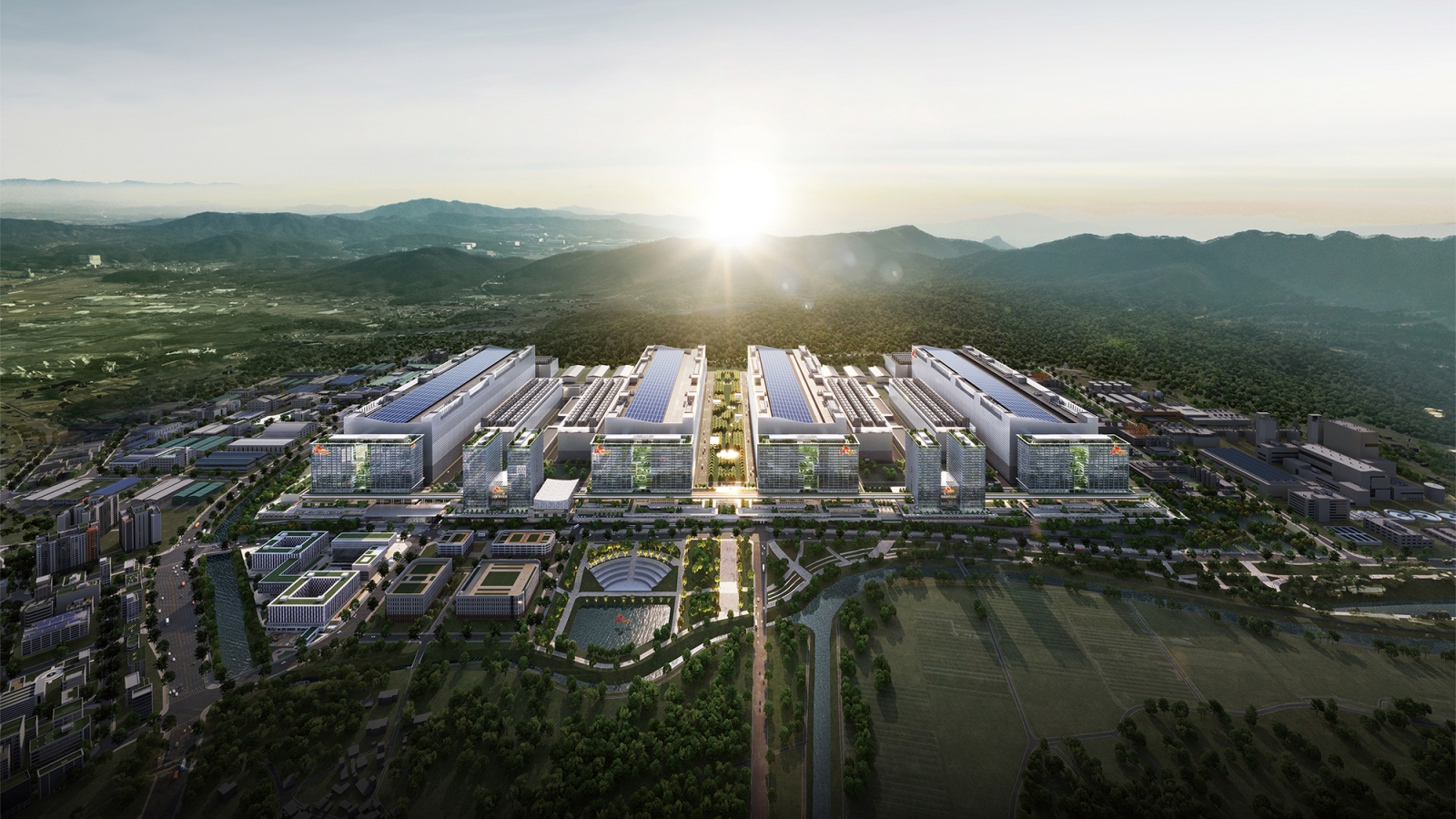
    SK Hynix's board approved a combined 54 trillion won, roughly $38.1 to $38.3 billion, investment to build two new fabs: the Y2 fab in Yongin and the M17 fab in Cheongju.
  • 02.
    The investment splits into 35.2 trillion won for the Yongin Y2 fab, which will produce DRAM and high-bandwidth memory, and 19.1 trillion won for the Cheongju M17 fab, a NAND flash facility.
  • 03.
    Yongin Y2 breaks ground in July 2027, opens its first cleanroom in June 2029, and spans roughly 341,000 pyeong (about 1.13 million square meters), with investment running through October 2031.
  • 04.
    Cheongju M17 breaks ground in February 2027, opens its first cleanroom in December 2028, and spans roughly 206,000 pyeong (about 680,000 square meters), leveraging existing M11/M12/M15 infrastructure.
  • 05.
    SK Hynix cited a projected 19 percent compound annual growth rate in DRAM and NAND demand from 2025 to 2030, per Omdia research, as the rationale for the expansion.
  • 06.
    The approval is part of a broader 1.1 quadrillion won mid-to-long-term plan announced in June 2026, under which SK Hynix moved up its full Yongin cluster completion target by twelve years, from 2045 to 2033.
  • 07.
    SK Hynix said it will actively review additional shareholder return measures alongside the capex commitment, with details expected in the third quarter of 2026.

Deep Analysis

A $38 Billion Bet That Won't Pay Off Until 2028

SK Hynix's board approved a combined 54 trillion won, roughly $38.1 to $38.3 billion, to build two new fabs: the Y2 fab in Yongin for DRAM and high-bandwidth memory, and the M17 fab in Cheongju for NAND flash [1]. The split is uneven and telling: 35.2 trillion won goes to Yongin Y2, more than 84 percent more capital than the 19.1 trillion won earmarked for Cheongju M17, underscoring how much more SK Hynix is willing to spend chasing HBM than commodity NAND [2].

What makes the timing striking is how far out the payoff sits. Yongin Y2 breaks ground in July 2027 and its first cleanroom does not open until June 2029, with the investment running through October 2031; Cheongju M17 breaks ground in February 2027 with its first cleanroom in December 2028 [1]. That means the fabs approved this week are aimed at demand SK Hynix expects to still be growing in 2029 and beyond, not the shortage buyers are feeling right now. The company's HBM, DRAM and NAND capacity is already reported to be essentially sold out for 2026 [4], and SK Hynix is citing a projected 19 percent compound annual growth rate in DRAM and NAND demand through 2030 as the reason it is building years ahead of need [1].

Every HBM Wafer Is a Wafer Taken From Your Next Phone

The capacity SK Hynix is racing to add is not evenly available to every buyer. High-bandwidth memory for AI accelerators and ordinary consumer memory, like the LPDDR5X in phones or NAND in SSDs, compete for the same wafer starts and cleanroom time, and hyperscaler demand for AI-grade chips is winning that fight [3]. Gartner forecasts memory prices could rise roughly 130 percent by the end of 2026 as a result, pushing PC prices about 17 percent and smartphone prices about 13 percent higher than 2025 levels, with PC shipments projected to fall 10.4 percent and smartphone shipments 8.4 percent [3].

SK Hynix's dominance of that reallocated capacity is also why Wall Street has gotten more bullish even as consumers pay more. Stifel estimates SK Hynix held more than 60 percent of the HBM market in 2025, while RBC Capital Markets pegs its current share closer to 55 to 56 percent; RBC also forecasts HBM pricing could rise more than 50 percent in 2027 as customers shift to the next-generation HBM4 standard [4]. Stifel, Wolfe Research and RBC have all initiated coverage with price targets of $200 to $240 per ADR, treating supply scarcity itself, not just chip performance, as the investable story [4].

South Korea's $576 Billion Chip Gamble

SK Hynix's board approval does not stand alone; it is one piece of a coordinated national push. On June 29, 2026, South Korean President Lee Jae Myung framed combined Samsung and SK Hynix investment commitments worth more than $576 billion as a 'tripolar mega-project' meant to cement the country's chip and AI infrastructure leadership [5]. Samsung is answering with its own buildout, expanding production capacity by about 50 percent in 2026 and constructing its P5 facility in Pyeongtaek, targeted to be operational by 2028, while Micron, the third major HBM player, has said it will exit the consumer memory and storage market entirely to focus on AI and enterprise customers [6].

Inside SK Hynix, the Yongin and Cheongju approvals sit inside a much larger 1.1 quadrillion won mid-to-long-term plan unveiled in June 2026, which includes 600 trillion won for the Yongin cluster and 100 trillion won for Cheongju expansion; the company also moved up its target for completing the full Yongin cluster by twelve years, from 2045 to 2033, a decision credited to SK Group chairman Chey Tae-won [2]. Alongside the capex commitment, SK Hynix said it will actively review additional shareholder return measures, with details expected in the third quarter of 2026, suggesting the company sees room to fund a decade-long buildout without abandoning payouts [7].

Wall Street's Conviction Meets Reddit's Boom-Bust Memory

The reaction outside official channels splits along familiar lines. Equity analysts have treated the expansion as validation of a durable AI supercycle, initiating bullish coverage on the strength of SK Hynix's HBM lead and pricing power heading into the HBM4 transition [4]. Retail investor discussion on Reddit was more measured: commenters generally agreed the spending is affordable, noting that $38 billion spread through 2031 is under one quarter of SK Hynix's profits and well within a reported twelve-month cash flow run rate near $200 billion, but the debate quickly moved to whether AI memory demand is secular or just the latest turn of a notoriously cyclical DRAM market.

That skepticism has a specific memory: the COVID-era memory overbuild that later left the industry oversupplied once demand normalized, and commenters raised it directly as a cautionary parallel. Others pushed back that each new GPU generation, from H100 to Blackwell to Rubin, requires more and faster memory, which is why capacity keeps expanding regardless of past cycles, though a counter-thread noted that power efficiency has not kept pace with capacity growth, meaning data centers may lack the cooling headroom to fully exploit the new memory even once it ships. Nothing in the current record resolves the question either way, which is itself the point: SK Hynix is committing 54 trillion won and five years of construction to a demand curve that will not be testable until the fabs are actually running.

Historical Context

2026-06-29
President Lee Jae Myung announced a combined $576 billion 'tripolar mega-project' with Samsung and SK Hynix to cement South Korea's chip and AI infrastructure leadership.
2026-06
SK Hynix unveiled a broader 1.1 quadrillion won mid-to-long-term plan, including 600 trillion won for the Yongin cluster and 100 trillion won for Cheongju expansion, moving the full Yongin cluster completion target up from 2045 to 2033.
2026-08-07
SK Hynix's board formally approved the 54 trillion won investment for the Y2 and M17 fabs.

Power Map

Key Players
Subject

SK Hynix $38 Billion Chip Fab Expansion

SK

SK Hynix

World's second-largest memory chipmaker and current HBM market leader (roughly 53-60% share depending on source/quarter); its board approved the 54 trillion won investment and holds full control over the buildout timeline.

CH

Chairman Chey Tae-won

SK Group chairman credited with championing the accelerated fab expansion strategy that moved up the Yongin cluster completion target by twelve years.

SO

South Korean government / President Lee Jae Myung

Framed combined Samsung and SK Hynix commitments worth more than $576 billion as a national 'tripolar mega-project,' aligning SK Hynix's fab expansion with state industrial policy.

SA

Samsung Electronics

Competing memory maker holding roughly 35% HBM share; separately expanding capacity by about 50% in 2026 and building the P5 facility in Pyeongtaek, targeted for 2028, putting direct pressure on SK Hynix to keep pace.

MI

Micron Technology

Third major memory maker (~11% HBM share); exiting the consumer memory and storage market to focus entirely on AI and enterprise customers, intensifying competition for the same AI-grade capacity SK Hynix is building.

HY

Hyperscalers and AI accelerator makers

Demand-side driver whose voracious appetite for HBM/DRAM is forcing memory makers to reallocate cleanroom capacity toward AI-grade components, squeezing consumer supply in the process.

Fact Check

7 cited
  1. [1] SK Hynix Invests 54 Trillion Won in Yongin Y2 and Cheongju M17 to Secure Mid-to-Long-Term Production Base for AI Memory Demand
  2. [2] SK Hynix Board Approves $38B Investment to Build Two Facilities for DRAM and NAND Chips
  3. [3] Memory Chip Shortage Hits $3 Trillion Market Value, Smartphones Cost 14% More in 2026
  4. [4] SK Hynix Stock Rises on Analyst Coverage of AI Memory Demand
  5. [5] South Korea Announces $576 Billion AI Investment With Samsung and SK Hynix
  6. [6] Samsung and SK Hynix to Scale Up Memory Production Capacity in 2026 to Meet AI Demand
  7. [7] SK Hynix Board Approves $38 Billion Investments for South Korea's Yongin, Cheongju Chip Plants

Source Articles

Top 5

THE SIGNAL.

Analysts

Framed the investment as necessary to capture AI-era demand growth, arguing that supply reliability itself is now a competitive advantage alongside technology.

SK Hynix
Corporate statement / press release

Described the investment as a timing decision made to avoid missing a market growth opportunity.

SK Hynix representative
Company spokesperson

Initiated bullish coverage with price targets of $200-$240 per ADR; Stifel estimates SK Hynix held over 60% of the HBM market in 2025 while RBC pegs current share at roughly 55-56%, and RBC forecasts HBM pricing could rise more than 50% in 2027 as customers transition to HBM4.

Stifel, Wolfe Research, RBC Capital Markets
Equity analysts covering SK Hynix ADRs
The Crowd

@SKhynix will invest approximately KRW 54 trillion in new fabs in Yongin and Cheongju to secure its mid-to-long-term production base for growing AI memory demand. The investment will support expanded production of HBM, DRAM, and NAND. https://t.co/UAfLZN5rXX #SKhynix

@@SKhynix122

SK Hynix to invest $38 billion building new memory chip plants as demand soars

@@CNBC48

$SKHY SK Hynix is going all in. 54T KRW ($39B) dropped into two new fabs: Yongin Y2 (DRAM/HBM) and Cheongju M17 (NAND). The core takeaways: > Yongin Y2 (DRAM/HBM): 35.2T KRW. Groundbreaking: July 2027, cleanroom: June 2029. > Cheongju M17 (NAND): 19.1T KRW.

@@FinnStockinger17

SK Hynix to invest $38 billion building new memory chip plants as demand soars

@u/Logical_Welder3467132
Broadcast
VIDEO: Jensen Huang Meets SK Chairman as Hynix Unveils Massive AI Chip Expansion Plan | AI1B

VIDEO: Jensen Huang Meets SK Chairman as Hynix Unveils Massive AI Chip Expansion Plan | AI1B

Why SK Hynix Is Spending $38 Billion to Expand AI Memory Capacity

Why SK Hynix Is Spending $38 Billion to Expand AI Memory Capacity

Bloomberg Money Minute: Micron and SK Hynix Expand as Meta Monetizes AI

Bloomberg Money Minute: Micron and SK Hynix Expand as Meta Monetizes AI