Nadella warns of the enterprise AI Reverse Information Paradox
TECH

Nadella warns of the enterprise AI Reverse Information Paradox

27+
Signals

Strategic Overview

  • 01.
    On July 12, 2026, Microsoft CEO Satya Nadella published a long-form essay on X coining the 'Reverse Information Paradox,' arguing that enterprises using AI pay for intelligence twice - once with money, and again with the proprietary knowledge they must reveal to make the model useful.
  • 02.
    Nadella frames the concept as an inversion of economist Kenneth Arrow's classic Information Paradox: instead of the seller of information risking loss of value by revealing it, in the AI age the buyer risks revealing valuable proprietary knowledge simply by using an AI system.
  • 03.
    As a remedy, Nadella calls for a hard trust boundary around the enterprise tenant across which nothing - not even the intelligence exhaust of prompts, corrections, and evals - crosses without explicit consent, a stance that positions Microsoft Azure as neutral infrastructure.

Deep Analysis

The leak is in the corrections, not the data export

The subtle part of Nadella's argument is where he locates the leak. It is not the obvious data-export risk that governance teams already police. Instead, models learn from what he calls enterprise 'intelligence exhaust' - the prompts people write, the tools agents invoke, and especially the corrections and evals people make when the output is wrong [2]. Every time an employee tells the system 'no, in our business it works like this,' they are teaching the provider's learning infrastructure something proprietary. Nadella says this happens gradually and almost imperceptibly, 'trace by trace, correction by correction, eval by eval' [2].

That framing matters because it reroutes the risk around the contracts most enterprises think protect them. A clause that forbids training on your raw documents does nothing about the accumulated judgment encoded in how your team steers, rejects, and re-scores model output. Nadella pushes the point further: 'the better you want the model to perform, the more of that knowledge you have to feed it' [3]. The incentive to reveal IP is therefore structural, not accidental - performance and disclosure move together, so the most valuable customers leak the most.
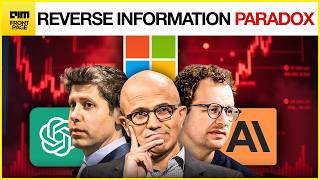

Arrow inverted: now the buyer carries the risk

The name is a deliberate nod to economist Kenneth Arrow, who in 1962 described the original Information Paradox: a buyer cannot know the value of information until it is revealed, but once it is revealed they have effectively obtained it for free, leaving the seller exposed [6]. Nadella flips the actors. 'Instead of the seller risking the loss of knowledge, the buyer now risks revealing valuable information simply by using an AI system' [4]. The enterprise is the seller of its own know-how, and the act of consumption is the act of disclosure.

His structural worry follows directly: 'if learning flows in only one direction, economic value converges toward the owners of the learning infrastructure rather than the creators of the knowledge' [2]. This is the billion-dollar reframing beneath the essay - the model is no longer the moat, the learning loop is [3]. An enterprise that pours years of domain corrections into a vendor's system is not renting intelligence; it is financing a competitor's compounding advantage while its own edge erodes.

A neutral-infrastructure pitch from the company with the biggest data surface

The uncomfortable subtext is who is delivering the warning. Microsoft owns roughly 27% of OpenAI and has access to nearly all of its IP outside consumer hardware [5], which makes a Microsoft CEO cautioning enterprises about frontier-model dependency a notable pivot. The Register framed the essay as Microsoft turning hostile on the very frontier labs it helped fund, guarding IP against risks its own investments helped create [1]. Nadella's proposed fix - a hard trust boundary where nothing crosses without consent, and protection 'akin to patents' for proprietary data [5]- conveniently routes enterprises toward a neutral cloud and tenant layer, which is to say, Azure. FourWeekMBA is blunt that the thesis is 'a strategic thesis, not a structural fact - and it is self-interested in a specific way' [2].

The community reaction sharpened the same tension. On X and Reddit, the underlying IP-leakage risk was broadly accepted as real, but Nadella's motives drew heavy skepticism, read by many as self-serving positioning for Copilot and Azure. Perplexity CEO Aravind Srinivas offered the most load-bearing rebuttal, pointing to the irony that one-directional learning terms and distillation restrictions are exactly what large providers - Microsoft included - already impose. Contrarian threads argued that blueprints are not execution, that knowing a competitor's secrets is worthless without their physical assets and supply chains, and that enterprise contracts already preclude training on customer data - making this a non-issue for most customers. The context cuts both ways: The Register noted a Securiti survey in which about half of more than 20 chief data officers had restricted or disabled Copilot deployments over data-governance concerns [1].

The remedy is a procurement principle, not a product

The constructive half of the essay is a framework reported as the Five C's - Control over data and traces, Capability, Choice through model-agnostic orchestration, Cost, and Compound, meaning a proprietary learning loop the enterprise actually keeps [2]. The through-line is decoupling the orchestration layer from any single model. Nadella's principle is simple: 'a company should be able to use a model without giving up the knowledge that makes it unique' [1]. In practice that means owning your evals, memory, and learning inside your own tenant so that swapping providers does not mean re-training your judgment from scratch [2].

Read as procurement advice, this is a negotiating lever more than a technology. An enterprise that can move its context and evals between models retains bargaining power; one that cannot is locked in and paying the second, invisible price. That is why the actionable takeaways surfacing in community discussion were consistent - self-host open models where feasible and build model-portable systems - even from people who distrust the messenger. The argument survives its own conflict of interest: whether or not you buy Azure, keeping the learning loop inside your boundary is defensible on its own terms.

Historical Context

1962
Economist Kenneth Arrow set out the original Information Paradox: the value of information is unknown to a buyer until revealed, but once disclosed the buyer has effectively acquired it without paying - the inversion Nadella's concept builds on.
2026-07-12
Nadella published the essay coining the 'Reverse Information Paradox' as a long-form post on X, arguing enterprises give away their competitive advantage through everyday AI use.

Power Map

Key Players
Subject

Nadella warns of the enterprise AI Reverse Information Paradox

SA

Satya Nadella / Microsoft

Author of the argument; positions Azure as a neutral tenant and learning-infrastructure layer that keeps enterprise knowledge inside the customer boundary - a stance that runs against vertically integrated model providers.

OP

OpenAI

A vertically integrated frontier model provider and, through Microsoft's roughly 27% ownership stake and near-total access to its IP, the lab most entangled with the essay's author; the argument's critique of value capture at the model layer cuts most directly against this integration.

AN

Anthropic

Named among frontier AI providers whose models enterprises feed proprietary knowledge to; implicated by the IP-leakage concern.

EN

Enterprises and Chief Data Officers

The party bearing the risk - they generate the valuable intelligence exhaust and, per Nadella, need a trust boundary and model choice to retain bargaining power.

Fact Check

6 cited
  1. [1] Microsoft chief turns hostile on frontier AI labs, warns companies to guard their IP
  2. [2] Nadella's Reverse Information Paradox and the Enterprise AI Moat
  3. [3] You pay for AI twice: Satya Nadella's Reverse Information Paradox raises a billion-dollar question
  4. [4] Satya Nadella warns of AI's Reverse Information Paradox
  5. [5] Satya Nadella Says Enterprises Need Something Akin To Patents When Sharing Proprietary Data With AI Models
  6. [6] Arrow information paradox

Source Articles

Top 5

THE SIGNAL.

Analysts

"Frames Nadella's move as Microsoft turning hostile on frontier AI labs, and highlights the irony that Microsoft invested billions in OpenAI while now warning enterprises about the data risks of relying on AI vendors."

Brandon Vigliarolo
Reporter, The Register

"Argues Nadella's thesis is a strategic and self-interested position rather than a structural fact - the call to distribute the learning infrastructure conveniently favors a neutral cloud and tenant layer, and reframes the real moat as the learning loop rather than the model itself."

Gennaro Cuofano (FourWeekMBA)
Business strategy analyst
The Crowd

"https://t.co/xv6csf1SbV"

@@satyanadella14358

"Satya Nadella just warned every company using AI: you are paying twice. Once with money. Again with something far more valuable. He published an article introducing something called the Reverse Information Paradox. And it changes how you think about every AI tool your company"

@@VaibhavSisinty2653

""I find it ironic that the status quo is to then turn around and impose restrictive terms on distillation, and to reserve the right to learn from customer usage and interaction data. If learning flows in only one direction, economic value converges toward the owners of the"

@@AravSrinivas1139

"Satya Nadella just warned every company using AI: you are paying twice. Once with money. He published an article introducing something called the Reverse Information Paradox."

@u/Current-Guide594493
Broadcast
REPORT: Nadella's Reverse Information Paradox -- The AI Trap No One Is Talking About

REPORT: Nadella's Reverse Information Paradox -- The AI Trap No One Is Talking About

AI Secret Cost - The Reverse Information Paradox (Unfiltered / Unedited)

AI Secret Cost - The Reverse Information Paradox (Unfiltered / Unedited)

Episode 50: Defeating the Reverse Information Paradox - Satya Nadella, Chairman & CEO of Microsoft

Episode 50: Defeating the Reverse Information Paradox - Satya Nadella, Chairman & CEO of Microsoft