Local Backlash Against AI Data Center Expansion
TECH

Local Backlash Against AI Data Center Expansion

28+
Signals

Strategic Overview

  • 01.
    Thor Equities filed a federal lawsuit against Urbana, Ohio (population ~11,000) after the city council reversed its data-center zoning and imposed a 12-month emergency moratorium that halted a roughly $1 billion project.
  • 02.
    More than 75 data center projects worth about $130 billion were blocked or stalled in the first three months of 2026, with over 800 opposition groups now active across 49 states.
  • 03.
    A Gallup poll found 71% of Americans oppose building an AI data center in their local area, with 48% strongly opposed and only 25% in favor.
  • 04.
    Sen. Bernie Sanders and Rep. Alexandria Ocasio-Cortez introduced the Artificial Intelligence Data Center Moratorium Act, which would halt construction or upgrades of data centers drawing 20 megawatts or more.

Deep Analysis

A Town of 11,000 Beat a $1B Project - Then Got Sued

The Urbana case has become the template for a national fight. After Urbana City Council amended its zoning in April 2025 to allow data centers in its M-1 Light Manufacturing District, Thor Equities, a New York-based developer, advanced a roughly $1 billion, 460,000-square-foot campus across about 230 assembled acres with a closed-loop cooling system [1]. Then residents organized, the council reversed itself, and in March 2026 it passed a 12-month emergency moratorium and rezoned the land as unsuitable for data centers [1].

Thor responded by suing the city, its council, and its building and zoning appeals board in the U.S. District Court for the Southern District of Ohio [1]. The developer says it spent $19.6 million on preliminary work in good-faith reliance on the council's earlier approval, and it alleges the moratorium was driven by 'wildly exaggerated claims about water usage, noise levels, and dangerous, baseless propaganda about health impacts' [1]. That misinformation framing is the developer's central counter-argument, and it is exactly the claim the lawsuit will test.

What makes this consequential is the asymmetry community advocates highlight: a town of roughly 11,000 facing off against a company those advocates describe as worth around $20 billion. The legal question - can a municipality reverse a data-center approval without owing damages - now hangs over hundreds of similar local fights, because a developer win would make towns think twice before saying no.

Who Pays: Big Bills, Heavy Water, Few Jobs

The opposition is grounded in a lopsided cost-benefit math. Harvard-affiliated researcher Ben Green argues data centers are 'a significant false promise' because they create almost no permanent local employment - an operational facility typically needs only 20 to 50 staff - while a typical hyperscale site can draw about 100 MW, as much electricity as 100,000 households [3]. Residents increasingly see the costs flowing the wrong way.

Those costs are large and local. Electricity bills near data centers have been rising by a factor of two or more, and the sector is projected to need 10-15% of total nationwide electricity demand within a couple of years [3]. A single data center can consume up to 5 million gallons of water per day, and two-thirds of US data centers built or in development since 2022 sit in water-stressed areas, with Phoenix-area data-center water use projected to rise about 870% [4]. Ratepayers across seven PJM states are already on the hook for $4.3 billion in 2024 grid infrastructure approved solely to connect data centers [5].

Meanwhile the public coffers shrink rather than grow. About 35-36 states offer data-center tax incentives, and Virginia and Georgia each gave up over $1 billion in tax revenue handed back to the industry [3]. On top of that, one analysis projects data centers could cost the US economy roughly $25 billion a year in hidden health and environmental damage, with public-health costs alone potentially reaching $11.7-$20.9 billion by 2028, largely from fine particulate matter [6]. The pattern - higher bills, stressed water, scant jobs, forgone tax revenue - is what residents organize against.

Why the Politics Are Cross-Partisan and Personal

Why the Politics Are Cross-Partisan and Personal
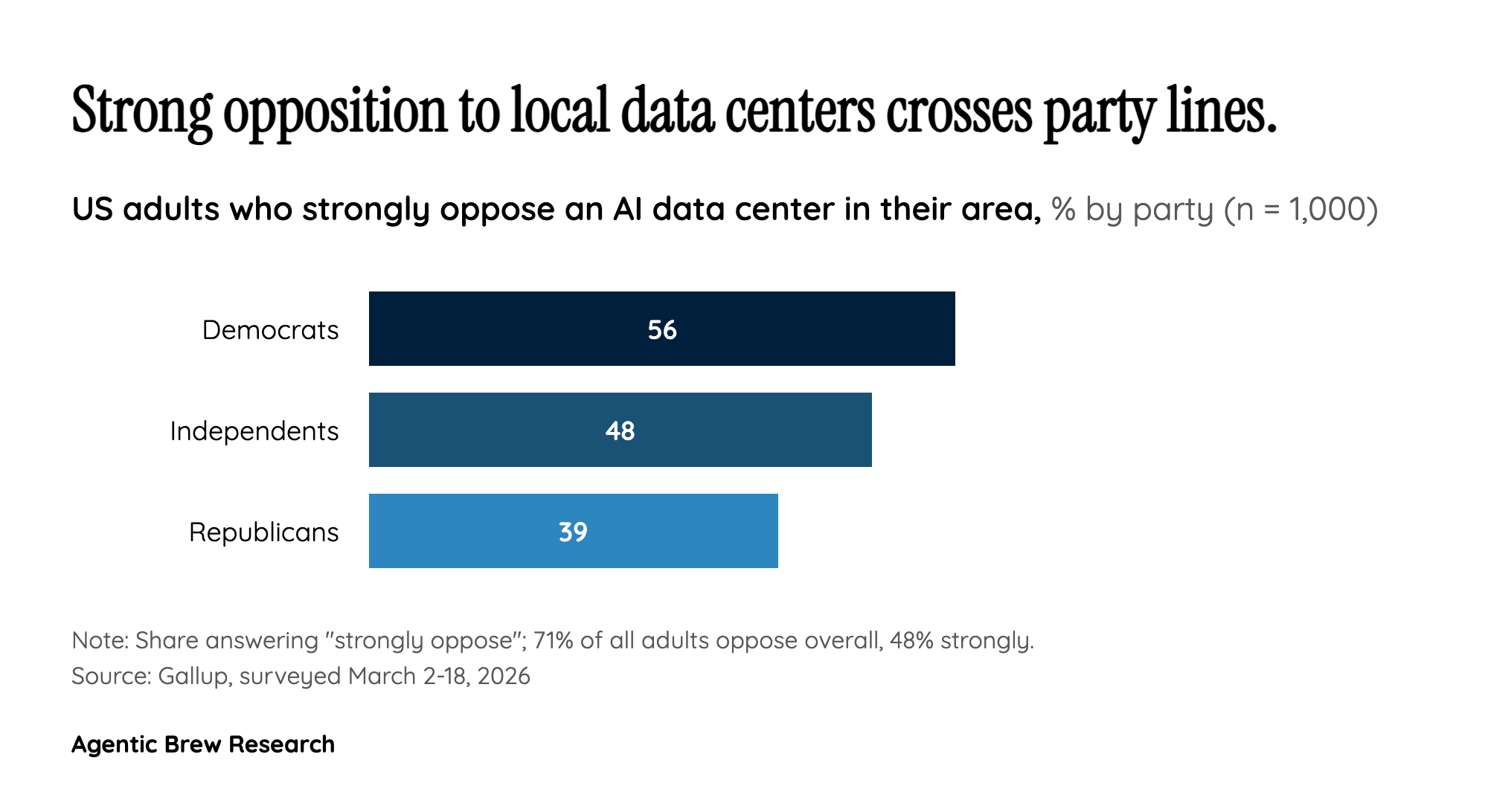
Strong opposition to local data centers crosses party lines, with majorities or near-majorities in every party strongly opposed (Gallup, March 2026).

What separates this backlash from past infrastructure fights is its coalition. Gallup found 71% of Americans oppose a data center in their area, with strong opposition spanning the spectrum - 56% of Democrats, 48% of Independents, and 39% of Republicans strongly opposed [7]. Yale's Anthony Leiserowitz captured the oddity: he had never seen a chart where conservative Republicans sit closer to liberal Democrats than to moderate Republicans [2].

Organizers also have something climate campaigns often lacked: concrete, nameable villains. Food and Water Watch's Alex Beauchamp notes that while 'no one can name the CEO of Exxon Mobil,' tech billionaires are 'real, actual villains to a lot of people' [2]. That turns a diffuse grievance into a sharp organizing target, and it helps explain why more than 800 groups have formed across 49 states to fight roughly 1,500 planned projects [2].

The sentiment online tracks this story closely. Across X, YouTube, and Reddit, the reaction skews overwhelmingly sympathetic to communities and hostile to Big Tech: the dominant threads frame opposition as ordinary people defending their water, power bills, and quiet against an industry that spent years bragging about replacing workers. Investigative video coverage zeroes in on hidden pollution and secrecy around sites, while community forums repeatedly mock the thin job-creation pitch. Genuine pro-data-center voices are nearly absent - a notable imbalance for a buildout backed by the world's largest companies.

Why Now: The Local Fight Goes National

The timing is what turns a string of zoning disputes into a structural standoff. In March 2026, Sen. Bernie Sanders and Rep. Alexandria Ocasio-Cortez introduced the Artificial Intelligence Data Center Moratorium Act, which would impose a nationwide halt on building or upgrading data centers with power demand of 20 megawatts or more [8]. That bill takes the argument residents have been making in council chambers and scales it to federal policy.

It collides head-on with the Trump administration, which treats data-center build-out as a strategic national priority and is pushing for faster permitting even as states and localities tighten zoning and impose moratoriums [9]. The result is a federal-versus-local conflict with no obvious resolution, and Harvard Kennedy School's Rachel Mural argues the backlash is 'just getting started' as communities demand a fair say amid more than a thousand pending proposals [10].

The clearest sign the resistance is biting is corporate. Microsoft and other hyperscalers have begun listing community opposition, local moratoriums, and hyper-local dissent as operational risks that could impede or delay infrastructure [5]. When a buildout that anchors trillion-dollar AI ambitions starts naming small-town councils in its risk disclosures, the backlash has stopped being a local nuisance and become a material drag on the industry's central growth story.

Historical Context

2023-06
Voters recalled two Port Authority officials for backing a $100 million data center, an early sign of local electoral backlash.
2025-01
The world's densest data-center market ended by-right approvals, requiring public hearings and board votes for new facilities.
2025-04
Amended zoning to allow data centers in the M-1 Light Manufacturing District, paving the way for Thor's proposal.
2026-03
Passed a 12-month emergency moratorium on data center developments and later rezoned the land as unsuitable.
2026-03-25
Introduced the Artificial Intelligence Data Center Moratorium Act for a nationwide pause on data centers of 20 MW or more.
2026-06-23
Filed a federal lawsuit against Urbana in the Southern District of Ohio over the zoning reversal and moratorium.

Power Map

Key Players
Subject

Local Backlash Against AI Data Center Expansion

TH

Thor Equities

New York-based developer behind the ~$1B Urbana Technology Hub; says it spent $19.6 million before the project was halted and is now suing the city, setting a litigation template other developers can follow.

CI

City of Urbana, Ohio

Small city that approved data-center zoning in April 2025, then unanimously reversed it and imposed a moratorium in March 2026; now a defendant testing whether towns can change their minds without federal liability.

GR

Grassroots opposition groups

More than 800 local groups across 49 states organizing against roughly 1,500 planned data centers; their pressure is what drives moratoriums and zoning reversals at the city level.

SE

Sen. Bernie Sanders and Rep. Alexandria Ocasio-Cortez

Federal lawmakers proposing a nationwide moratorium on data centers of 20 MW or more, elevating scattered local fights into a single national policy question.

TR

Trump administration

Treats data-center build-out as a strategic national priority and pushes faster permitting, creating direct tension with the state and local moratoriums.

MI

Microsoft and other hyperscalers

Now list community opposition, local moratoriums, and hyper-local dissent as operational risks that may impede or delay infrastructure - a signal the backlash has reached investor disclosures.

Fact Check

10 cited
  1. [1] Thor Equities files lawsuit against Ohio's Urbana after data center moratorium disrupts project
  2. [2] The data center backlash is going bipartisan
  3. [3] Why are communities pushing back against data centers?
  4. [4] AI Data Centers' Impact on Electric Bills, Water, and More
  5. [5] Policymakers Consider Temporary Pause on AI Data Center Construction
  6. [6] Data centers could cost the US economy $25 billion a year in health and environmental damage
  7. [7] Americans Oppose Data Centers in Their Area
  8. [8] Artificial Intelligence Data Center Moratorium Act
  9. [9] Federal AI Data Center Policy Meets Resistance From State Lawmakers
  10. [10] Data center backlash: Harvard study on zoning and local pushback

Source Articles

Top 1

THE SIGNAL.

Analysts

"Argues data centers do not bring meaningful local economic development, especially jobs, while pushing up electricity and water costs for residents: 'data centers don't bring meaningful economic development, especially in jobs ... It's a significant false promise of these data centers.'"

Ben Green
Assistant Professor, University of Michigan School of Information and Public Policy; Faculty Associate, Berkman Klein Center for Internet & Society

"Says the backlash is just getting started as communities demand a fair say: 'There is little question that data centers and AI will be part of our collective future. Today, communities are asking for a fair say in what their futures will be.'"

Rachel Mural
Senior Research Associate, Harvard Kennedy School

"Notes an unusual cross-partisan alignment: 'I'm not sure I've ever seen a chart where conservative Republicans are closer to liberal Democrats than liberal [and] moderate Republicans are.'"

Anthony Leiserowitz
Director, Yale Program on Climate Change Communication

"Explains the organizing potency of nameable tech executives: 'No one can name the CEO of Exxon Mobil...These guys are real, actual villains to a lot of people.'"

Alex Beauchamp
Northern Regional Director, Food and Water Watch

"Says residents now grasp the energy stakes: 'People are super aware of the ways that building other infrastructure in their towns is potentially going to make their access to less expensive energy impossible.'"

Dana R. Fisher
Director, Center for Environment, Community, and Equity, American University
The Crowd

"Big Tech is suing a tiny Ohio town of Urbana after its city council listened to the residents and voted no on a massive AI data center Urbana only has a population of about 11,000 but they're going up against a $20 billion company The company wants to put in a data center so"

@@WallStreetApes1832

"Bodycam footage just came out of a farmer speaking against a planned data center, being handcuffed at a city council meeting for going a few seconds over the 3-minute public comment limit. Darren Blanchard was speaking in Claremore, Oklahoma when two officers told him to leave,"

@@IntCyberDigest13857

"Michigan woman records 24/7 data center in Dowagiac affecting approx. 1,300 homes. Constant noise causes headaches & sleepless nights. A class-action lawsuit been filed"

@@TaraBull4967

"Americans Have Grown Dramatically Anti-Data Center in Just Months, Survey Finds"

@u/Plastic_Ninja_901417000
Broadcast
We Saw What AI Data Centers Don't Want You to See

We Saw What AI Data Centers Don't Want You to See

Why Tech Companies Are Quietly Cancelling AI Data Centers

Why Tech Companies Are Quietly Cancelling AI Data Centers

Why communities are revolting against data centers

Why communities are revolting against data centers