Meta launches Muse Image, an agentic AI image model wired into its ad machine
TECH

Meta launches Muse Image, an agentic AI image model wired into its ad machine

34+
Signals

Strategic Overview

  • 01.
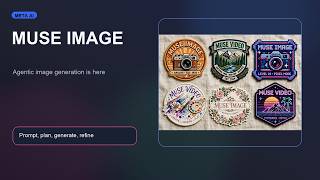
    Meta launched Muse Image on July 7, 2026, the first in-house image generation model from Meta Superintelligence Labs, available across the Meta AI app, meta.ai, Instagram Stories in the US, and WhatsApp in limited countries.
  • 02.
    Muse Image operates as an agent that invokes web search and coding tools, self-refines its own generations, and scales test-time compute before producing a final image.
  • 03.
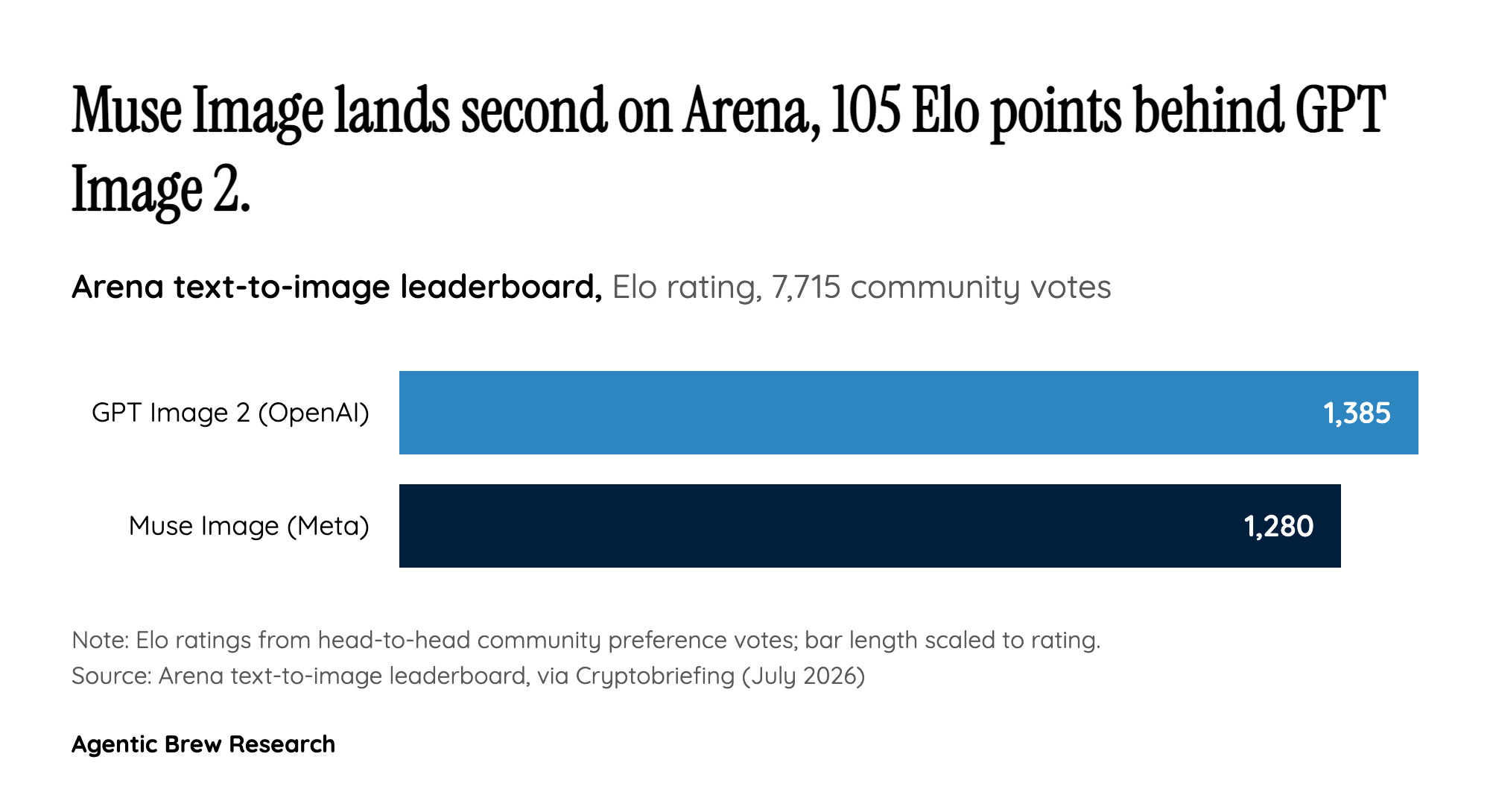
    Muse Image ranks No. 2 on Arena text-to-image with an Elo score of 1280 from 7,715 community votes, trailing OpenAI's GPT Image 2 at Elo 1385.
  • 04.
    The launch drew immediate privacy backlash because a feature lets users pull another public Instagram user's photos into AI images by tagging them, with users opted in by default and not notified.

The Image Model Is a Trojan Horse for the Ad Machine

Read the headline and Muse Image is a consumer creativity tool. Follow the money and it looks more like the last bolt in a fully automated advertising factory. Meta's Advantage+ suite - its AI-driven system for placing and optimizing campaigns - is already generating roughly $60 billion in annualized revenue [4], and until now the one step it still needed a human for was making the ad image itself. Wire an in-house image model into Advantage+ and that step disappears too.

Forbes framed it bluntly: Meta didn't build an image model to compete with Midjourney; it built the last component of a machine that turns a URL and a budget into a campaign [4]. The strategic consequence is that ad creative gets commoditized. Once a system can spin up unlimited on-brand image variations for free, the scarce, valuable thing is no longer the picture - it is the placement, the frame, and the audience Meta controls. That reframes Muse Image from a Midjourney rival into a defensive moat around Meta's core business, and it explains why the model launched inside the ad stack rather than as a standalone creative app.

It Doesn't Just Draw - It Reasons, Searches, and Runs Code

The technical wedge in Muse Image is that it behaves like an agent, not a one-shot prompt-to-pixels model. Rather than mapping text straight to an image, it invokes web search and coding tools to improve accuracy, self-refines its own generations, and improves through scaling test-time compute [1]- meaning it can spend more compute reasoning before it commits to a picture. Alexandr Wang described the same loop on X, framing the model as agentic and pairing it with the Muse Spark LLM to reason through a prompt, search the web, and plan before generating.

That toolset produces concrete capabilities other image models fumble. Muse Image learns to write and execute code that produces accurate plots and QR codes and conditions on those rendered figures to improve the accuracy of the final image [1]- the classic failure zone for diffusion models. It also grounds images in real-time facts via search, and Meta shipped a companion Muse Video model on the same pretraining base with native audio support [1]. Images generated in the Meta AI app also carry a hidden provenance signal that survives cropping, compression, resizing, and screenshotting [1], a nod to the provenance problem that the privacy backlash makes urgent.

The Privacy Landmine: Opted In by Default, No Notification, No Undo

The feature drawing the sharpest reaction lets someone manipulate another public Instagram user's photos with AI simply by tagging them - and Meta's policy says the tagged user will not be notified, because users are opted in by default [2]. Meta says you can disable this in Instagram settings, but images already created from your photos before you opt out persist [2], so the control is partial at best. That combination - default consent, silent activation, no retroactive deletion - is what turned a product launch into a controversy within a day.

The community reaction split cleanly along that fault line. The loudest general-tech discussion skewed overwhelmingly negative and privacy-focused, with users questioning whether an opt-out toggle counts as meaningful consent and raising the specter of AI images built from people who never agreed. Enthusiast circles were more forgiving, praising output quality on the first try even while grumbling that Muse portraits look like every other AI-generated face. One thread noted a tutorial for editing Instagram photos with Muse had racked up enormous engagement, a reminder that virality and backlash are running in parallel rather than canceling out. A TechCrunch-cited commenter captured the worried camp's read: pulling real users into generated photos without explicit consent is a privacy landmine waiting to detonate [2].

By The Numbers: Second Place on Fidelity, First Place on Distribution

By The Numbers: Second Place on Fidelity, First Place on Distribution
Arena text-to-image Elo: Muse Image (1,280) trails OpenAI GPT Image 2 (1,385) by 105 points.

On raw quality, Muse Image is a strong runner-up, not the champion. It sits at No. 2 on Arena text-to-image with an Elo of 1280 from 7,715 community votes, while OpenAI's GPT Image 2 leads at Elo 1385 - a 105-point gap [3]. Muse Image also holds No. 2 on Arena for single-image and multi-image editing, and the previewed Muse Video ranks No. 3 in text-to-video Elo [1][3]. Skeptics on hands-on forums were candid that GPT Image 2 remains the leader and that Muse's outputs feel comparable but not superior.

The contrarian read is that fidelity is not where this fight is won. Meta ships Muse live inside apps hundreds of millions of people already open - the Meta AI app, dozens of Instagram Stories effects, WhatsApp - and layers on context no pure model has: identity, the social graph, chat surfaces, and Marketplace, where a room-redesign feature can pull real purchasable products into a generated scene. That is the distribution bet: Meta is wagering that owning the surfaces and the social context beats winning the benchmark, and a 105-point Elo deficit is a price it is willing to pay if the model lives where the users and the ad budgets already are.

Historical Context

2026-04
The lab debuted its first large language model, Muse Spark, ahead of Muse Image.
2026-07-07
Muse Image launched as Meta's first in-house consumer image model, succeeding earlier Emu-based features and reducing reliance on third-party models like Midjourney and Black Forest Labs.

Power Map

Key Players
Subject

Meta launches Muse Image, an agentic AI image model wired into its ad machine

ME

Meta Superintelligence Labs

Builder of Muse Image and the previewed Muse Video; this is its first media generation model, following the Muse Spark LLM it debuted in April 2026.

AL

Alexandr Wang

Meta Chief AI Officer leading Superintelligence Labs, the division under which Muse Image was built and which earlier shipped Muse Spark.

AD

Advertisers and agencies (via Advantage+)

Target customers; Muse Image integrates into Advantage+ creative to auto-generate on-brand ad variations, closing the last human-dependent step in Meta's campaign automation loop.

OP

OpenAI (GPT Image 2)

Chief competitor; ranks No. 1 on Arena text-to-image ahead of Muse Image, which Meta's internal benchmarks and the public leaderboard show it trailing.

IN

Instagram public account holders

Affected parties in the privacy backlash; their public photos can be pulled into AI images by others via tagging, opted in by default.

Fact Check

4 cited
  1. [1] Introducing Muse Image and Muse Video
  2. [2] Meta rolls out Muse, a new AI image generator
  3. [3] Meta Muse Image climbs Arena rankings
  4. [4] Meta's New Image Model Isn't Competing With Midjourney. It's Competing For Your Ad Budget

Source Articles

Top 5

THE SIGNAL.

Analysts

"Muse Image is not aimed at Midjourney but at capturing ad budgets by completing Meta's automated campaign machine; when creative variation becomes free, value shifts to the ad placement and frame."

Gabriela Linzainescu
Contributor, Forbes

"Pulling real users into AI-generated photos without explicit consent is a serious privacy risk - a landmine waiting to detonate."

Unnamed X user (cited by TechCrunch)
Social media commenter
The Crowd

"Introducing Muse Image and Muse Video, the first media generation models developed by Meta Superintelligence Labs. Muse Image is our most advanced image generation model yet. It follows instructions faithfully, edits with precision, composes from multiple references, and draws"

@@AIatMeta2138

"1/ releasing muse image today — the first image generation model from MSL. it's agentic: pairs with muse spark to reason through your prompt, search the web, and plan before it generates. people get what they meant on the first try. live now in the Meta AI app."

@@alexandr_wang1947

"NEW: Meta faces backlash after launching an AI that can generate images using public Instagram profile pictures."

@@Polymarket150

"Meta just launched a new AI generator, Muse Image, and users are already pushing back over use of their photos"

@u/Hungry__Hornet130
Broadcast
Forget ChatGPT: Meta Muse Is FREE & Unlimited (No Install)

Forget ChatGPT: Meta Muse Is FREE & Unlimited (No Install)

Meta just released Meta Muse Image! #MetaPartner

Meta just released Meta Muse Image! #MetaPartner

Meta Muse Image: Agentic Image Generation in Meta AI

Meta Muse Image: Agentic Image Generation in Meta AI