Meta AI Wearables Push
TECH

Meta AI Wearables Push

34+
Signals

Strategic Overview

  • 01.
    Meta is developing an AI-powered pendant built on its late-2025 Limitless acquisition, with testing slated to begin within the next year.
  • 02.
    An internal memo from VP of Wearables Alex Himel outlines three pillars: a pendant, an expanded glasses lineup (Luna, RBM2 Refresh, Mojito VIP, Artemis, SSG), and a B2B 'Wearables for Work' subscription.
  • 03.
    The hardware is positioned around a consumer AI agent codenamed Hatch, running on Meta's Muse Spark model and currently powered by Anthropic's Claude during development.
  • 04.
    Reality Labs reported a $4.028B operating loss on $402M revenue in Q1 2026, prompting CFO Susan Li to say VR investment will 'decrease significantly' while wearables spend ramps.

Deep Analysis

The $83B hole and the 10M-unit lifeline
The $83B hole and the 10M-unit lifeline
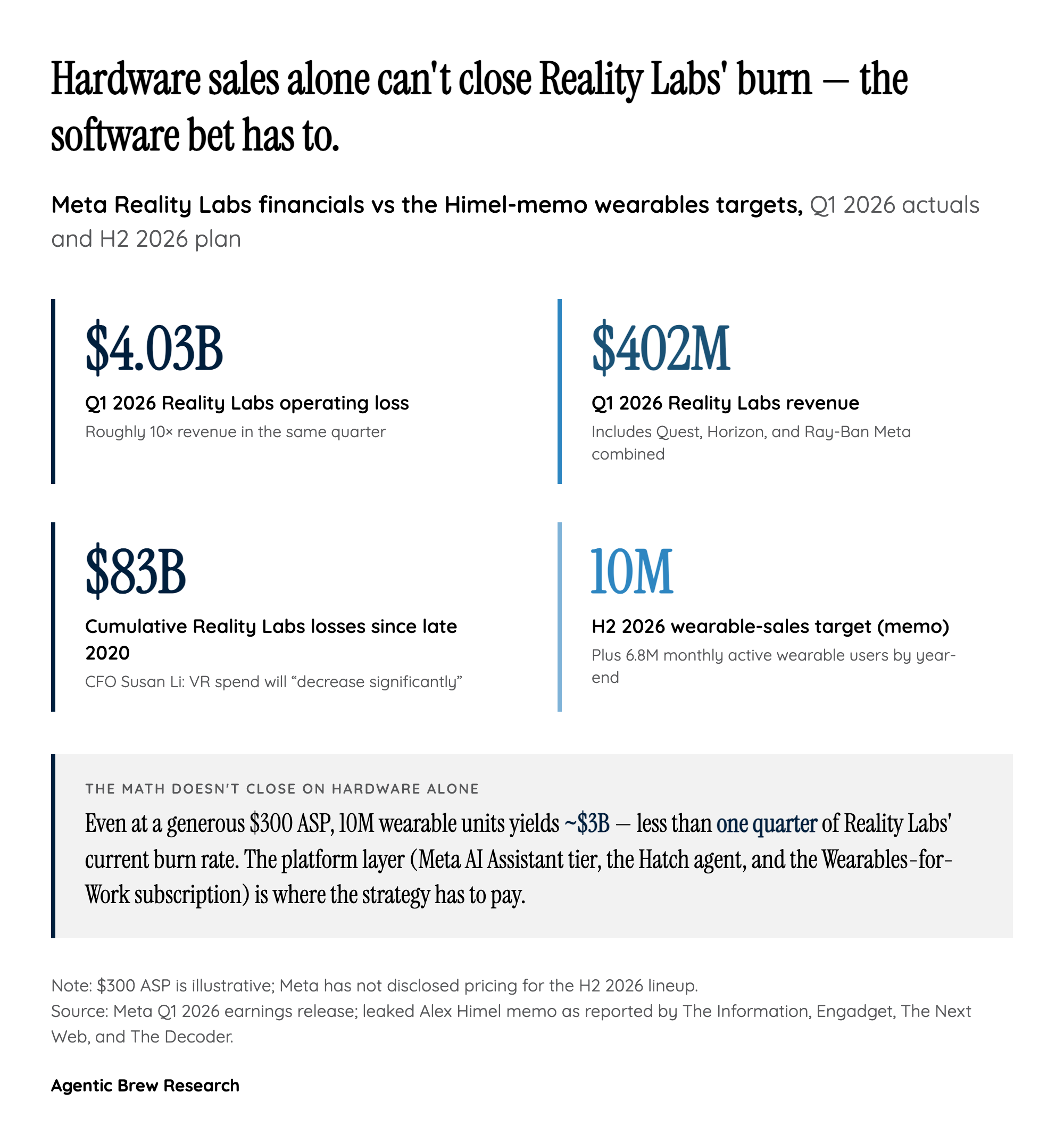
Reality Labs Q1 2026 financials versus the Himel-memo wearables targets — hardware revenue alone cannot close the burn.

Meta's wearables blitz is, before anything else, a capital-allocation story. Reality Labs printed a $4.028B operating loss on just $402M of revenue in Q1 2026 — a roughly 10:1 burn-to-revenue ratio that pushes cumulative RL losses past $83B since the segment was carved out in late 2020 [1]. CFO Susan Li told investors VR spend will 'decrease significantly,' an unusually direct admission that the Quest-era thesis has lost [2]. The memo's 10M wearable sales target for H2 2026 and 6.8M MAU goal by year-end [5]translate the financial pressure into operational quotas: EssilorLuxottica is being scaled to 10M Ray-Ban Meta units per year of capacity to make those numbers physically possible [3]. The arithmetic is stark — even at an ambitious $300 ASP, 10M units yields $3B of hardware revenue, less than one quarter of RL's current burn rate. That gap is exactly why the strategy is not really about hardware.
The real bet is the software layer, not the pendant

Read Himel's memo carefully and the hardware is a Trojan horse. Three of the pillars are software margins: the Meta AI Assistant tier, the consumer agent codenamed Hatch (running on Meta's Muse Spark model but currently powered by Anthropic's Claude during development [4]), and a B2B 'Wearables for Work' subscription targeting at least ten enterprise signups with meeting transcription, ambient note-taking, and workplace integrations [5]. The unusual detail is the Claude dependency: shipping a flagship Meta consumer agent on a competitor's frontier model is a tell that Hatch is being rushed to market faster than Llama can support it. If the platform play works, Meta extracts recurring revenue from the same 7M-unit install base; if it doesn't, the company is left with a thinner-margin glasses business and a pendant nobody asked for.

Buying into a category the smart money says is already dead

Sacra's read of the Limitless acquisition is brutal: the AI-pendant category absorbed roughly $241M of VC across 2023-24 and produced no durable consumer product, with Sacra arguing 'the future AI pendant experiences will live inside glasses, earbuds, watches, and phones' rather than as a dedicated necklace [6]. That framing recasts the Limitless deal — $33M+ raised, $99 retail — as a talent-and-IP grab rather than a hardware thesis [7]. Meta is therefore racing into a form factor that the most credible category analyst already declared structurally over, on the bet that distribution (7M-glasses install base, Ray-Ban retail) can succeed where standalone startups failed.

The consent problem Meta can't design around

Digital Trends frames the core product risk in one sentence: 'A wearable built around always-on listening raises entirely new questions about consent, recording, and data storage' [8]. That problem compounds for Meta specifically — the company's privacy reputation is the baseline, not the surprise. The leaked memo describes 'supersensing' glasses (the SSG prototype) and a pendant that listens, remembers, and summarizes conversations, which means every social interaction with a Meta wearer becomes a non-consensual data event for the other party [9]. The Wearables-for-Work pitch may actually be the cleanest path through this — in enterprise settings, consent can be contractually pre-negotiated via employment agreements, which is exactly the loophole Microsoft's Copilot economics have exploited.

The Ray-Ban paradox: hated online, sold out in stores

Ray-Ban Meta units tripled in 2025 to roughly 7M, giving Meta an estimated 82% of the smart-glasses category and forcing EssilorLuxottica into a 10M-unit-per-year manufacturing expansion [10]. That commercial success exists in parallel with an online-discourse layer that is openly hostile — analyst voices read the Limitless deal as anti-competitive consolidation, independent reviewers treat the pendant as a solution looking for a problem, and developer communities point displaced Limitless owners at third-party software like Omi.me that still runs on the original hardware. The reconciliation is the Ray-Ban brand itself: the fashion-first rebrand decouples the hardware from the Meta corporate identity at the point of purchase. That precedent is what makes the rest of the 2026 lineup interesting — Luna, the RBM2 Refresh, Mojito VIP, and the Artemis/SSG prototypes — each appears designed to keep the Meta name off the frame. The pendant, by contrast, has no fashion partner to hide behind, which is why its launch will be the cleanest test yet of whether the brand-laundering strategy scales beyond eyewear [11].

Historical Context

2025-12-05
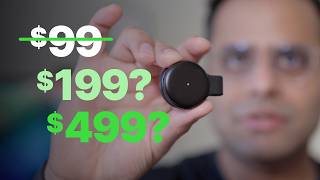
Meta acquires AI-wearables startup Limitless, the $99 always-listening pendant maker that had raised over $33M.
2025-12-31
Ray-Ban Meta sales tripled across 2025 to roughly 7M units, giving Meta an estimated 82% share of the smart-glasses category.
2026-04
Q1 2026 earnings show a $4.028B Reality Labs operating loss on $402M revenue, pushing cumulative RL losses past $83B since late 2020.
2026-05-30
The Himel memo leaks, revealing the pendant program, four-plus new glasses SKUs, and the Wearables-for-Work enterprise subscription with a 10M H2 2026 sales target.

Power Map

Key Players
Subject

Meta AI Wearables Push

AL

Alex Himel

VP of Wearables, Meta — author of the three-pillar strategy memo that leaked and set the public narrative

SU

Susan Li

CFO, Meta — controls the capital reallocation away from VR toward wearables

LI

Limitless (acquired)

Source of the pendant IP, $99 hardware design, and the always-listening product paradigm Meta is inheriting

ES

EssilorLuxottica

Manufacturing partner scaling Ray-Ban Meta capacity to ten million units per year — the supply-side bet behind the 10M H2 2026 sales target

AN

Anthropic

Provides the Claude model powering the Hatch consumer agent during development — an unusual dependency for a Meta flagship

Fact Check

11 cited
  1. [1] Meta Reality Labs Q1 2026 Earnings: VR Smart Glasses Pivot
  2. [2] Facebook Meta Reality Labs Q1 2026
  3. [3] Ray-Ban Meta glasses sold 2M units, production to be vastly increased
  4. [4] Meta develops consumer AI agent codenamed Hatch
  5. [5] Meta's leaked memo reveals AI pendant, supersensing glasses and enterprise wearables strategy
  6. [6] Why Meta bought Limitless
  7. [7] Meta acquires AI device startup Limitless
  8. [8] After smart glasses, Meta apparently wants you to wear its all-listening AI pendant
  9. [9] Meta is reportedly working on an AI pendant and more smart glasses
  10. [10] Meta Ray-Ban smart glasses sales tripled in 2025
  11. [11] Meta is preparing an AI pendant for the wearable race

Source Articles

Top 3

THE SIGNAL.

Analysts

"Told investors that VR investment specifically would 'decrease significantly' as the company reorients Reality Labs spend toward AI wearables."

Susan Li
CFO, Meta

"Argues the standalone pendant category is structurally over and that 'the future AI pendant experiences will live inside glasses, earbuds, watches, and phones' — framing the Limitless deal as a talent-and-IP buy rather than a hardware bet."

Sacra Research
Private-markets research firm

"Warns that 'a wearable built around always-on listening raises entirely new questions about consent, recording, and data storage,' especially given Meta's existing privacy track record."

Digital Trends (editorial)
Consumer-tech publication

"Lays out a three-pillar plan: ship the pendant, expand glasses across four-plus SKUs through 2026, and monetize an enterprise subscription targeting at least ten initial corporate signups."

Alex Himel
VP of Wearables, Meta (memo author)
The Crowd

"$META is planning a major AI wearables push including an AI pendant, expanded AI glasses & new business-focused "Wearables for Work" service. Meta clearly trying to monetize the software layer too with AI subscriptions tied to Meta AI Assistant, Hatch & future wearable apps."

@@StockSavvyShay724

"NEW: Meta is reportedly developing an AI pendant as part of a broader push into "wearables for work.""

@@Polymarket512

"According to reports, Meta is developing: • An AI-powered pendant that listens, remembers, and summarizes conversations • Multiple new AI smart glasses launching through 2026 • A business subscription called "Wearables for Work" • A broader push toward always-on personal AI"

@@TechieUltimatum7

"Meta aims to sell 10 million wearables in the H2 2026 by launching an AI pendant and up to four new smart glasses and expanding into more countries"

@u/AR_MR_XR13
Broadcast
Developer Preview: Introducing Meta Wearables Device Access Toolkit

Developer Preview: Introducing Meta Wearables Device Access Toolkit

Meta pushes AI wearables into the future with jaw-dropping features

Meta pushes AI wearables into the future with jaw-dropping features

Acquired by Meta / Limitless AI Pendant Review - Is this the most Controversial AI Gadget of 2025?

Acquired by Meta / Limitless AI Pendant Review - Is this the most Controversial AI Gadget of 2025?