Nvidia's AI Factory Infrastructure Buildout
TECH

Nvidia's AI Factory Infrastructure Buildout

34+
Signals

Strategic Overview

  • 01.
    Nvidia partnered with six major asset managers - Apollo, BlackRock, Blackstone, Brookfield, Goldman Sachs, and KKR - on August 10, 2026, to mobilize more than $500 billion in third-party financing so customers can buy Nvidia AI compute they could not otherwise afford.
  • 02.
    Cisco expanded its Secure AI Factory with Nvidia to a rack-scale architecture on August 25, 2026, partnering with Supermicro on liquid- and air-cooled systems that support more than 200 kilowatts per rack, with integrated systems available starting October 2026.
  • 03.
    NVLink Fusion opens Nvidia's interconnect and rack-scale architecture to third-party custom XPU silicon, while new BlueField-4 DPUs add 'Scale-In' as a fifth networking pillar for agentic AI factories, running at up to 800 Gb/s.
  • 04.
    Nvidia is investing up to $3 billion in Blackstone-backed power developer Lancium to help deploy gigawatt-scale, power-ready AI factories across Lancium's 15+ GW site pipeline.

Deep Analysis

Building the Standardized AI Factory Stack

Nvidia's rack-scale push arrived in a pair of announcements dated August 25, 2026: Cisco is expanding its Secure AI Factory architecture with Nvidia into rack-scale systems, bringing in Supermicro to supply the compute layer[1]. The joint architecture is described as the first NVIDIA Cloud Partner-compliant reference design built on partner-developed networking spanning both Cisco Silicon One and Nvidia Spectrum-X switch silicon, with rack-to-fabric liquid cooling exceeding 200 kilowatts per rack and integrated Supermicro systems slated for October 2026[1][2]. Cisco's Will Eatherton described the technical split cleanly: Cisco layers its NX-OS or SONiC software on top of Nvidia's Spectrum silicon for the scale-out GPU fabric, while Nvidia's Marc Hamilton frames the deal as reaching beyond a single rack to a full AI-factory-wide reference architecture that partners adopt wholesale rather than assemble piecemeal[1]. That framing lines up with how Jensen Huang has described the AI factory in a recent fireside chat with Cisco CEO Chuck Robbins: as five stacked layers - energy, chips, infrastructure, models, and applications - with Huang arguing enterprises should build on-premises or hybrid rather than rent pure cloud capacity, since the most valuable intellectual property a company holds is not the answers a model produces but the proprietary questions and context used to prompt it.

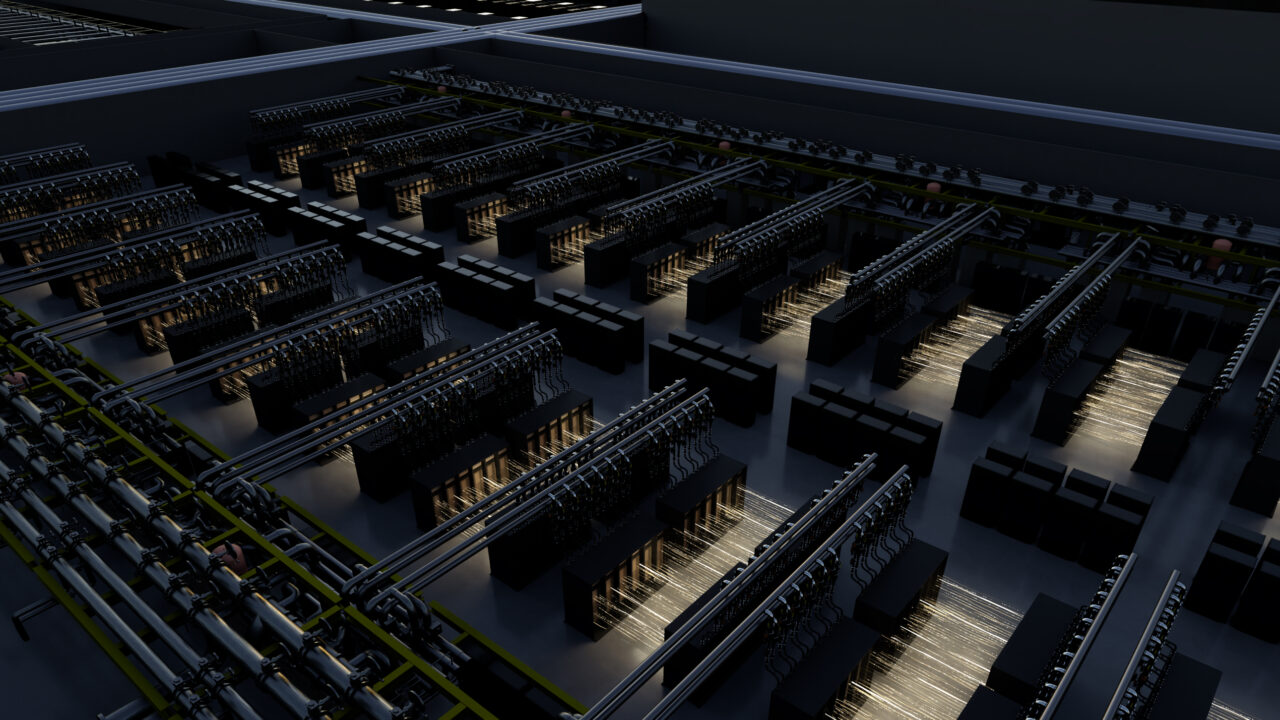
Underneath the rack sits Nvidia's newest networking layer: BlueField-4 DPUs introduce what Nvidia calls 'Scale-In,' a fifth pillar of AI factory networking. The 64-core Grace-based DPU runs at up to 800 Gb/s and offloads security, storage, and tenant-isolation processing independent of the host CPU, with Nvidia citing up to 1.45x the storage throughput of off-the-shelf Ethernet[3]. Nvidia has also pointed to its own internal AI factory operations as evidence that capacity like this cannot be conjured overnight - the company has said its internal AI factory serves several trillion tokens per month at very high availability, and that standing up new capacity requires many months of procurement and power planning, which is part of why pre-validated, off-the-shelf reference designs matter even as physical buildout timelines stay long. Together, the rack-scale reference architecture and the DPU-level networking layer are meant to do the same job at two different altitudes: turn what used to be a bespoke, vendor-by-vendor data-center build into a standardized, validated design that any enterprise, neocloud, or sovereign cloud can order off the shelf.

NVLink Fusion: Opening the Moat to Capture Custom Silicon

For most of its history Nvidia sold complete GPU systems. NVLink Fusion changes that calculus: it lets third-party custom XPU silicon - not just Nvidia's own chips - plug directly into Nvidia's NVLink scale-up network and rack-scale architecture, either through direct NVLink-C2C connections for custom CPUs or a UCIe bridge chiplet for custom ASICs and XPUs[4]. Nvidia's pitch is speed and efficiency: NVLink Fusion claims 3x lower latency and 10x higher packet rates than off-the-shelf Ethernet, NVLink-C2C offers up to 6x the energy efficiency of PCIe, and sixth-generation NVLink already supports a 72-XPU domain with a roadmap toward 1,152 accelerators in a single coherent fabric[4]. Marvell is building the first reference designs, pairing Marvell XPUs with Nvidia's Vera CPU and ConnectX NICs, targeted for the third quarter of 2026, with Intel, MediaTek, GUC, Amazon's Annapurna Labs, and QCT also named as ecosystem partners[4][5]. The strategic logic: hyperscalers designing their own AI chips still need those chips to interoperate with Nvidia's dominant software and networking stack, and by opening the interconnect rather than trying to block custom silicon outright, Nvidia captures a share of infrastructure spend it would otherwise lose entirely to fully independent XPU stacks.

500 Billion Dollars: Real Estate-Style Financing for Compute - and the Bear Case

On August 10, 2026, Nvidia said it would partner with six of the largest asset managers - Apollo, BlackRock, Blackstone, Brookfield, Goldman Sachs, and KKR - on independent financing platforms aiming to mobilize more than $500 billion in third-party capital for customers to buy Nvidia AI compute[6]. Jensen Huang framed Nvidia GPUs themselves as the collateral, calling compute 'broadly adopted, flexible across models and workloads, fungible and transferable across customers and operators' - the same language used to describe a financeable real asset[6]. Apollo's Jim Zelter went further, calling compute 'a scarce, mission-critical asset class with compelling investment characteristics'[6]. Importantly, none of the six platforms are done deals - each remains subject to definitive agreements still to be negotiated[6].

The market's reaction undercut the celebratory framing: Nvidia shares fell 2.9% the day of the announcement, erasing nearly $60 billion in market capitalization, as reporting drew comparisons to mortgage-backed securitization and questioned whether Nvidia guaranteeing up to 25% of residual value on some contracts amounts to financing its own demand[7]. Coverage the next day sharpened around hardware depreciation risk: if GPU useful life runs closer to the shorter multi-year range some skeptics argue for, rather than the decade-plus productivity Huang claims, the collateral backing $500 billion in loans could be worth far less than assumed by the time it is repaid, with some analysts pricing in default-risk-adjusted yields of 11%-17% to compensate[8]. Retail investors are split on the same fault line: bulls point to Nvidia's own low debt-to-equity ratio, arguing it is financing others with cash it has already earned rather than borrowed money, while skeptics counter that the real debt risk sits with Nvidia's customers, and that demand may look larger than it is because Nvidia itself is financing the purchases.

The Power Land Grab: Lancium and Gigawatt-Scale Site Control

Chips and networking mean nothing without electricity, and Nvidia's most recent move addresses exactly that bottleneck: a strategic investment of up to $3 billion in Lancium, a Blackstone-backed developer of powered land and data-center sites, to support deployment of Nvidia's full-stack AI platform and DSX reference designs across Lancium's development pipeline[9][10]. Lancium currently has roughly 4 gigawatts of capacity under lease and more than 15 gigawatts of powered land in various stages of development[11]. Nvidia's DSX MaxLPS reference design is engineered to fit up to 40% more GPUs into the same power budget, a meaningful lever now that grid interconnection - not chip supply - is increasingly the pacing constraint on new AI factory capacity[12]. Lancium CEO Michael McNamara framed the deal simply: partnering with Nvidia 'ensures every campus will deploy industry's most advanced technology'[10]. The investment fits a pattern visible across the whole announcement cluster: Nvidia is no longer just supplying chips into other people's data centers, it is co-investing in the land, power contracts, and financing structures that determine whether those data centers get built at all.

Historical Context

2026-03
Jensen Huang framed AI factories as 'token factories' generating intelligence as the fundamental unit of output, extending the AI factory vision beyond chips to a full infrastructure and software stack.
2026-08-10
Announced the $500 billion AI compute infrastructure financing partnership with six asset managers.
2026-08-25
Cisco announced expansion of its Secure AI Factory with Nvidia to a rack-scale architecture in partnership with Supermicro.

Power Map

Key Players
Subject

Nvidia's AI Factory Infrastructure Buildout

NV

Nvidia

Orchestrates the full-stack AI factory ecosystem - chips, networking (NVLink Fusion, BlueField-4), rack-scale reference architectures, financing access, and power-site partnerships - positioning itself as the standardized backbone for enterprise and hyperscaler AI buildout.

CI

Cisco

Expands its Secure AI Factory architecture with Nvidia, contributing Silicon One switch silicon and liquid-cooled rack-to-fabric networking systems; brought in Supermicro for the compute layer.

SU

Supermicro

Supplies liquid- and air-cooled rack-scale server systems validated and sold within Cisco's Secure AI Factory portfolio, enabling deployment of Nvidia Vera Rubin NVL72 and HGX Rubin NVL8 platforms.

AP

Apollo, BlackRock, Blackstone, Brookfield, Goldman Sachs, KKR

Six asset managers each independently underwriting financing platforms to mobilize over $500 billion so customers can purchase Nvidia AI compute they could not finance alone.

LA

Lancium

Blackstone-backed power and data-center land developer with 4 GW leased and 15+ GW in development; will deploy Nvidia's DSX reference designs across its sites after receiving Nvidia's strategic investment.

MA

Marvell (and NVLink Fusion silicon partners: Intel, MediaTek, GUC, Amazon/Annapurna Labs, QCT)

Joining the NVLink Fusion ecosystem to build semi-custom XPU/CPU silicon that plugs into Nvidia's rack-scale interconnect; Marvell/Nvidia reference designs pairing Marvell XPUs with Nvidia's Vera CPU are targeted for Q3 2026.

Fact Check

12 cited
  1. [1] Nvidia and Cisco push the enterprise AI factory into the rack-scale era
  2. [2] Cisco Expands Secure AI Factory With Nvidia for the Rack-Scale Era
  3. [3] NVIDIA BlueField-4 Powers New Scale-In Network Infrastructure for Agentic AI Factories
  4. [4] How XPUs Meet a World-Class AI Factory
  5. [5] Marvell and NVIDIA Provide Custom Solutions for Advanced AI Infrastructure
  6. [6] NVIDIA Partners With Apollo, BlackRock, Blackstone, Brookfield, Goldman Sachs and KKR to Establish AI Compute Infrastructure Financing Platforms to Mobilize Over $500 Billion of Third-Party Capital
  7. [7] Nvidia Shares Fall Nearly 3% as $500 Billion Financing Deal Raises Circular-Financing Concerns
  8. [8] Nvidia's AI Funding Plan Faces Scrutiny Over Depreciation, China Risk
  9. [9] Nvidia to Invest Up to $3 Billion in Blackstone-Backed Power Developer Lancium
  10. [10] Lancium Announces Partnership With NVIDIA to Advance Gigawatt-Scale AI Factory Development Across Its 15 GW Portfolio
  11. [11] Lancium Adds Nvidia as Investor and Partner, Targeting Gigawatt AI Factories Across a 15GW Pipeline
  12. [12] Lancium, Nvidia Partner on Gigawatt-Scale AI Data Centers

Source Articles

Top 5

THE SIGNAL.

Analysts

Positions Nvidia compute as a broadly adopted, fungible asset class suitable to underpin large-scale third-party financing platforms.

Jensen Huang
CEO, Nvidia

Frames compute infrastructure as a new scarce, investable asset class akin to real assets.

Jim Zelter
President, Apollo

Argues AI scaling must be paired with data control and cost/ROI management, framing the Secure AI Factory rack-scale expansion as addressing that need.

Jeetu Patel
President and Chief Product Officer, Cisco

Frames the Cisco partnership as extending beyond a single rack to a full AI-factory-wide reference architecture that partners adopt wholesale.

Marc Hamilton
VP, Solutions Architecture, Nvidia

Frames the Nvidia partnership as ensuring Lancium's power campuses get the most advanced deployment technology.

Michael McNamara
CEO, Lancium
The Crowd

From the show floor to the AI factory: Hot Chips 2026 was all about extreme co-design to accelerate agentic workloads — the most complex workload in history. Vera CPU, Vera Rubin, Groq 3 LPX, Spectrum-X Multiplane, BlueField-4 Scale-In networking. One full AI stack platform

@@nvidia159

Great partnership! @Supermicro and @Cisco are joining forces to support the next generation of AI DC. Together, we are bringing total, full-stack, rack to fabric liquid-cooled DCBBS solutions to power the Cisco Secure AI Factory with @NVIDIA

@@charlesliang57

Lancium and Nvidia just announced a partnership that puts a number behind the AI infrastructure buildout in Texas: 4 GW under lease, and more than 15 GW of powered land in development. What's in the deal: ➡️ Lancium will deploy Nvidia's DSX reference designs across its campuses

@@MrDataCenters1

Everyone's calling Nvidia's financing deals circular and I think they're mostly wrong

@u/Quechivoeth81
Broadcast
The AI Factory: Infrastructure for Intelligence | Jensen Huang, CEO, NVIDIA

The AI Factory: Infrastructure for Intelligence | Jensen Huang, CEO, NVIDIA

Inside the NVIDIA AI Factory by PNY: Powering scalable AI without compromise

Inside the NVIDIA AI Factory by PNY: Powering scalable AI without compromise

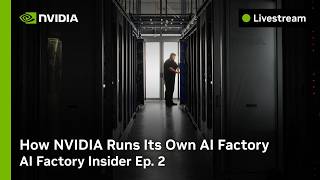
How NVIDIA Runs Its Own AI Factory | AI Factory Insider Ep. 2

How NVIDIA Runs Its Own AI Factory | AI Factory Insider Ep. 2

Nvidia's AI Factory Infrastructure Buildout — AI News | Agentic Brew