Moonshot AI's Kimi K3 launch and reception
TECH

Moonshot AI's Kimi K3 launch and reception

68+
Signals

Strategic Overview

  • 01.
    Moonshot AI launched Kimi K3, a 2.8-trillion-parameter open-weight mixture-of-experts model with a 1-million-token context window, on July 16, 2026, calling it the largest open-weight AI model released to date.
  • 02.
    K3 placed third on GDPval-AA v2 and scored 57 on the Artificial Analysis Intelligence Index - beating Claude Opus 4.8 and GPT-5.5 but trailing Claude Fable 5 and GPT-5.6 Sol - while topping the Frontend Code Arena outright.
  • 03.
    The launch triggered a broad AI and semiconductor stock selloff dubbed a 'second DeepSeek shock,' with Z.ai falling roughly 30%, TSMC dropping 7%, SoftBank down 9%, and Nvidia briefly losing its status as the world's most valuable company.
  • 04.
    Kimi K3 is live now via kimi.ai and the Kimi API at $3 per million input tokens and $15 per million output tokens, with full model weights scheduled for release under a Modified MIT license by July 27, 2026, and the model already wired into Cloudflare and Vercel AI gateways.

How Moonshot Built a Frontier Model Without Frontier Chips

Kimi K3 is Moonshot AI's largest model yet: 2.8 trillion total parameters spread across 896 experts, of which only 16 activate per token - roughly 1.8% of the pool. Layer that mixture-of-experts design on top of Kimi Delta Attention, a hybrid linear-attention mechanism paired with Attention Residuals, and the result is a model with native vision and a 1-million-token context window that still runs at a fraction of the compute a dense model this size would require [1].

That efficiency-first design is being read as more than an engineering choice. Coverage has framed the sparse activation pattern as Moonshot's way of maximizing capability under the compute ceiling U.S. export controls impose on Chinese labs, rather than simply buying more chips [2]. The payoff shows up in the numbers: K3 posted a GDPval-AA v2 score of 1,687 - third place, just behind Claude Fable 5 Max (1,815) and GPT-5.6 Sol Max (1,747.8) - and an Artificial Analysis Intelligence Index score of 57 [3]. It also topped the Frontend Code Arena outright, beating Claude Fable 5 in blind developer testing on web coding tasks [2].
The 'Second DeepSeek Shock' That Wasn't as Cheap as It Looked

The 'Second DeepSeek Shock' That Wasn't as Cheap as It Looked
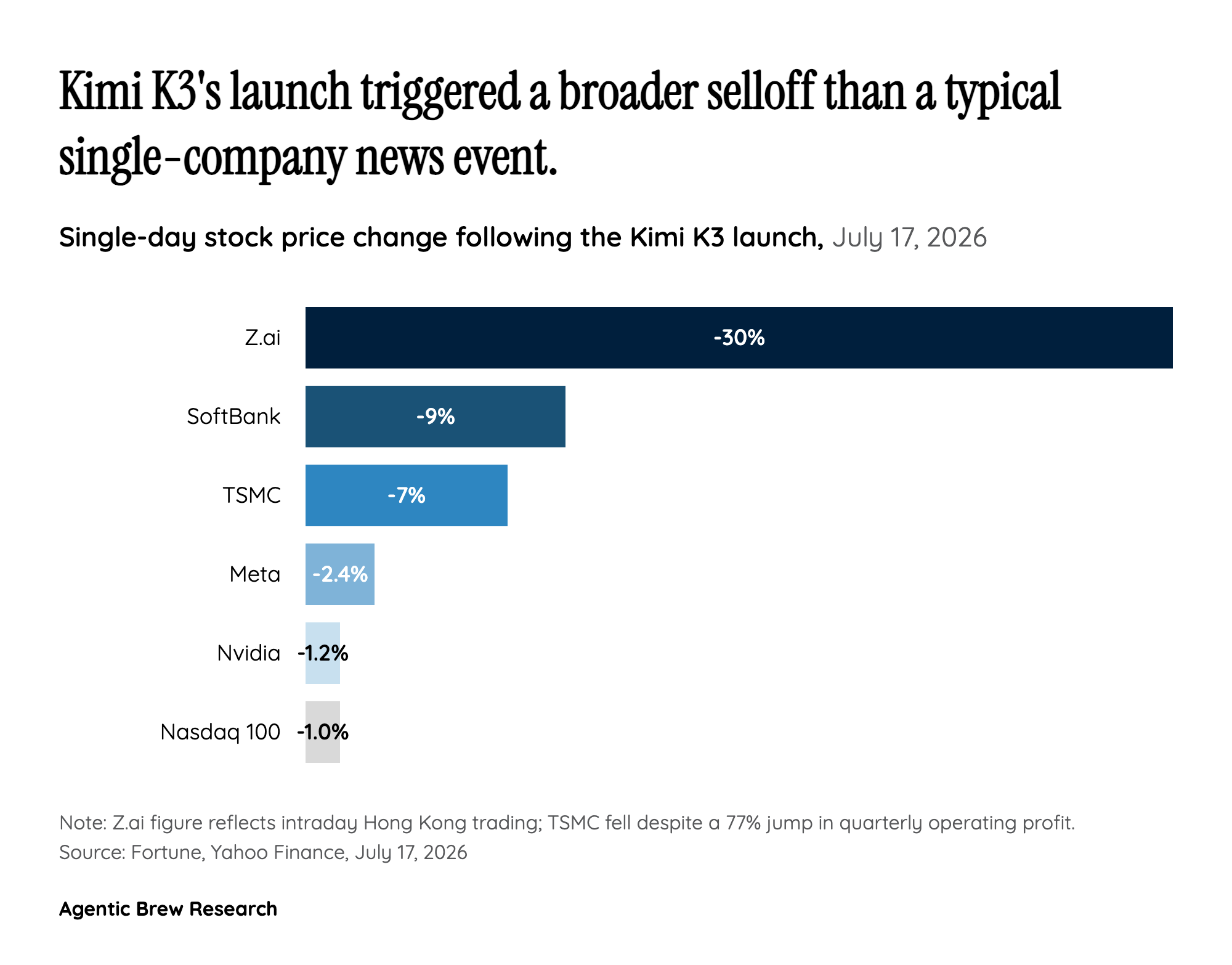
Single-day stock price change following the Kimi K3 launch, July 17, 2026. Source: Fortune, Yahoo Finance.

The market's reaction to K3 was immediate and violent. Z.ai's Hong Kong-listed shares fell as much as 30% - their largest single-day drop since the January listing - while TSMC dropped 7% despite reporting a 77% jump in quarterly operating profit, SoftBank fell 9%, and Nvidia briefly lost its title as the world's most valuable company to Apple [4]. Commentators reached instinctively for the same comparison: this looked like a repeat of January 2025, when DeepSeek's R1 undercut OpenAI's o1 pricing by roughly 25x and wiped about $590 billion off Nvidia's market cap in a single session [5].

The label does not quite fit, though. DeepSeek's shock came from radical cost efficiency - a model that was both good and drastically cheaper. K3 is neither small nor cheap: its API pricing of $3 per million input tokens and $15 per million output tokens sits in line with Western mid-tier models, and analysts note K3 is not actually cheaper per completed task than GPT-5.6 Sol Medium [5]. What spooked the market wasn't a price collapse - it was proof that an open-weight lab outside the U.S. frontier club could get this close on capability at all.

Why Wall Street's Panic Might Be Right for the Wrong Reason

If the 'second DeepSeek shock' framing overstates the pricing story, it may understate the structural one. Reed Albergotti argues that because Kimi's models now perform at or near the frontier, labs like Anthropic and OpenAI face a business model that is not sustainable in its current form - potentially forcing a shift away from publicly shipping frontier models and toward proprietary, vertically integrated software products instead [6].

Atreides Management CIO Gavin Baker frames the same dynamic from an investor's seat: increased competition at the model layer compresses the roughly 90% inference margins frontier labs have enjoyed, while every other layer of the stack - chipmakers, hyperscalers, neoclouds, and application-layer software companies - benefits from cheaper, more abundant intelligence [7]. That is a different read from 'China caught up.' It is closer to 'the model layer stopped being where the money is,' and it explains why a launch that didn't actually undercut frontier pricing still moved markets this hard.

The Distillation Question Nobody Can Fully Answer

Not everyone is convinced K3's jump reflects a clean research breakthrough. Anthropic has accused Chinese labs, including Moonshot, of running large-scale distillation campaigns that use exchanges with advanced American models as training data - and one widely circulated incident had K3 identify itself as 'Claude' mid-conversation, cited as circumstantial evidence, though Moonshot has neither confirmed nor denied Claude-specific distillation [8].

Community reaction splits along similar lines. Technical discussion among self-hosters has debated whether the leap from Kimi K2.6 to K3 reflects genuine research talent at Chinese labs or a mix of distillation and benchmark-specific tuning, with skeptics pointing to stylistic similarities between K3's coding output and Claude Fable 5's. Investors weighing in elsewhere have cautioned against reading too much into the comparison at all: unlike DeepSeek, K3 does not demonstrate the same efficiency advantage over frontier training runs - it shows China can train a competitive model roughly six months behind the U.S. frontier, a narrower claim than a genuine efficiency breakthrough.

Beijing's Timing Was Not an Accident

K3 didn't launch in a vacuum. Hours after Moonshot pushed the model live, Chinese President Xi Jinping used his keynote at the World Artificial Intelligence Conference to reject what he called a 'solo performance' model of AI development, calling instead for a 'symphony of global cooperation,' and promoting the newly formed World AI Cooperation Organization, which now counts 29 member countries [9].

The pairing reads as deliberate. A Chinese open-weight model landing within striking distance of the U.S. frontier, delivered the same week as a presidential pitch for China-led, open-source global AI governance, doubles as a rebuttal to the export-control regime that is supposed to be constraining exactly this kind of progress [10]. Whether or not K3 itself changes the balance of power, the optics were built to suggest that compute restrictions have a shelf life - and that open-weight releases are now part of China's diplomatic toolkit, not just its product roadmap.

Historical Context

2019
Completed his PhD at Carnegie Mellon in four years under Ruslan Salakhutdinov and William Cohen, authoring the XLNet and Transformer-XL papers before working at Google Brain and Meta.
2023-03
Founded by Zhilin Yang, Zhou Xinyu and Wu Yuxin, Tsinghua University schoolmates.
2025-01
DeepSeek's R1 release triggered the original 'DeepSeek shock,' undercutting OpenAI's o1 pricing by roughly 25x and wiping about $590 billion off Nvidia's market cap in a single session.
2026-05
Raised $2 billion at a valuation of more than $20 billion.
2026-07-16
Launched Kimi K3 late Thursday night, immediately compared to the original DeepSeek moment.
2026-07-17
Delivered a keynote at the World Artificial Intelligence Conference calling AI development a 'symphony of global cooperation,' timed alongside the K3 release.

Power Map

Key Players
Subject

Moonshot AI's Kimi K3 launch and reception

MO

Moonshot AI

Beijing-based startup that built and released Kimi K3; its decision to ship an open-weight model at this scale is what forced the frontier-lab comparison in the first place.

ZH

Zhilin Yang

Moonshot AI co-founder and CEO; a CMU-trained researcher behind XLNet and Transformer-XL, whose research credibility underpins Moonshot's claim that K3 reflects genuine capability rather than imitation.

AN

Anthropic

Frontier lab whose Claude Fable 5 / Opus 4.8 models serve as K3's benchmark and which has accused Chinese labs of distilling from its models, making it the loudest voice contesting K3's legitimacy.

OP

OpenAI

Frontier lab whose GPT-5.6 Sol / GPT-5.5 models are the other benchmark comparison point, and whose premium API pricing model is directly challenged by a near-frontier open-weight alternative.

Z.

Z.ai

Chinese AI rival whose Hong Kong-listed shares fell as much as 30% after K3's launch, its worst single-day drop since its January listing, showing the release reshuffled competitive standing within China too.

XI

Xi Jinping / World AI Cooperation Organization

Timed a WAIC keynote promoting China-led, open-source global AI governance alongside the K3 launch, turning a product release into a geopolitical statement about export controls and open-weight strategy.

Fact Check

13 cited
  1. [1] Kimi K3 - Moonshot AI
  2. [2] Moonshot releases 2.8 trillion parameter Kimi K3
  3. [3] Kimi K3 - Intelligence, Performance & Price Analysis
  4. [4] China's Kimi K3 launch triggers a broad AI stock selloff
  5. [5] Markets May Have Just Experienced a 'Second DeepSeek Shock'
  6. [6] Kimi K3 Threatens AI Business Models
  7. [7] Gavin Baker Says Kimi K3 Is Bad For Anthropic And OpenAI But Good For Others
  8. [8] China's Kimi K3 Stokes Anthropic Distillation Concerns
  9. [9] Xi Jinping Rejects AI 'Solo Performance' By One Country As China's Kimi K3 Lands To Challenge OpenAI, Anthropic
  10. [10] Xi Jinping Pitches AI Cooperation Organization in Shanghai
  11. [11] Kimi K3 - Cloudflare AI Models
  12. [12] Kimi K3 is now available on AI Gateway
  13. [13] Kimi K3 Is Live: Pricing, Benchmarks

Source Articles

Top 5

THE SIGNAL.

Analysts

"Calls K3 a potential inflection point that is negative for Anthropic and OpenAI's inference margins but net positive for the rest of the AI stack - chips, hyperscalers, neoclouds, and software."

Gavin Baker
CIO, Atreides Management

"Argues frontier labs face real pressure because Kimi's models now perform at or near the frontier, and that this is not sustainable for labs relying on publicly selling frontier-model access."

Reed Albergotti
AI industry analyst

"Cautions against overstating the DeepSeek comparison, noting K3 is neither cheap nor small and shows China can train a competitive model roughly six months behind the frontier - not the same efficiency leap DeepSeek demonstrated."

Steven Lubka
Investor/commentator

"Ran his 'SVG pelican riding a bicycle' benchmark on K3 and found its vision output and generated image a notable improvement over Kimi 2.5, while flagging real per-task token cost as a practical consideration."

Simon Willison
Independent developer and AI blogger
The Crowd

"Meet Kimi K3 https://t.co/ou00Av3VoS"

@@Kimi_Moonshot27130

"Kimi K3 scores 57 on the Artificial Analysis Intelligence Index. Its intelligence is comparable to Opus 4.8 and GPT-5.5 but remains behind Fable 5 and GPT-5.6 Sol. Moonshot AI has expressed plans to release the 2.8T parameter model's weights, which would make it the leading open"

@@ArtificialAnlys5895

"Kimi K3 may be an important inflection point for AI. Potentially negative for Anthropic and OpenAI while being net positive for essentially every other company in the world. I mean that very literally. Although the real “Sputnik moment” would be an open-source frontier model that"

@@GavinSBaker5450

"Kimi-K3 arrived: The era of the Chinese labs being far behind is over"

@u/AloneCoffee45381949
Broadcast
Kimi K3 Is Fable Level... (they should be worried)

Kimi K3 Is Fable Level... (they should be worried)

Kimi K3 Is INSANE – Is THIS a Sol & Fable Competitor?

Kimi K3 Is INSANE – Is THIS a Sol & Fable Competitor?

I Tested Kimi K3 So You Don't Have To...

I Tested Kimi K3 So You Don't Have To...