OpenAI's proposed 5% US government equity stake
TECH

OpenAI's proposed 5% US government equity stake

36+
Signals

Strategic Overview

  • 01.
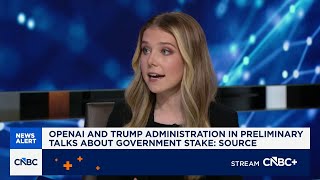
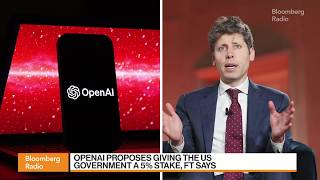
    OpenAI has reportedly proposed handing the US government a 5% ownership stake in the company to defuse mounting political pressure in Washington, according to a Financial Times report first covered on July 2, 2026.
  • 02.
    The 5% holding would be worth roughly $42.6 billion based on OpenAI's $852 billion valuation from its March 2026 funding round.
  • 03.
    The plan envisions the equity being held in a sovereign wealth fund modeled on the Alaska Permanent Fund, and calls for other leading US AI firms - Anthropic, Google and Meta among them - to cede a similar 5% cut, creating a government-owned slice of the whole US AI industry.
  • 04.
    The discussions are described as conceptual and early-stage, implementing any deal might require an act of Congress, and it is unclear whether rival AI companies would agree.

Deep Analysis

Insurance, Not Altruism: Why the Offer Landed Now

The timing is the tell. OpenAI floated the 5% stake just days after Washington delayed OpenAI's GPT-5.6 rollout and forced restrictions on Anthropic's models over national security concerns [1]. Read against that backdrop, the equity offer looks less like a spontaneous act of generosity and more like a bid to defuse mounting political pressure and regulatory scrutiny [2]. Pressure had been building on other fronts too, as Washington grew warier of cybersecurity vulnerabilities in frontier models and rising competition from Chinese open-source systems [3].

Altman's public framing is that giving the public a financial interest in the company is the best way to share the upside of AI, an extension of the 'Public Wealth Fund' concept OpenAI floated in April 2026 [3]. But the sequence - restriction first, offer second - is what fuels the skeptics. If the point of the stake were purely to spread prosperity, it would not need to arrive the same week regulators were tightening the screws. The more coherent reading is a trade: partial ownership in exchange for a lighter regulatory touch and a friendlier posture toward the next model release.

The Referee Buys Into the Team

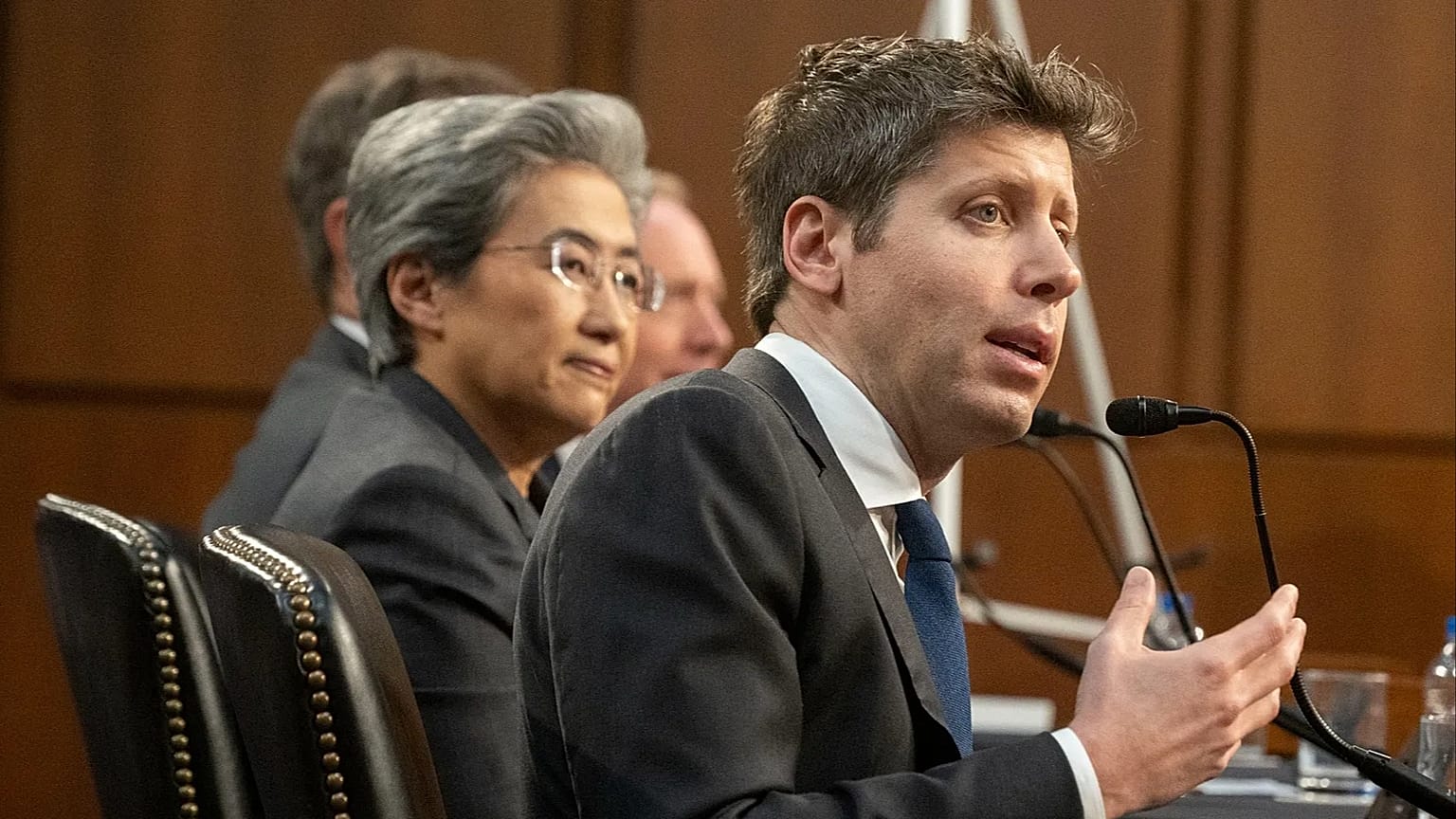
The sharpest objection is structural, and it dominated community discussion: a government that owns a slice of an AI company also regulates that company, and the two roles pull in opposite directions. Reddit framed it bluntly as a referee owning part of a team - a built-in conflict of interest where the state now has a financial incentive to see OpenAI win, even as it is supposed to police it. The same threads read the offer as a de facto bribe or a case of regulatory capture, and drew a pointed distinction between 'the government' owning equity in the abstract and 'this administration' controlling it in practice.

There is a milder, defense-side version of the same debate. Proponents argue equity aligns incentives the way a CEO's own stock does, and point to precedents like state minority stakes in TSMC in Taiwan and Samsung in South Korea. But the crux both camps keep returning to is structure: an arm's-length sovereign wealth fund on the Alaska model, paying out broad citizen dividends, is far more palatable than direct Treasury ownership that hands the sitting executive branch a lever over a company it also regulates. Notably, several critics argued the ordinary mechanism for a company to fund the public already exists - it is called taxes.

The Math That Undercuts 'Share the Wealth'

The Math That Undercuts 'Share the Wealth'
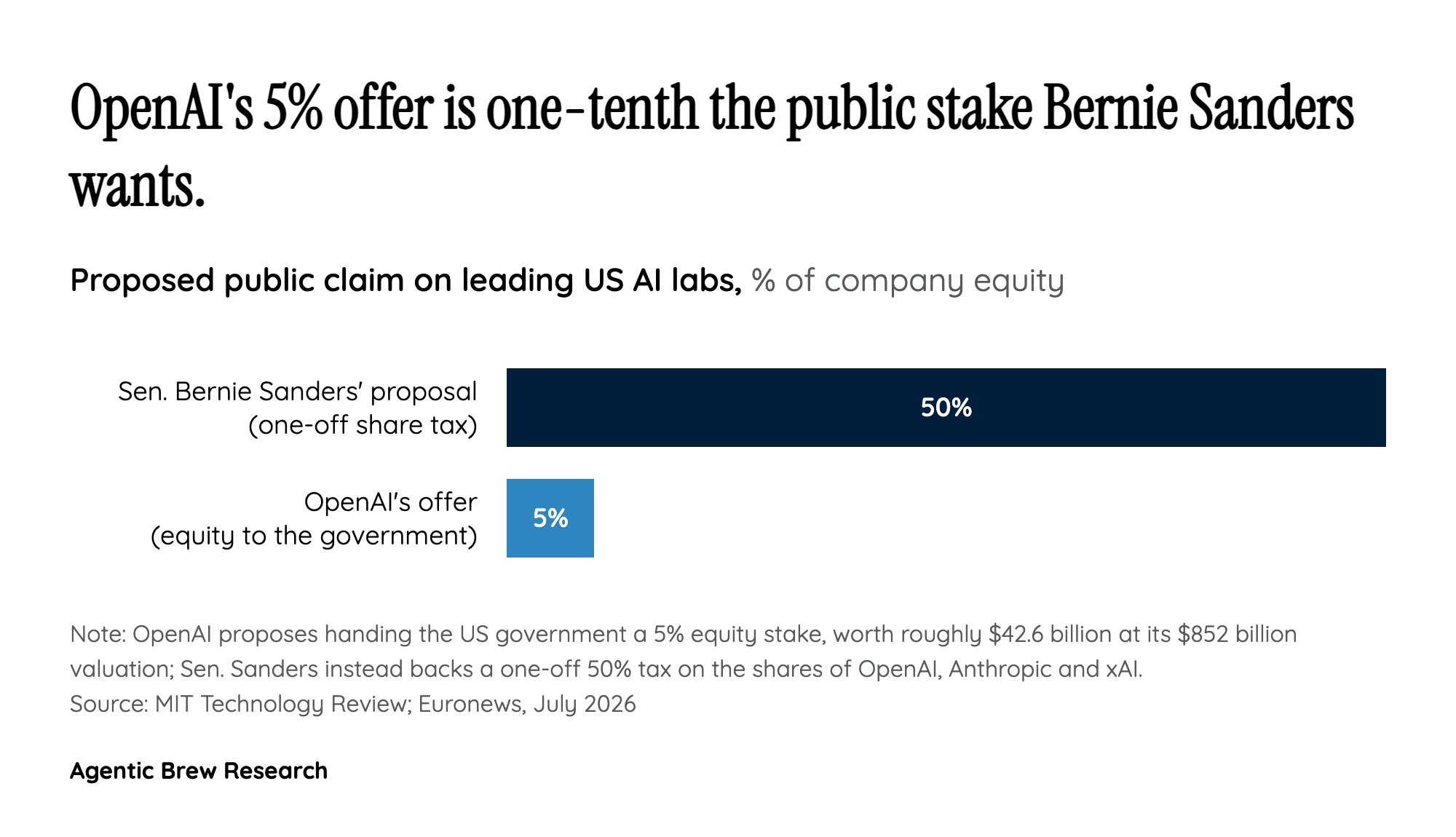
OpenAI proposes a 5% government stake; Sen. Bernie Sanders backs a far larger 50% claim on the leading AI labs.

The headline number is large and the per-person number is not. If the ~$42.6 billion stake were ever distributed equally across roughly 133 million US households, it would come to about $320 per household [4]- a one-time figure that critics say hollows out the 'share the wealth' pitch. That gap between the billions in the headline and the few hundred dollars per family is exactly why the framing draws suspicion rather than gratitude.

The proposed vehicle sets expectations it may struggle to meet. The stake would sit in a sovereign wealth fund modeled on the Alaska Permanent Fund, which channels state oil revenues into annual resident dividends and was valued at roughly $91.2 billion as of late May [5]. Alaska's fund pays out because it holds diversified, income-producing assets accumulated over decades; a single pre-IPO equity slice in one AI company is concentrated, illiquid, and speculative by comparison. And to Sanders, even the full 5% is far too little: he has pushed instead for a one-off 50% tax on the shares of the leading labs [2].

The Global Boomerang Washington May Not See Coming

The second-order risk lives outside US borders. Analysts warn that a pre-IPO government stake could backfire internationally, with foreign jurisdictions demanding analogous equity arrangements as a condition for market access [1]. If Washington normalizes the idea that a national government should hold a slice of its home-grown AI champions, other governments can invoke the same logic to extract their own cut - or to justify shutting American models out.

The deeper cost is trust. The same analysis warns the arrangement could force European and Asian enterprise buyers to reassess the data sovereignty and neutrality of US AI providers [1]. An enterprise customer in Frankfurt or Singapore evaluating a US model already weighs where its data flows; a US government equity position gives that customer a concrete reason to ask whether the provider now answers to Washington. For a business staking billions on being the world's default AI layer, a stake meant to buy domestic goodwill could quietly erode the international neutrality that made the product exportable in the first place.

Historical Context

2025-01
Altman first pitched the concept of a government stake directly to the Trump administration, beginning more than a year of talks.
2026-03
OpenAI closed a funding round at an $852 billion valuation, the basis for the ~$42.6 billion figure attached to a 5% stake.
2026-04
OpenAI published a policy document proposing a 'Public Wealth Fund' to hold assets capturing AI growth and give Americans an automatic stake in AI companies and infrastructure.
2026-07-02
The FT reported the 5% stake proposal, prompting wide coverage across major outlets.

Power Map

Key Players
Subject

OpenAI's proposed 5% US government equity stake

OP

OpenAI / Sam Altman

The company proposing the stake, with Altman first pitching the concept to the Trump administration in early 2025 and engaging administration officials directly since. If OpenAI withdrew the offer, the entire framework collapses.

PR

President Donald Trump

Head of the administration that would receive the stake and the authority whose regulatory pressure the deal aims to relieve; he reportedly described the idea favorably.

CO

Commerce Secretary Howard Lutnick and Treasury Secretary Scott Bessent

Administration officials involved in the talks who would help design and administer any government holding, giving the executive branch operational control over how the stake is structured.

SE

Sen. Bernie Sanders (I-Vt.)

A leading legislative critic who dismisses the 5% offer as too small and pushes a far larger public claim, shaping the left-flank political ceiling on any eventual deal.

AN

Anthropic, Google and Meta

Rival AI leaders the proposal expects to cede matching 5% stakes; their assent or refusal determines whether this becomes an industry-wide arrangement or an OpenAI-only concession.

Fact Check

5 cited
  1. [1] OpenAI Proposes 5% Federal Government Stake to Defuse Regulatory Pressure
  2. [2] OpenAI offers the US government a 5% ownership stake
  3. [3] OpenAI proposes US government own 5% stake to address political blowback
  4. [4] Your family's $300 stake in OpenAI
  5. [5] OpenAI Reportedly Pitches Granting US Government 5% Stake

Source Articles

Top 5

THE SIGNAL.

Analysts

"Dismissed Altman's proposal as a watered-down alternative to real public ownership and instead wants a one-off 50% tax on the shares of OpenAI, Anthropic and xAI to compensate for the industry's unauthorized use of human data."

Sen. Bernie Sanders
US Senator, I-Vt.

"Warn that a pre-IPO government stake could backfire globally, with foreign jurisdictions demanding analogous equity for market access and pushing European and Asian enterprise buyers to reassess the data sovereignty and neutrality of US AI providers."

Techstrong.ai industry analysts
Industry analysts, Techstrong.ai

"Argues that after roughly five years of on-and-off discussion no concrete plan has materialized and public skepticism of AI companies is high, so these proposals currently function more as a story than a policy."

MIT Technology Review
The Crowd

"OpenAI proposes handing Trump administration 5% stake"

@@FT679

"OpenAI has proposed handing the U.S. government a 5% stake in the company, the Financial Times reported Thursday, as the artificial intelligence startup seeks to defuse mounting political pressure in Washington. A 5% holding would be worth roughly $42.6 billion, after the AI lab..."

@@CNBC130

"OpenAI wants to give the US government a 5 percent stake in OpenAI and charge nothing for it. The public-benefit pitch is the wrapper. When the government took its stake in Intel last year, it paid 8.9 billion dollars in cash for the shares. OpenAI is proposing the reverse."

@@buckintosh0

"OpenAI reportedly proposed giving the Trump administration 5% stake in the company"

@u/Outside-Iron-8242510
Broadcast
OpenAI Just Offered The Government $42 Billion. This Is The Real Reason.

OpenAI Just Offered The Government $42 Billion. This Is The Real Reason.

Here's why OpenAI could want the U.S. government to take a stake in AI firms

Here's why OpenAI could want the U.S. government to take a stake in AI firms

OpenAI Proposes Giving the US Government a 5% Stake, FT Says

OpenAI Proposes Giving the US Government a 5% Stake, FT Says