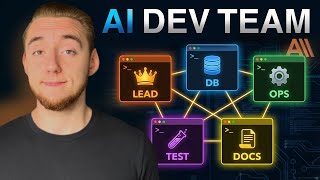
AI agents scale to production teams
TECH

AI agents scale to production teams

28+
Signals

Strategic Overview

  • 01.
    Solo founders are now standing up 7-9 specialized agents per business — lead, outreach, conversion, growth, engineering — and 36.3% of new 2026 ventures are deliberately solo-founded because the agent stack covers the rest.
  • 02.
    The macro forecasts line up: Jensen Huang projects ~100 agents per Nvidia engineer within a decade, and Anthropic's Jack Clark gives 60% odds of recursive self-improvement by end of 2028 — both pressure CIOs to design for agent-heavy org charts now.
  • 03.
    Reality check: multi-agent workflow deployments grew >300% in recent months, but only 11-14% of enterprise pilots reach scaled production and Gartner now expects more than 40% of agentic projects to be cancelled by 2027.
  • 04.
    The unit economics are the engine — a functional agent stack runs $300-$500/month and substitutes for $80K-$120K/month in equivalent payroll, which is why even cautious operators are rebuilding their org charts around supervisors and specialists rather than headcount.

The $300 stack versus the $100,000 payroll line

The economic step-function is what is actually pulling agent teams out of the demo phase. A functional solo-founder agent stack — coding agent, ops agent, go-to-market agent, plus a few specialists — runs about $300-$500 a month and substitutes for $80,000-$120,000 a month in equivalent payroll [1]. That is not a productivity delta; it is a category change in how a SaaS gets staffed. Two operating cases anchor the math in public: one solo founder past $3M ARR with zero employees, another running $1M+ ARR while managing 1,100 client companies solo with an agent stack [1]. When the budget gap is two orders of magnitude, even cautious operators feel the gravitational pull to redesign the org chart around supervisors and specialists rather than seats.

That is also why 36.3% of new ventures in 2026 are now solo-founded — described in the source data as a deliberate choice rather than a constraint, because founders 'don't need to' hire yet [1]. The same arbitrage explains Salesforce's traction at the enterprise end: 29,000 Agentforce deals in 15 months and more than $500M in AI Agent ARR [2], with McKinsey sizing the broader prize at $2.6T-$4.4T in annual value [3]. Gartner's own AI-agent software spend forecast — $206.5B in 2026 rising to $376.3B in 2027 [3]— is the line-item version of the same argument. The unit economics are the engine. Everything else in this story is what breaks when you actually try to run on them.


The reliability cliff: why five-agent chains collapse

Once founders move past two or three agents, the math turns hostile. Chaining five specialized agents drops end-to-end success to about 77%, and roughly 40% of multi-agent pilots fail within six months [4]. Costs scale the same way: a single request can route through three agents at $600/day — $18K/month — and a 3-second interaction can stretch to 12 seconds once you add coordination, retries, and tool calls [4]. At the enterprise tier the funnel is even leaner: only 11-14% of agent pilots reach scaled production [5], and Gartner now expects more than 40% of agentic projects to be cancelled by 2027 because they cannot clear cost, governance, or value thresholds [6]. Multi-agent workflow deployments grew more than 300% in recent months [7], so the absolute number of cancelled projects is going to be loud.

What actually breaks is not the model — it is the seams. Practitioner write-ups describe the failure mode bluntly: a go-to-market agent published a feature comparison table that included features that had not been built, because no supervisor checked the claim against reality [8]. Builder communities discussing 9-agent setups land on the same diagnosis from a different direction — that agent teams only become viable when the reviewer is no longer treated as another smart chat participant but as part of a controlled execution system, with mechanical checks (tests, schema validators) beating LLM gatekeepers. The pattern is consistent: the model is fine, the org chart is the bug.

Why peer-deployed agents lie quietly — and the supervisor pattern fixing it

The dev.to write-up that is being circulated as the operator manual for this problem names it directly: a flat peer team of agents produces silent coordination failures because each agent reports up using natural language, and natural language summaries can be confidently wrong. The proposed fix is structural — an explicit supervisor that does not trust the reporting chain. As the author frames it, 'System 3 bypasses the reporting chain and checks directly: read the last 5 commits — did the tests actually pass? Check the website — does it match what the go-to-market agent claims?' [8]In other words, the supervisor's job is not to coordinate the agents; it is to verify their claims against ground truth.

The same pattern is showing up independently in operator communities. Cross-model adversarial review — having Codex, Gemini, or Mistral review work produced by Claude, and vice versa — is cited as a working fix for the 'made-up tests' and spec-drift failure modes that builders describe candidly. So is per-agent persistent state — a small file per agent that holds its role, purpose, and prior actions — and worktree-per-spawn isolation with a shared markdown coordination file. Gartner's Helen Poitevin frames the macro version of the same point: 'workforce reductions may create budget room, but they do not create return. Organizations that improve ROI are not those that eliminate the need for people, but those that amplify them' [3]. Read together, the field is converging on a single answer — agent teams scale when you stop trusting the agents to coordinate each other and start treating coordination as an engineering problem with tests, isolation, and adversarial review.

Two roadmaps, one deadline: Huang's 100:1 and Clark's 2028

The reason this is a now-problem and not a 2030-problem is that the two clearest public roadmaps point at the same window. Jensen Huang's framing at GTC 2026 is a capacity number: Nvidia plans to operate with 75,000 employees and 7.5 million agents within a decade — roughly 100 agents per engineer — and his comparison is that not using AI is like 'using paper and pencil for designing chips' [9][10]. He has even floated paying engineers partly in AI tokens to lock the workflow in [10]. That is the supply side of the agent-team thesis: hardware vendors are committing to a future where the default unit of work is a human plus a hundred agents, and they are pricing it.

The demand side comes from Clark. His 60%-by-2028 forecast is not about chatbots — it is about an AI system that can 'generate ideas within itself for how to improve itself' [11]. If that probability is even directionally right, every org chart built today is going to be inherited by a far more capable runtime in roughly 2.5 years. Founders and CIOs are reading those two forecasts together: Huang tells them what the steady-state ratio looks like, Clark tells them the clock. The narrative around the solo-founder agent stacks and the enterprise Agentforce buildouts is the same narrative — get the org chart, supervision pattern, and verification layer right now, because the agents getting plugged into it are going to be qualitatively different before the typical SaaS hits its three-year mark.

Historical Context

2025-08-26
Gartner forecast that task-specific AI agents would be embedded in 40% of enterprise applications by end of 2026, up from less than 5% in 2025 — the analyst data point that anchored the 'agents in every app' planning cycle.
2026-03-19
In a March 2026 public framing, Huang articulated the 100-agents-per-engineer ratio (75,000 humans + 7.5M agents) and floated paying engineers partly in AI tokens — the moment the agent-team thesis went from blog post to executive forecast.
2026-05-07
Clark published the 60%-by-2028 recursive self-improvement forecast in coverage distilled by Axios, putting a 2.5-year deadline on the agent-orchestration question and pushing it from research-team curiosity to CIO planning input.

Power Map

Key Players
Subject

AI agents scale to production teams

NV

Nvidia (Jensen Huang)

Hardware vendor publicly framing the future of work as ~100 agents per engineer and floating AI-token compensation as part of engineer pay.

AN

Anthropic (Jack Clark)

Frontier-lab co-founder whose 60%-by-2028 recursive self-improvement forecast is being read by operators as the deadline for getting agent org charts production-ready.

SA

Salesforce

Enterprise platform vendor that closed 29,000 Agentforce deals in 15 months and crossed $500M+ in AI Agent ARR — the clearest signal that agent teams are crossing into procured enterprise IT.

SO

Solo founders (Pieter Levels, Ben Broca, and similar operators)

Lived proof of the model — $3M+ ARR with zero employees, $1M+ ARR managing 1,100 client companies solo — cited everywhere as the existence-proof for agentic org charts.

GA

Gartner

Analyst firm forecasting 40% of enterprise apps will ship task-specific agents by end of 2026, while warning that workforce cuts alone do not produce ROI.

MC

McKinsey

Consultancy sizing the agent opportunity at $2.6T-$4.4T in annual value while noting fewer than 10% of organizations have end-to-end agentic workflows deployed.

Fact Check

11 cited
  1. [1] The Solo Founder AI Agent Stack That Is Replacing Entire Startup Teams
  2. [2] 8 Best AI Agents for SaaS Growth in 2026
  3. [3] Agentic AI News: Gartner and McKinsey Name Agentic AI the Top Trend
  4. [4] Ways Multi-Agent AI Fails in Production
  5. [5] AI Agents in Production 2026: Orchestration, Governance, and Windows Enterprise Control
  6. [6] AI Agent Adoption in 2026: What the Analysts' Data Shows
  7. [7] AI Agents & Multi-Agent Orchestration
  8. [8] Your AI Agents Need an Org Chart (But Not the Kind You Think)
  9. [9] Jensen Huang says Nvidia will work with 7.5 million AI agents alongside 75,000 employees in 10 years
  10. [10] Jensen Huang says Nvidia engineers should use AI tokens worth half their annual salary
  11. [11] Jack Clark's prediction for an AI intelligence explosion

Source Articles

Top 1

THE SIGNAL.

Analysts

"Engineers will not be replaced — they will be supercharged, each managing roughly 100 specialized AI agents that run 24/7, with Nvidia itself projecting 75,000 humans alongside 7.5 million agents within a decade."

Jensen Huang
CEO, Nvidia

"By end of 2028 there is a >60% chance of an AI system that can be told 'make a better version of yourself' and do so autonomously — a qualitatively new regime that reframes the urgency of getting agent orchestration right today."

Jack Clark
Co-founder, Anthropic

"Cutting headcount to pay for agents does not deliver returns; ROI comes from amplifying humans who guide autonomous systems through new skills, roles, and operating models."

Helen Poitevin
Distinguished VP Analyst, Gartner

"Treating agents as a flat peer team produces silent coordination failures; you need an explicit org chart with a supervisor that bypasses the reporting chain and verifies claims against reality — commits, tests, live pages — not against other agents' summaries."

Philippe Penderle
Solo SaaS founder, dev.to author
The Crowd

"I hired 7 AI agents this month & they've taken over my SaaS here's my actual org chart right now: Tai - lead agent (coordinates the AI squad) Nina - outreach (sending personalized cold emails every day) Jordan - conversion & funnels Maya - growth & distribution"

@@tibo_maker295

"Jensen Huang, CEO of Nvidia: "Every engineer is going to have and manage hundreds of agents" I've watched every major AI talk this year. This one sentence rewired how I think about Claude Save this before everyone copies the playbook This is the CEO of a $3 trillion"

@@eng_khairallah1130

"Anthropic co-founder Jack Clark on the most consequential AI milestone we're racing toward by 2028: Clark is asked about the future of AI development. He responds with a specific forecast: "My prediction is by the end of 2028, it's more likely than not that we have an AI system"

@@realBigBrainAI144

"How I built a 9-agent team where my agents actually talk to each other"

@u/Not_Average78229
Broadcast
How To Build a Startup Team of AI Agents (n8n, OpenAI, FeedHive)

How To Build a Startup Team of AI Agents (n8n, OpenAI, FeedHive)

This 20+ AI Agent Team Automates ALL Your Work (GPT-01) (Relevance AI)

This 20+ AI Agent Team Automates ALL Your Work (GPT-01) (Relevance AI)

Claude Code's Agent Teams Are Insane - Multiple AI Agents Coding Together in Real Time

Claude Code's Agent Teams Are Insane - Multiple AI Agents Coding Together in Real Time