Nvidia concedes China AI chip market to Huawei
TECH

Nvidia concedes China AI chip market to Huawei

48+
Signals

Strategic Overview

  • 01.
    Nvidia CEO Jensen Huang told CNBC alongside Q1 FY2027 earnings on May 21, 2026 that Nvidia has 'largely conceded' China's AI chip market to Huawei.
  • 02.
    Nvidia reported zero China-related data center revenue and shipped no Hopper products into China for the quarter, versus $4.6 billion in the same period a year earlier, even as total revenue hit $81.6 billion up 85% YoY.
  • 03.
    Huang told investors to 'expect nothing' regarding near-term approvals to sell advanced Nvidia AI chips into China.
  • 04.
    On May 22, 2026 Taiwan's Keelung District Prosecutors' Office moved to detain three Taiwanese men for allegedly forging documents to ship Super Micro AI servers containing Nvidia chips to Hong Kong, Macau and mainland China, the island's first formal semiconductor-smuggling crackdown.
  • 05.
    Investigators executed search warrants at 12 locations on May 21, 2026, seized about 50 AI servers equipped with advanced Nvidia chips and recovered NT$9 million in cash.
  • 06.
    On arrival in Taipei the next day, Huang publicly urged Super Micro to tighten compliance with US export controls in light of the Taiwan detentions.
  • 07.
    Alongside the China concession, Huang positioned the new Vera CPU line as opening a 'brand new' $200 billion total addressable market for Nvidia, with CFO Colette Kress guiding to $20 billion in 2026 CPU revenue.

Deep Analysis

The Concession Is Bidirectional — China Is Refusing What Nvidia Can Legally Sell
The Concession Is Bidirectional — China Is Refusing What Nvidia Can Legally Sell
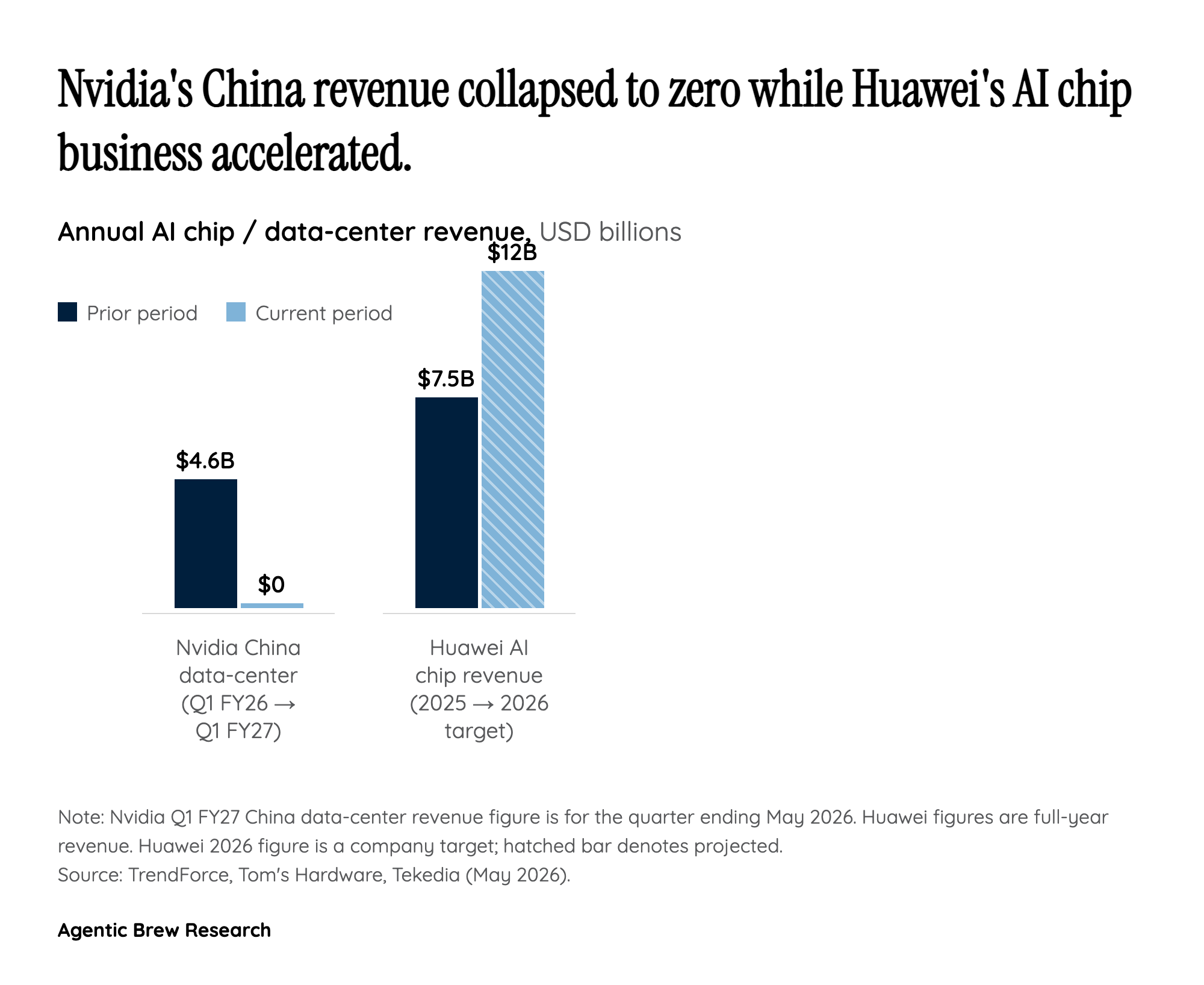
Nvidia's China data-center revenue collapsed from $4.6B (Q1 FY26) to $0 (Q1 FY27) while Huawei guided to a $7.5B → $12B AI chip revenue jump.

The headline most outlets ran with — 'Nvidia concedes China to Huawei' — buries the more striking half of the story: China is also conceding Nvidia. After the Trump administration cleared H200 exports under a 25% surcharge in December 2025 and formalized the policy by proclamation on January 14, 2026 [4], Beijing instructed domestic firms to stop buying the previous-generation H20 over national-security concerns [5]. The result is a zero on Nvidia's quarterly China data center line that no longer reflects what Washington forbids — it reflects what Beijing refuses. Nvidia reported $0 in China-related revenue versus $4.6 billion in the same quarter a year earlier, and shipped no Hopper-family products into the country at all [2].

This matters because it changes the policy lever. If China were a willing buyer blocked only by US rules, partial relicensing (H200 with a surcharge, H20 with a license) would unlock real revenue. Instead, the demand side has been politically captured. Industry commentary on the May 21 print converged on the same read: Stacy Rasgon at Bernstein told CNBC the ban 'effectively hands' the AI market to Huawei [3], while Huang's own line to investors — 'expect nothing' on near-term approvals — implicitly acknowledges that even if the door reopens, the room is empty [1]. Morgan Stanley pegs China's AI chip market at $67 billion by 2030 [6], and Nvidia is now structurally outside it.


Huawei's Real Threat Isn't Silicon — It's CANN Eating CUDA's Moat

CFR's Chris McGuire is correct in narrow terms: Huawei's per-chip performance trails Nvidia roughly 5x today and could widen to 17x by 2027 on raw FLOPS [7]. But that framing misses where the lock-in war is actually being fought. Huawei's CANN software stack is increasingly positioned as a drop-in replacement for CUDA, and the 950PR is projected to take roughly 60% of China's domestic AI accelerator demand [8]. SMIC remains the practical ceiling — yields reported at 50-60% versus TSMC's 80-90% [8]— but inside that ceiling, the software story is moving faster than the silicon story.

The per-chip gap also gets narrowed by cluster-scale engineering. Huawei's Atlas 950 SuperCluster paired with the HCCS interconnect closes part of the gap at training-cluster scale, and the DeepSeek lineage compounds this: DeepSeek-V4 was reportedly tuned for Ascend 950PR [8]. The strategic implication is that CUDA's moat — the real reason Nvidia commanded 95% China share before controls — is being deliberately retired inside China's borders. Bernstein's January 2026 estimate already had Nvidia and Huawei tied at ~40% each in China [3]. By Q1 FY2027 that balance has snapped, and the snap is software-driven as much as silicon-driven.

Vera And The $200B Pivot — Why The Stock Doesn't Care

Nvidia's stock didn't break on the China zero because the company simultaneously reframed itself as a CPU company. Huang announced that the Vera CPU line opens a 'brand new' $200 billion total addressable market 'we have never addressed before, and every major hyperscaler and system maker is partnering with us to deploy it' [1]. CFO Colette Kress guided to $20 billion in 2026 Nvidia CPU revenue [2], and the company paired the print with an $80 billion buyback authorization [1]. Total revenue still printed $81.6 billion, up 85% year-over-year [2]. The market read: lose a $4.6B-per-quarter China datacenter business, replace it with a multiple of that in datacenter CPUs sold into the same hyperscalers Nvidia already owns on GPU.

This is the cleanest explanation for why Bernstein's Rasgon can simultaneously say China was 'handed to Huawei' and that Nvidia stock keeps working [3]: non-China demand is supply-constrained, not demand-constrained, so the dollars Nvidia can ship anywhere it wants are still gated by capacity. The Vera pivot is also a strategic answer to the lock-in story above — if CUDA is being decoupled inside China, Nvidia's response is to deepen the rack-level integration story (CPU + GPU + interconnect + NVLink) outside it, where lock-in still compounds. The China line item becomes a rounding error against a $20B-and-growing CPU business that didn't exist a year ago.

The Smuggling Map Is Being Audited: From DOJ To Taiwan Prosecutors

The Taiwan detentions are not an isolated enforcement event. They are a new node in a smuggling map that has surfaced in the last fourteen months. The US DOJ arrested Super Micro co-founder Wally Liaw in March 2026 over an alleged $2.5 billion ring routing Super Micro/Nvidia servers through Taiwan, Thailand and Hong Kong to mainland China between 2024 and 2025 [9].

Against that backdrop, Taiwan's Keelung District Prosecutors' Office raiding 12 sites, seizing ~50 AI servers and NT$9 million in cash, and moving to detain three men named You, Wang and Chen on May 22 [10]reads as the first formal Taiwan-side enforcement of US controls on its own soil — a sovereignty signal as much as a criminal case. Huang's response, telling reporters in Taipei that Super Micro 'has to run their own company' and urging it to 'enhance and improve their regulation compliance' [11], is the public part of what is almost certainly a private message to every Nvidia OEM partner: the perimeter is being audited, the prosecutors are now on it, and your access to allocation depends on your paperwork. The grey market that propped up Nvidia's de facto China shipments through 2024-2025 is being closed from the supply side at the same time the demand side disappears.

Self-Inflicted Wound Or Working As Designed? The Policy Verdict

Two competing readings of the same data dominate expert commentary. CFR's McGuire frames the outcome as proof the controls are working: Huawei is bottlenecked by SMIC yields reported at 50-60% versus TSMC's 80-90% [8], the per-chip performance gap is widening not narrowing, and pushing China onto a slower domestic stack is precisely the desired outcome [7]. Reuters/IDC data via Medium shows Nvidia's China accelerator share fell from 95% to 55% across 2025 [12]— under the McGuire reading, that is exactly what successful denial looks like. The American Action Forum framing of the 25% H200 surcharge as a 'political tax' [4]adds a fiscal dimension: even where sales are allowed, they're now revenue events for the US Treasury.

The contrarian read is that controls accelerated the very capability they were meant to suppress. Huawei's $7.5B-to-$12B revenue jump year-over-year [6]and the DeepSeek-V4-on-950PR pivot [8]describe an ecosystem that has industrialized rather than stagnated. Even Bernstein's January 2026 read of a 40/40 split [3]implies parity reached faster than the McGuire timeline assumed. The honest synthesis is that both can be true: per-chip leadership remains American, but ecosystem control inside China has shifted irrevocably, and the question for the next four years is whether that ecosystem stays bounded by Chinese borders or starts winning third-country deals — which is the scenario in which McGuire's read fails and the contrarians' wins.

Historical Context

2022-10-01
Washington began restricting exports of advanced semiconductors and chipmaking equipment to China, prompting Nvidia to develop China-specific variants A800, H800 and later H20.
2025-04-09
Trump administration effectively bans H20 exports to China; Nvidia disclosed up to ~$5.5 billion in Q1 charges tied to H20 inventory and purchase commitments.
2025-07-01
Reapproves H20 sales under a licensing regime; China subsequently instructs domestic firms to stop buying H20s citing security concerns, turning the policy reversal into a no-op for revenue.
2025-12-09
Trump announces Nvidia can sell the more powerful H200 to China subject to a 25% surcharge; formalized by proclamation on January 14, 2026.
2026-03-19
Co-founder Yih-Shyan 'Wally' Liaw arrested and charged in an alleged $2.5B smuggling ring routing Super Micro/Nvidia servers through Taiwan, Thailand and Hong Kong to mainland China between 2024 and 2025.
2026-05-21
Nvidia reports $81.6B quarterly revenue (+85% YoY) but $0 China data center revenue; Huang publicly concedes China to Huawei on CNBC.
2026-05-22
Taiwan launches its first formal semiconductor-smuggling crackdown, seeking detention of three Taiwanese men over forged exports of Super Micro/Nvidia AI servers to Hong Kong.
2026-05-23
Huang publicly urges Super Micro to tighten regulatory compliance in response to the Taiwan detentions.

Power Map

Key Players
Subject

Nvidia concedes China AI chip market to Huawei

NV

Nvidia / Jensen Huang

US AI accelerator vendor whose advanced chips are restricted from sale to China; publicly conceding the market while pivoting to a $200B Vera CPU TAM and an $80B buyback.

HU

Huawei

Dominant Chinese AI accelerator supplier via the Ascend line (910C, 950PR), targeting ~$12B AI chip revenue in 2026 on roughly 750,000 planned units.

SU

Super Micro Computer (SMCI)

US server OEM whose Nvidia-powered AI servers are at the center of both the US Wally Liaw $2.5B indictment and the new Taiwan smuggling case; pressured by Nvidia to tighten compliance.

TA

Taiwan Keelung District Prosecutors' Office

Lead prosecutor in Taiwan's first formal crackdown on semiconductor smuggling; raided 12 sites and is seeking detention of three suspects surnamed You, Wang and Chen.

US

US government (BIS / Trump administration)

Architect of the H20/H200 export regime: April 2025 H20 ban, July 2025 license requirement, and December 2025 H200 sales with a 25% surcharge formalized in January 2026.

SM

SMIC

Huawei's Chinese foundry partner producing 7nm-class Ascend chips; the practical ceiling on Huawei output, reportedly running 50-60% yields versus TSMC's 80-90%.

Fact Check

12 cited
  1. [1] Nvidia's Jensen Huang Concedes China's AI Chip Market To Huawei, But Announces New $200B Market
  2. [2] Nvidia Earnings Spotlight: $20B CPU Sales Target in 2026, China Concession to Huawei, and Reporting Overhaul
  3. [3] Huawei could seize China's AI chip crown in 2026 as Nvidia's H200 shipments stall in regulatory limbo
  4. [4] Trump's Political Tax on Nvidia Chips to China
  5. [5] Nvidia, Trump, China Chips Deal: H20, Blackwell, National Security Concerns
  6. [6] Huawei Expects $12 Billion In AI Chip Revenue This Year As Nvidia's China Market Share Hits Zero
  7. [7] China's AI Chip Deficit: Why Huawei Can't Catch Nvidia and U.S. Export Controls Should Remain
  8. [8] Decoding DeepSeek-V4: How Huawei's Ascend 950 PR Is Powering China's Push to Break CUDA Dependence
  9. [9] Super Micro / Nvidia Chip Smuggling To China — 2026 Indictment
  10. [10] Prosecutors seek to detain three for smuggling Nvidia AI servers to China
  11. [11] Nvidia CEO Urges Super Micro to Tighten Up Amid Taiwan Crackdown
  12. [12] Nvidia's China AI Chip Market Share Fell From 95% To 55%: How US Export Controls Accelerated

Source Articles

Top 4

THE SIGNAL.

Analysts

"Argues Huawei is not yet a credible long-term competitor to Nvidia and that the concession narrative is being misread; export controls are working precisely because China is being pushed to a slower, lower-performance domestic stack."

Chris McGuire
Senior Fellow for China and Emerging Technologies, Council on Foreign Relations

"Says the China ban 'effectively hands' the market to Huawei, but Nvidia's stock keeps rallying because non-China demand is supply-constrained, not demand-constrained."

Stacy Rasgon
Senior semiconductor analyst, Bernstein Research (via CNBC)

"Estimated in January 2026 that Huawei and Nvidia were roughly tied at about 40% each of the China AI accelerator market, a balance that has since broken decisively toward Huawei."

Bernstein equity research team
Sell-side semiconductor research

"Projects China's AI chip market will reach $67 billion by 2030, quantifying the size of the opportunity Nvidia is walking away from."

Morgan Stanley
Investment bank, semiconductor research

"Frames the China zero-revenue print as offset by Vera CPU momentum, guiding to $20 billion in 2026 CPU revenue against a newly addressable $200 billion TAM."

Colette Kress
Chief Financial Officer, Nvidia
The Crowd

"Nvidia says it has 'largely conceded' China's AI chip market to Huawei, per CNBC"

@@unusual_whales2157

"I'LL BE BLUNT: $NVDA LOST CHINA TO HUAWEI. Jensen Huang says Nvidia has 'largely conceded' China's AI chip market to Huawei. The man running the most important company in the world just gave up on the second largest economy on earth. Nvidia didn't lose because China..."

@@cryptogoos1417

"CHINA JUST TOLD THE US TO KEEP THEIR OLD NVIDIA CHIPS. Because they're smuggling the newest ones in. Taiwanese prosecutors just arrested three people for smuggling NVDA AI chips into China. They forged documents to ship 50 Super Micro servers loaded with advanced..."

@@cryptogoos511

"Nvidia says it has 'largely conceded' China's AI chip market to Huawei"

@u/joe49421400
Broadcast
Nvidia is in big trouble, as Huawei rolls out 5G and AI across the world

Nvidia is in big trouble, as Huawei rolls out 5G and AI across the world

China Destroying NVIDIA with Drop In CUDA Replacement - Huawei CANN Next

China Destroying NVIDIA with Drop In CUDA Replacement - Huawei CANN Next

How China is Building AI WITHOUT Nvidia (The Huawei Ascend Revolution)

How China is Building AI WITHOUT Nvidia (The Huawei Ascend Revolution)