
Anthropic's junior technical hiring drop amid AI agent adoption
TECH

Anthropic's junior technical hiring drop amid AI agent adoption

32+
Signals

Strategic Overview

  • 01.
    Anthropic's internal employment study found junior staff fell from 27% of new technical hires in early 2025 to just 9% by 2026, while junior employees' share of the overall technical workforce fell from 21% to 14% over the same period.
  • 02.
    By August 2026, Anthropic's AI coding agents were logging six times as many work hours as human employees, having first overtaken total human work hours back in March 2026.
  • 03.
    Code commits per engineer rose roughly 5x in six months even as Anthropic tripled its total headcount over the past year - the opposite of how a fast-growing company typically hires, since the junior share of technical teams fell rather than rose.
  • 04.
    The report, published October 16, 2026 by Anthropic economists Nathan Wilmers, Regina Catipon, Maxim Massenkoff, and Peter McCrory, compared 192 engineers who adopted coding agents against 74 non-adopters using internal employment records, AI usage telemetry, surveys, calendar data, and 17 employee interviews.

Deep Analysis

The Real Mechanism: 'Claude Runs the Experiments Now'
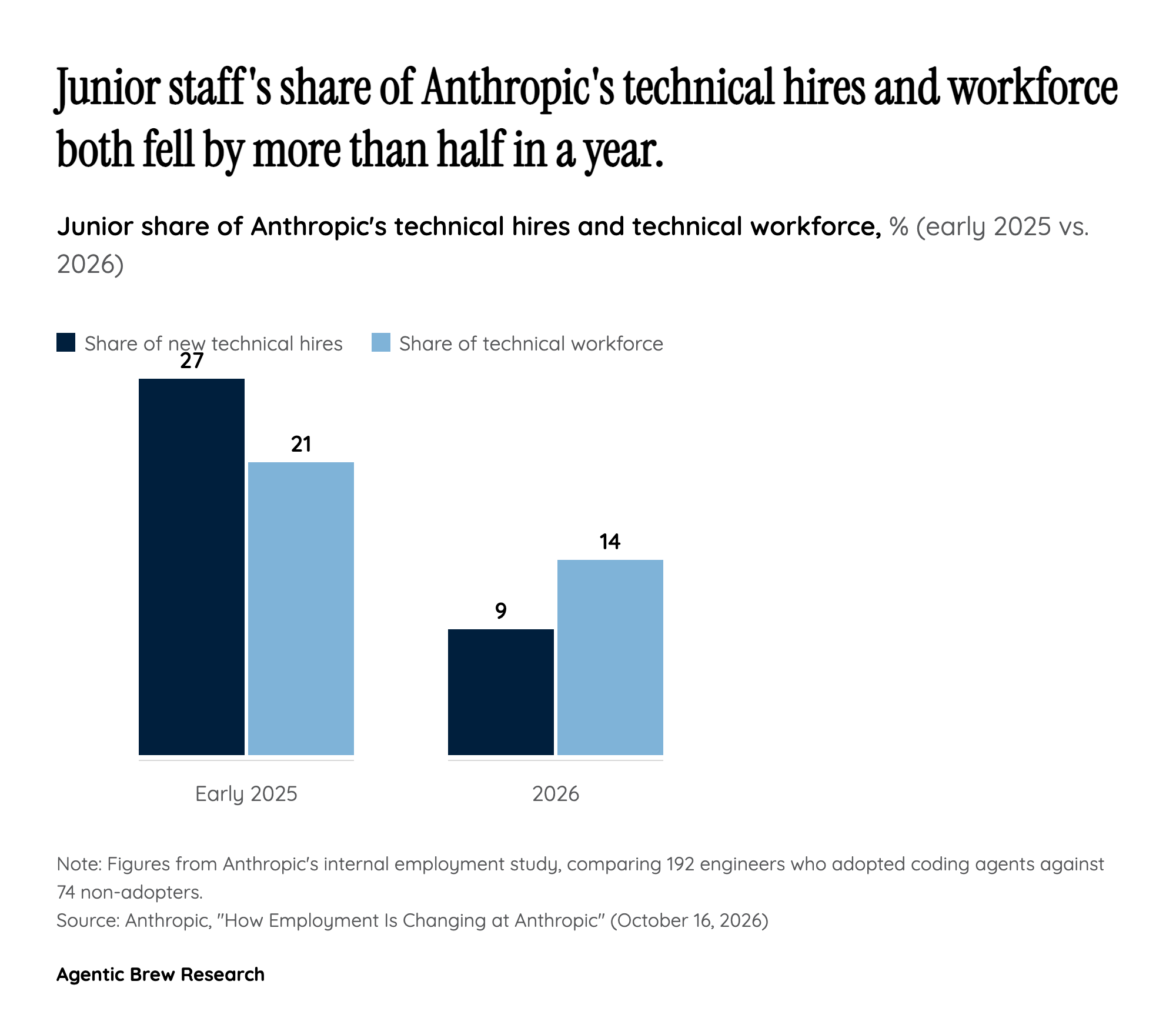
The Real Mechanism: 'Claude Runs the Experiments Now'
Junior share of Anthropic's technical hires and workforce, early 2025 vs. 2026.

The headline stat - junior technical hires falling from 27% to 9% - sounds like straightforward AI-replaces-humans job loss. But Anthropic co-founder Jack Clark's own account of the shift is more pointed: the company isn't just automating junior work, it has deliberately rebalanced who it hires. 'The returns on intuition are much greater than before because now you don't do the schlepp work to run your experiments... Now, Claude runs the experiments,' Clark has said, arguing this is why Anthropic now hires 'way more people with senior intuition' instead of scaling junior engineers around them. That mechanism lines up with the hard numbers in Anthropic's own study: code commits per engineer rose roughly 5x in six months [1], even as the company tripled its total headcount [1]- the opposite of how a fast-growing company normally hires. The juniors aren't simply being replaced one-for-one by agents; the career rung they used to occupy is being removed from the ladder entirely.


The Bottleneck Isn't the AI - It's Human Attention

By August 2026, AI coding agents at Anthropic were logging six times as many work hours as human employees, having first overtaken total human work hours back in March 2026 [2]. Yet the same research found that interactive agent sessions spend roughly 80% of their elapsed time idle, simply waiting for a human to respond [3]. Taken together, the two numbers complicate the simple 'AI took the jobs' story: agents are doing enormous volumes of work, but the pace is still gated by how much supervision and judgment a human can supply, not by any ceiling on agent capability. Anthropic's study tried to isolate this effect by comparing 192 engineers who adopted coding agents against 74 who didn't, drawing on internal employment records, usage telemetry, surveys, calendar data, and 17 employee interviews [4]. About a third of machine-learning managers and a fifth of software-engineering managers said in an April 2026 survey that they were explicitly hiring fewer people because of AI capability [3].

Fierce Pushback: Share vs. Headcount, and Competing Studies

The study landed to considerable skepticism, both from independent researchers and from practitioners sharing it across AI-focused online communities. The most common rebuttal: a falling hiring share is not the same as a falling headcount, since Anthropic's total headcount roughly tripled over the same period [1]- critics note that extrapolating the 27%-to-9% trend in a straight line, as some early commentary did, is statistically shaky when both the numerator and the denominator are moving this fast. The evidence outside Anthropic is genuinely mixed: Anthropic's technical staff share of its own total workforce also slipped, from 61% to 56%, as sales, finance, and recruiting grew faster than engineering [5], and a separate Danish labor study found no difference in entry-level hiring between AI-adopting and non-adopting firms at all [5], directly cutting against the narrative that AI is uniformly squeezing junior roles. Anthropic's own authors acknowledge the limits here, cautioning the findings are a single-company case study that may not generalize, and that higher commit volume doesn't necessarily mean better code or more business impact [4].

A Wider Pattern: Stanford's Entry-Level Data and Amodei's Own Warnings

Anthropic's internal numbers echo a broader signal independent economists have been tracking. Stanford's Erik Brynjolfsson, updating his 'Canaries in the Coal Mine' research in August 2026, found that employment for 22-to-25-year-olds in the most AI-exposed occupations - software development and customer service among them - was running 19% below peers in less-exposed fields, up from a 13% gap a year earlier [6], a trend he calls 'real, persistent and widening' [7]. Anthropic's own CEO, Dario Amodei, has gone further in public, warning that AI could eliminate up to half of entry-level white-collar jobs within one to five years and push unemployment to 10-20% [8], and that because AI's 'cognitive breadth' spans many domains at once, the disruption could hit finance, consulting, law, and technology simultaneously rather than moving through one sector at a time [9]. Whether Anthropic's own hiring data is a leading indicator for the rest of the economy, as report co-author Peter McCrory's 18-month head-start argument suggests, or simply an outlier shaped by one fast-scaling AI lab, remains the open question the report itself cannot settle.

Historical Context

2025-01-01
Baseline period (early 2025): junior staff were 27% of technical hires and 21% of the technical workforce.
2025-12-01
Junior job postings began falling particularly sharply.
2026-03-01
Total AI agent work hours exceeded total human work hours at the company for the first time.
2026-04-01
About a third of machine-learning managers and a fifth of software-engineering managers reported hiring fewer people because of AI.
2026-08-01
AI agents were logging six times as many work hours as human employees; junior hiring and workforce shares hit their lowest measured points (9% and 14% respectively).
2026-10-16
Report 'How Employment Is Changing at Anthropic' published, authored by Nathan Wilmers, Regina Catipon, Maxim Massenkoff, and Peter McCrory.

Power Map

Key Players
Subject

Anthropic's junior technical hiring drop amid AI agent adoption

AN

Anthropic

Company whose internal employment data is the subject of the study

PE

Peter McCrory

Head of economics at Anthropic and report co-author, formerly an economist at LinkedIn and J.P. Morgan

JA

Jack Clark

Anthropic co-founder and policy lead who publicly explains the hiring-mix shift toward senior 'intuition' hires

DA

Dario Amodei

Anthropic CEO who has separately warned AI could eliminate up to half of entry-level white-collar jobs within one to five years

ER

Erik Brynjolfsson / Stanford researchers

Independent economists whose 'Canaries in the Coal Mine' study finds entry-level employment in AI-exposed occupations falling relative to peers, corroborating the broader trend

NO

Nolan Lovett

Researcher at NATO Special Operations University who frames the dynamic as a 'tragedy of the cognitive commons'

Fact Check

9 cited
  1. [1] Anthropic's Junior Technical Headcount Drops to 14%
  2. [2] Anthropic Has Nearly Stopped Hiring Junior Staff Because AI Agents Now Work Six Times as Many Hours
  3. [3] Anthropic Says Junior Technical Hiring Fell as Employee-Directed Agents Logged Six Times More Hours
  4. [4] How Employment Is Changing at Anthropic
  5. [5] At Anthropic, Junior Jobs Are Shrinking
  6. [6] Stanford's Brynjolfsson Study: Entry-Level Employment in AI-Exposed Jobs Now -19%
  7. [7] Stanford Economist: AI Entry-Level Jobs Crisis
  8. [8] Anthropic CEO Says AI Could Eliminate Half of Entry-Level Jobs
  9. [9] AI Could Replace Entry-Level Jobs Soon, Warns Anthropic CEO Dario Amodei

Source Articles

Top 5

THE SIGNAL.

Analysts

“Argues Anthropic is running roughly 18 months ahead of the broader economy in AI adoption, making its internal data a potential early indicator of labor-market shifts elsewhere, while cautioning the findings are a single-company case study.”

Peter McCrory
Anthropic economist and report co-author

“Finds that an August 2026 update shows employment for 22-25-year-olds in the most AI-exposed occupations is 19% below peers in less-exposed fields, up from a 13% gap the prior year, calling the effect 'real, persistent and widening.'”

Erik Brynjolfsson (Stanford)
Labor economist studying AI's effect on entry-level employment

“Describes a 'tragedy of the cognitive commons' - individual firms gain efficiency from AI while society loses the pipeline that develops future expertise, since today's senior experts were trained in junior roles 5-20 years ago.”

Nolan Lovett
Researcher, NATO Special Operations University

“Warns that AI could eliminate up to half of entry-level white-collar jobs within one to five years and push unemployment to 10-20%, arguing AI's broad 'cognitive breadth' could hit finance, consulting, law, and tech simultaneously rather than one sector at a time.”

Dario Amodei
Anthropic CEO

“Explains the hiring-mix mechanism directly: Anthropic now hires people with more experience because the returns on 'intuition' are higher now that Claude, not junior engineers, runs the experiments. Separately frames early hiring weakness for 22-25 year olds as the start of a transition he says could be far larger and faster than the industrial revolution, while cautioning the evidence currently shows only early weakness in graduate hiring, not systemic unemployment.”

Jack Clark
Anthropic co-founder and policy lead
The Crowd

“Pretty wild that we're seeing this at the same time we're learning that Anthropic is on track to cease hiring junior technical talent by mid-2027.”

@@JoalStein119

“There are 168 hours in a week.Reading everything Claude writes for the average Anthropic engineer would take 424. Anthropic’s own report is basically saying humans are becoming the bottleneck: "Claude spends around 80% of its session time waiting for human input". That shift”

@@vikktorrrre81

“AI WIRE VIDEO BRIEF Anthropic just measured what AI agents did to its own hiring, and junior roles took the hit. Junior share of technical hires fell from 27% to 9% while agent hours ran 6x employee hours. Why it matters: the entry level ladder is shrinking first, so”

@@jarvushi0

“Anthropic is on track to stop hiring technical juniors next year”

@u/Confident_Salt_8108933
Broadcast
Anthropic's Jack Clark on the jobs crisis the politicians aren't ready for

Anthropic's Jack Clark on the jobs crisis the politicians aren't ready for

Is AI Really Taking All the Jobs? Anthropic Co-Founder Reveals the Data

Is AI Really Taking All the Jobs? Anthropic Co-Founder Reveals the Data

You Join the Top AI Lab at 23. There Is No Junior Level

You Join the Top AI Lab at 23. There Is No Junior Level

Anthropic's junior technical hiring drop amid AI agent adoption — AI News | Agentic Brew