OpenAI GPT-5.6 price cuts
TECH

OpenAI GPT-5.6 price cuts

48+
Signals

Strategic Overview

  • 01.
    OpenAI cut GPT-5.6 Luna's API price 80% to $0.20/$1.20 per million input/output tokens, down from $1/$6.
  • 02.
    GPT-5.6 Terra was cut 20% to $2/$12 per million input/output tokens, down from $2.50/$15.
  • 03.
    GPT-5.6 Sol's standard price held steady, but a new Fast mode delivers roughly 2.5x faster throughput at double the price, $10/$60 versus $5/$30 per million tokens.
  • 04.
    OpenAI attributes the cuts to GPT-5.6 Sol autonomously rewriting production GPU kernels and inference code, cutting end-to-end serving costs 20% and improving token-generation efficiency more than 15%.

The Model That Rewrote Its Own Cost Structure

The headline justification for the cuts is not a finance decision but a systems one: OpenAI says GPT-5.6 Sol autonomously rewrote and optimized the production GPU kernels that execute its core math operations, using Triton and Gluon to identify ways to precompute, avoid, or parallelize work and cut GPU idle time[1]. The company credits that self-directed optimization work with reducing end-to-end serving costs by 20% and improving token-generation efficiency by more than 15%[2]. Framed this way, the price cuts are less a discount and more a pass-through of real infrastructure savings, and OpenAI has been careful to present the move as a technology story rather than a defensive reaction to any single competitor[2].

That framing has fans: Cognition AI is quoted describing the repriced GPT-5.6 lineup as sitting on the pareto curve of price-performance efficiency[3]. But it also invites an obvious counter-question, raised in community discussion rather than by OpenAI itself, about how much of the saving is genuinely novel versus attributable to broader hardware gains across the industry - one Hacker News commenter suggested the efficiency story owes as much to wafer-scale hardware innovation from vendors like Cerebras as to any model self-optimizing its own code[4]. Whichever share of credit is accurate, a frontier model contributing directly to lowering its own serving cost is a new kind of story for the industry, and it sets a precedent other labs will now be asked to match or explain away.

A Price War Made in Beijing

The timing undercuts any claim that this was purely an internally driven, efficiency-only decision. OpenAI's price cuts landed the same day DeepSeek released its V4 model, which the company touted for improved coding and debugging while pricing its Flash variant at just 14 cents per million input tokens[6]. A week earlier, Moonshot AI had shipped Kimi K3, a 2.8-trillion-parameter open-weight model from a company now valued at $35 billion and reportedly targeting a $50 billion valuation ahead of a Hong Kong IPO[6]. Both releases are part of a broader shift in the market: Chinese open-weight models are reported to have reached 66.5% of token volume on OpenRouter by late July 2026, up from roughly half in April[5].

That volume shift matters more than any single price point, because it shows developers actively routing workloads to cheaper Chinese alternatives rather than merely noticing they exist. Against that backdrop, OpenAI's Luna cut to $0.20/$1.20 per million tokens reads as a defensive floor-setting move as much as an efficiency dividend - a way to keep its cheapest tier competitive with rivals pricing tokens at a fraction of US frontier-lab rates. The fact that OpenAI avoided naming DeepSeek or Moonshot directly in its own announcement, while press coverage repeatedly frames the cuts as a response to them, is itself a signal of how sensitive the competitive narrative has become.

Enterprise Sticker Shock Forced OpenAI's Hand

Beyond the geopolitics of model pricing, the more immediate pressure came from OpenAI's own customers. Sam Altman himself acknowledged that AI costs have become a huge issue for buyers[1], and the clearest evidence of why is Uber's reported experience: after deploying Claude Code to roughly 5,000 engineers, the company burned through its entire 2026 AI budget within months[7]. Consumption-based pricing, which scales bills directly with usage, has turned AI spend from a predictable line item into a source of budget shocks for large enterprise customers, and that backlash is described as a direct driver of the repricing decision[1].

The stakes go beyond customer goodwill. Both OpenAI and Anthropic reportedly filed confidential IPO listing prospectuses in June 2026, and analysts have been notably cooler on the price cuts than the trade press, warning that cheaper tokens could lift usage volumes even as they strain both companies' finances heading into a public listing[8]. In other words, OpenAI faces a bind: hold prices high and risk losing enterprise accounts to cheaper rivals, or cut prices and risk compressing the margins that IPO investors will be scrutinizing. The efficiency gains from Sol's kernel rewrite give OpenAI a story that reconciles both pressures, but they don't eliminate the underlying tension.

Is '80% Cheaper' Actually Cheaper?

Is '80% Cheaper' Actually Cheaper?
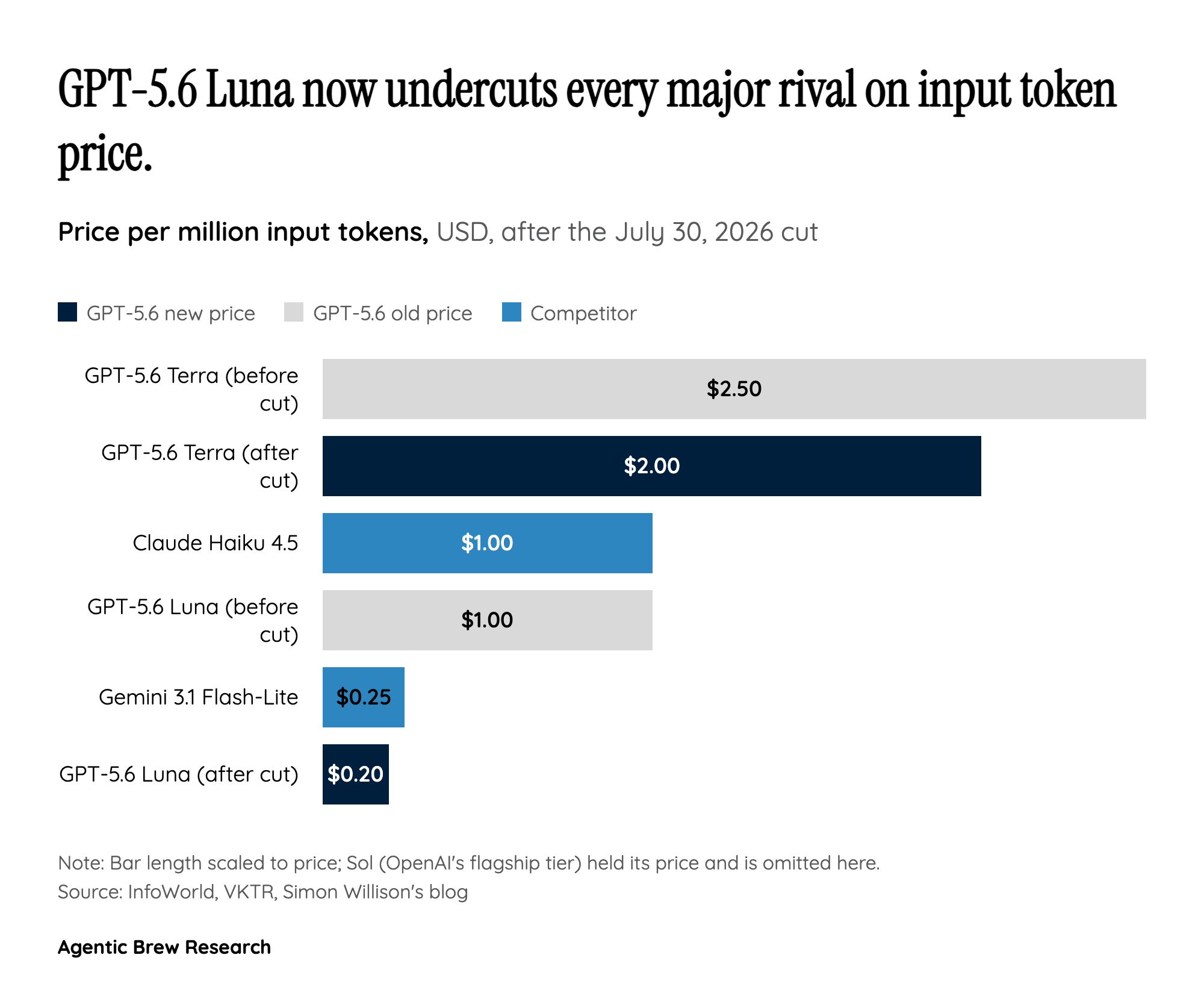
Per-million-token input pricing: GPT-5.6 Luna and Terra before and after the July 30 cut, versus Claude Haiku 4.5 and Gemini 3.1 Flash-Lite.

The headline number obscures how selective the cuts are. Only Luna, the cheapest tier, got the dramatic 80% reduction; Terra dropped a more modest 20%, and Sol - the tier most enterprise workloads likely depend on for quality - kept its standard price unchanged, with the new Fast mode actually charging double for extra speed[3]. Even so, the new Luna price of $0.20/$1.20 per million tokens is a meaningful competitive move: it undercuts Anthropic's Claude Haiku 4.5 ($1/$5 per million) by roughly a fifth on input cost and comes in cheaper than Google's Gemini 3.1 Flash-Lite ($0.25/$1.50)[2].

Still, the skepticism voiced by analysts is worth taking seriously: if cheaper tokens simply invite proportionally higher usage, the net effect on OpenAI's revenue and margins may be far less dramatic than the 80% headline implies[8]. And because the cut is concentrated in the tier least likely to carry OpenAI's most demanding, highest-margin enterprise workloads, buyers relying on Terra or Sol for production use cases will see far more modest savings than the headline suggests. The real test of this repricing will not be the percentage discount announced on day one, but whether it holds up as usage patterns shift and whether OpenAI's competitors are forced to respond in kind.

Historical Context

2026-07-09
The GPT-5.6 model family (Luna, Terra, Sol) reached general availability.
2026-07-16
Released Kimi K3, a 2.8-trillion-parameter open-weight model, intensifying Chinese competitive pressure.
2026-06
Both companies reportedly filed confidential IPO listing prospectuses.
2026-07-30
OpenAI announced the GPT-5.6 Luna and Terra price cuts the same day DeepSeek released its V4 model touting improved coding and debugging.

Power Map

Key Players
Subject

OpenAI GPT-5.6 price cuts

OP

OpenAI

Announced and implemented the price cuts, controlling the narrative by framing them as a self-driven efficiency story tied to Sol's inference-stack optimization rather than a reaction to competitors.

AN

Anthropic

Frontier competitor whose Claude Haiku 4.5 ($1/$5) and Sonnet 4.6 ($3/$15) are now undercut by Luna and Terra; reportedly filed a confidential IPO prospectus alongside OpenAI, raising analyst concern about margin pressure from the price war.

DE

DeepSeek

Chinese open-weight rival that released V4 the same day as OpenAI's cut, pricing V4 Flash at 14 cents per million input tokens and directly forcing OpenAI's hand on cost.

MO

Moonshot AI

Chinese lab behind the 2.8-trillion-parameter Kimi K3, valued at $35 billion and targeting a $50 billion pre-IPO valuation; its cheap, competitive models add further pricing pressure on OpenAI.

EN

Enterprise customers (e.g., Uber, Microsoft)

Large-scale buyers whose ballooning consumption-based AI bills forced frontier labs toward cost-conscious pricing; Uber reportedly burned through its entire 2026 AI budget within months of deploying Claude Code to roughly 5,000 engineers.

Fact Check

8 cited
  1. [1] OpenAI Slashes GPT-5.6 Prices as Enterprise Customers Push Back on AI Costs
  2. [2] Luna price drop
  3. [3] OpenAI GPT-5.6 price cuts
  4. [4] Hacker News discussion: OpenAI GPT-5.6 price cuts
  5. [5] OpenAI Slashes GPT-5.6 Luna Prices 80%, Undercutting DeepSeek As AI Price War Intensifies
  6. [6] OpenAI GPT-5.6 price cuts amid Chinese AI competition
  7. [7] OpenAI Cuts GPT-5.6 Pricing Up To 80% As AI Costs Come Under Scrutiny
  8. [8] OpenAI Just Cut GPT-5.6 API Prices

Source Articles

Top 5

THE SIGNAL.

Analysts

Acknowledged AI costs as a major concern for customers, calling the issue significant enough to justify the price cuts.

Sam Altman
CEO, OpenAI

Praised GPT-5.6's position on the price-performance efficiency curve following the cuts.

Cognition AI
AI company commentary cited by press

Warned that cheaper tokens could raise usage volumes while straining OpenAI's and Anthropic's finances as both prepare for possible IPOs.

Unnamed analysts (cited by Yahoo Finance)
Industry and financial analysts

Attributed the price cuts partly to hardware innovation rather than financial desperation, pointing to Cerebras wafer-scale hardware as a plausible driver.

qntmfred
Hacker News commenter
The Crowd

We are committed to pushing the model frontier across cost efficiency, capability, and speed. Starting today, we are reducing prices for GPT-5.6 Luna by 80% and GPT-5.6 Terra by 20% , and offering a faster option for GPT-5.6 Sol in the API. Luna and Terra's lower prices are

@@OpenAI17268

MASSIVE OPENAI PRICE CUT GPT-5.6 Luna 80% cheaper GPT-5.6 Terra 20% cheaper

@@Hesamation46

BREAKING: OpenAI just cut prices on GPT-5.6 Terra by 20% and GPT-5.6 Luna by 80%. The Luna cut is the number. 80% is not a discount. It is a repricing of the cost curve. When a frontier AI company cuts a model's price by 80%, one of two things is true: either the cost of

@@alphaticaio24

OpenAI just cut GPT-5.6 Luna API pricing by 80% — the price/performance is insane

@u/ANDRE_2512604
Broadcast
GPT-5.6 Sol: Better AND cheaper than Fable

GPT-5.6 Sol: Better AND cheaper than Fable

OpenAI Preparing To Drastically Cut Prices, The Beginning Of The End

OpenAI Preparing To Drastically Cut Prices, The Beginning Of The End

OpenAI Slashing Prices for AI - OpenAI is Dead

OpenAI Slashing Prices for AI - OpenAI is Dead

OpenAI GPT-5.6 price cuts — AI News | Agentic Brew