How Dell Became a Memory and GPU Pass-Through
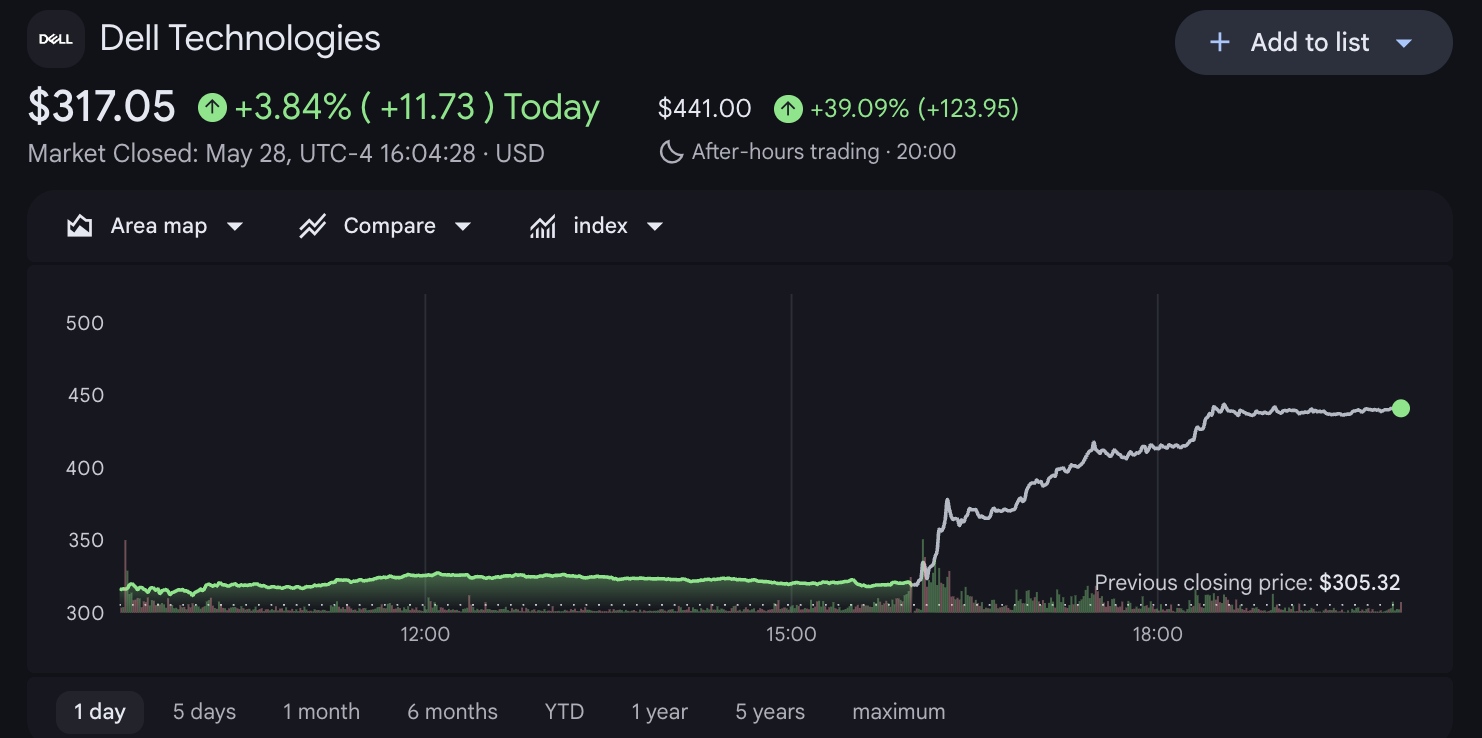
The cleanest way to read Dell's $43.8B quarter is that the company has effectively become a financialized pass-through for Nvidia GPUs, DRAM, and NAND — not a hardware vendor in the traditional sense. AI-optimized server revenue exploded 757% YoY to $16.1B, eclipsing Dell's PC unit ($14.6B) for the first time in the company's history [1]. Infrastructure Solutions Group revenue jumped 181% to $29B with operating income up 206% to $3.1B [5]. None of these numbers come from a software moat or proprietary silicon. They come from Dell's ability to source constrained components, integrate them into a rack-scale system, and ship them faster than HPE or Super Micro to hyperscaler and sovereign buyers.
The pricing mechanics make this explicit. COO Jeff Clarke told large customers Dell 'cannot tell them what the price is gonna be' for multi-year AI server contracts because DRAM, NAND, and CPUs are the binding supply constraints [4]. Retail trader summaries of the same call described near-daily repricing on memory and GPU components. That is highly unusual language for a commodity server vendor — it means a non-trivial share of the 88% revenue growth is component inflation flowing through to the top line, not pure unit growth. Retail trader forums seized on exactly this gap, with a 'shovel seller' camp arguing the AI revenue line is partly relabeled commodity server sales repriced upward as memory and GPU costs spiked [8]. Gross margin compression — Dell is outbidding peers for Nvidia allocation — is the cost of holding that pass-through position.