Reframing the firm for an AI-agent economy
TECH

Reframing the firm for an AI-agent economy

22+
Signals

Strategic Overview

  • 01.
    The shift to AI agents is a shift to AI that can take action — distinct from chatbots that only generate text — so agents are actors that plan, act, and learn rather than tools waiting for instructions.
  • 02.
    Because agents act, they dissolve the separation between technology and organizational design, simultaneously reshaping processes, roles, decision rights, and the culture of accountability.
  • 03.
    Realizing AI's true productivity gains requires redesigning organizations around agents rather than layering AI onto human-centered systems — the same lesson manufacturers learned when electricity forced them to rebuild factories.
  • 04.
    The payoff is unproven: Gartner projects 40% of agentic AI projects will be scrapped by 2027 for failing to link to measurable business value, and many firms remain stuck in experimentation.

Agents act, so the tech/org-design wall comes down

The defining claim of this platform shift is that agents take action rather than merely augment. The shift to AI agents is explicitly framed as a shift to AI that can take action [5], and agentic systems are described as able to plan, act, and learn on their own — actors, not tools waiting for instructions [1]. That single property has a structural consequence: because agents act, they dissolve the long-standing separation between technology and organizational design, simultaneously influencing the design of processes, the structure of roles, the allocation of decision rights, and the culture of accountability [1]. This is why leaders insist it is a platform shift in how people work and deliver value, not merely a new tool [4]. The reframing is already reaching the top of the org chart, not just entry-level work — C-suite and board roles are being redefined just as profoundly as the bottom [3].

The electricity lesson: rewire the firm, don't bolt agents on

The most cited mental model for why incremental adoption fails is the electrification of manufacturing. AI's true productivity gains require redesigning organizations, not merely adding AI to human-centered systems [2]. The historical parallel is precise: it took decades for manufacturers to realize that electricity's true potential required tearing down the old multi-story factories and building single-story plants where machines could be placed wherever the work demanded [2]. Applied to agents, rewiring means restructuring data into machine-readable formats, exposing systems via APIs, and eliminating silos so agents can work across domains [2][6]. One structural side effect is the flattening of management: when agents surface relevant insights in real time, the information rationale for layers of middle management weakens, and 45% expect a reduction in middle-management layers within three years [2][7]. Humans correspondingly move from executing activities to owning and steering end-to-end outcomes [6].

The reality gap: adoption is racing ahead of strategy

The reality gap: adoption is racing ahead of strategy
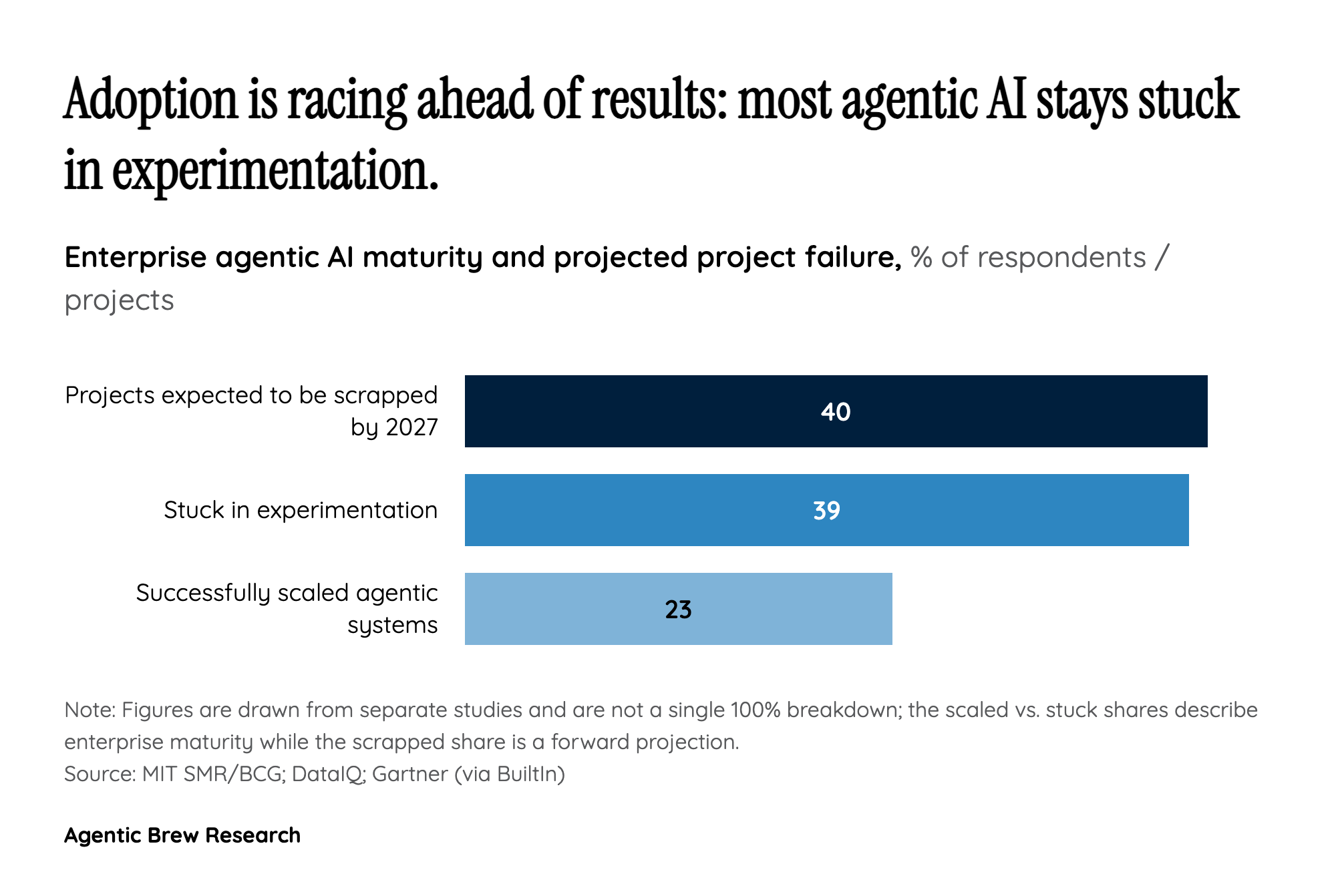
Most enterprises remain stuck experimenting with agentic AI; Gartner expects 40% of projects scrapped by 2027.

The optimism collides with an unproven track record. Gartner projects that 40% of agentic AI projects will be scrapped by 2027 for failing to link to measurable business value [8], and roughly 23% of enterprises have successfully scaled agentic systems while 39% remain stuck in experimental phases because of legacy integration hurdles [9]. The cause is structural impatience: organizations are rapidly adopting agentic AI well before they have a strategy in place [1], and decentralized development without a unifying strategy produces costly, siloed, insecure, and duplicative agents. The data also shows enthusiasm running ahead of proof, with 76% of global executives viewing agentic AI as more like a coworker than a tool and only about 35% currently adopting it [1]. The same brief that promises leapfrog opportunity for laggards warns of accelerated decline for leaders who chase only incremental efficiency [6].

The contrarian read: agility beats orchestration sprawl

Practitioners and small-firm operators push back on the 'replace the whole company with agents' narrative. The recurring community view is that small firms hold the upper hand because agility is the new moat, with defensibility coming from customer trust, proprietary data, and speed rather than headcount. Operators repeatedly warn that the scary 'weekend prototype' is mostly a mirage, because the last 20% — edge cases, compliance, and integrations — consumes 80% of the effort, echoing the enterprise finding that the hard part is deployment inside regulated, legacy-laden organizations rather than the model itself. The emerging design pattern is 'human-led company with agent-assisted workflows,' where the real challenge is engineering agent-human handoff points and decomposing work into error-tolerant tasks versus judgment-heavy human-review tasks. A notable contrarian thread among builders is that the unlock was not adding more agents but getting far better at directing one — a direct counter to orchestration sprawl.

Historical Context

2025-11
Published 'The Emerging Agentic Enterprise' report framing agents as digital actors and an organizational-design challenge.
2026-01-30
Argued workplaces must be redesigned around agents, drawing the electricity-and-factories analogy for prior platform shifts.
2026-04-21
Framed AI as a platform shift 'not another experiment,' marking the move from experimentation to deliberate enterprise execution.
2026-06-08
Documented that AI is reshaping C-suite and board roles, not just the lower levels of the org chart.

Power Map

Key Players
Subject

Reframing the firm for an AI-agent economy

MI

MIT Sloan Management Review & Boston Consulting Group

Joint research authority framing the 'agentic enterprise' as an organizational-design problem and surveying global executives on agent adoption.

MC

McKinsey (QuantumBlack)

Frames agentic AI as a chance for laggards to leapfrog and for incumbents to be displaced, urging transformation over incremental efficiency.

HA

Harvard Business Review

Publishes management guidance reframing firms around agents — workplace redesign and the reshaping of C-suite and board roles.

MI

Microsoft / EY

Position AI as a platform shift rather than another experiment, with EY acting as 'client zero' for enterprise agentic AI implementation and governance.

GA

Gartner

Forecasts a high failure rate for agentic projects, supplying the 'unproven / productive failure' counterweight to the optimism.

Fact Check

9 cited
  1. [1] The Emerging Agentic Enterprise: How Leaders Must Navigate a New Age of AI
  2. [2] Is Your Workplace Set Up for AI Agents?
  3. [3] How C-Suite and Board Roles Are Being Reshaped Around AI
  4. [4] AI as a Platform Shift, Not Another Experiment
  5. [5] The AI Agent Platform Shift
  6. [6] Seizing the Agentic AI Advantage
  7. [7] New Rules of the Platform Strategy in the Age of Agentic AI
  8. [8] Agentic AI and the Productivity Problem
  9. [9] Agentic AI: The Six Biggest Challenges

Source Articles

Top 1

THE SIGNAL.

Analysts

"Agentic AI are autonomous actors, not tools, and most organizations are adopting them before they have a strategy in place, making integration an organizational-design problem."

Sam Ransbotham, David Kiron, Shervin Khodabandeh, Sesh Iyer, Amartya Das
Authors, MIT Sloan Management Review & Boston Consulting Group report (Nov 2025)

"Productivity gains require redesigning organizations around agents, not bolting AI onto human-centered systems — the same lesson manufacturers learned with electricity."

Harang Ju
Assistant Professor, Johns Hopkins Carey Business School

"AI reshapes leadership at the top of the org chart as profoundly as at the bottom; C-suite and board roles are being redefined."

Tomas Chamorro-Premuzic
Chief Science Officer, Russell Reynolds Associates; Professor of Business Psychology, UCL & Columbia

"Agents represent a platform shift because they take action rather than merely generate text."

Patrick McGuinness
Author, 'The AI Agent Platform Shift'

"AI is a platform shift in how people work and deliver value, not merely a new tool."

Mark Luquire
Managing Director & Global Co-Innovation Leader, EY
The Crowd

"When doing product management for AI agents, the biggest shift is that the user you think about making successful is the agent. They are effectively your new “customer”. And the whole game is to figure out how to get the agent the most relevant context possible to execute their"

@@levie558

"If you’re building AI Agents, it’s super important to figure out the optimal use-cases that maximize what agents are good vs. what they’re not ready for *yet*. There are so many categories of work that AI Agents can help automate or augment. Choosing the right ones that can"

@@levie341

"APIs taught software how to talk. MCP teaches it how to act. This isn’t a small technical upgrade. It’s an architectural shift that redefines how agents interact with tools."

@@augmentcode77

"Small company leader here. AI agents are moving faster than our strategy. How do we stay relevant?"

@u/No_Prior2279567
Broadcast
This New AI Agent Turns You Into a One-Person Company

This New AI Agent Turns You Into a One-Person Company

Inside a $19M YC Startup Building AI Agents for Enterprise

Inside a $19M YC Startup Building AI Agents for Enterprise

The Next Big Shifts in Enterprise AI: AgentExchange, Headless Systems, and Agent-First Workflows

The Next Big Shifts in Enterprise AI: AgentExchange, Headless Systems, and Agent-First Workflows