Cheap coding models: Grok 4.5 and SWE-1.7 undercut the frontier
TECH

Cheap coding models: Grok 4.5 and SWE-1.7 undercut the frontier

25+
Signals

Strategic Overview

  • 01.
    xAI released Grok 4.5, a coding and agentic model co-trained with the Cursor editor, priced at $2 per million input tokens and $6 per million output tokens.
  • 02.
    Cognition released SWE-1.7, the model inside its Devin coding agent, quoting roughly $1.97 per completed task and serving it through Cerebras at about 1,000 tokens per second.
  • 03.
    Both launches undercut premium incumbents - Anthropic's Claude Opus 4.8 at about $5 and $25 per million tokens and OpenAI's GPT-5.6 Sol at about $5 and $30 - while claiming near-frontier coding capability.
  • 04.
    Part of Grok 4.5's cost edge is token efficiency: it reportedly resolves a SWE-Bench Pro task with about 15,954 output tokens versus roughly 67,020 for Opus 4.8.

The Real Discount Is Measured in Tokens, Not Dollars
The Real Discount Is Measured in Tokens, Not Dollars
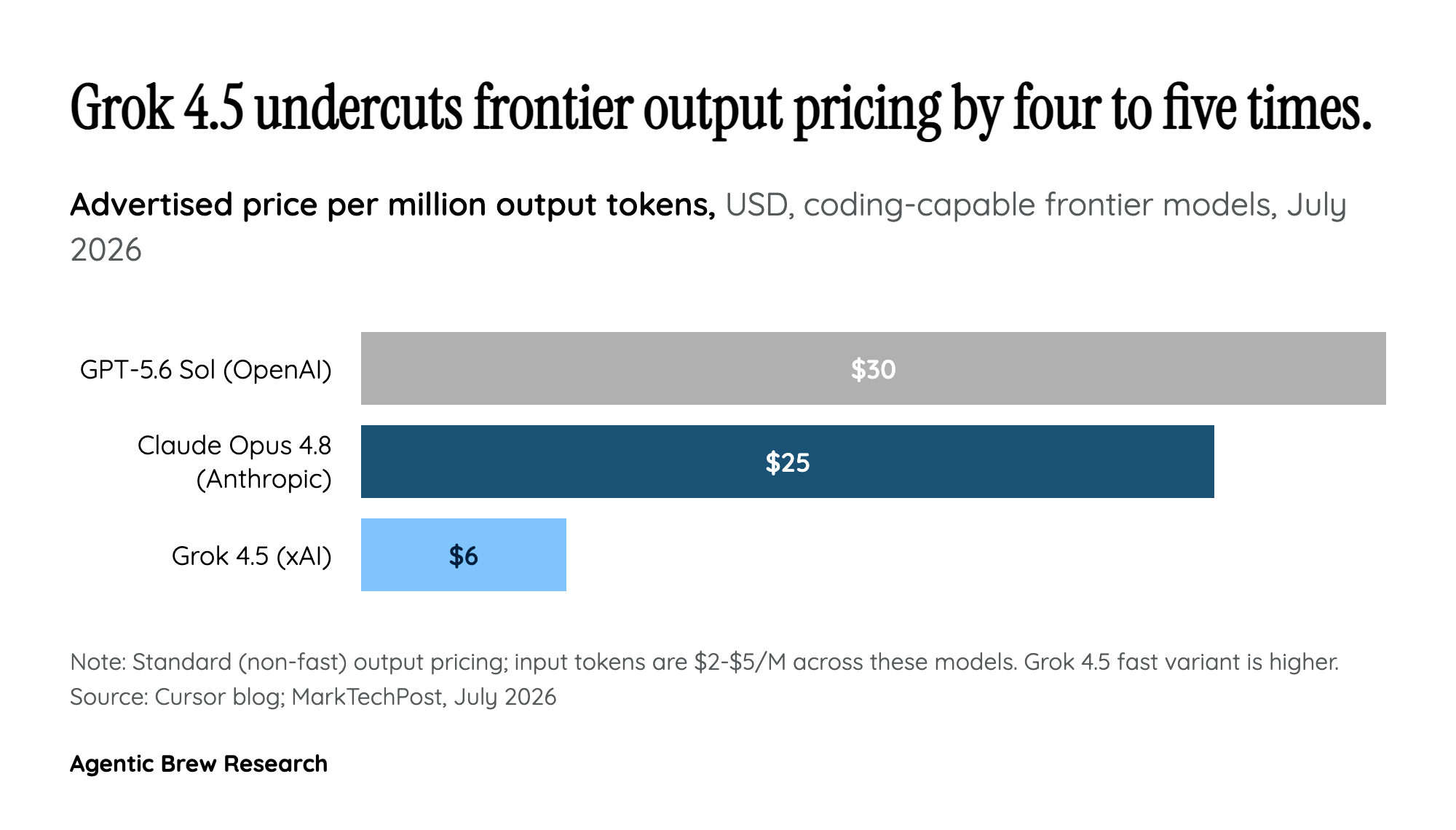
Advertised output-token pricing for coding-capable frontier models, July 2026. Grok 4.5's $6 rate undercuts Opus 4.8 and GPT-5.6 Sol by four to five times.

On paper the gap looks simple. Grok 4.5 lists at $2 per million input tokens and $6 per million output tokens, while the incumbents it targets sit far higher - Anthropic's Claude Opus 4.8 at roughly $5 and $25, and OpenAI's GPT-5.6 Sol at about $5 and $30 [2]. Cognition skips per-token framing entirely and quotes SWE-1.7 at about $1.97 per completed task [4].

The more interesting lever is hidden underneath the sticker price: token efficiency. On the SWE-Bench Pro coding benchmark, Grok 4.5 reportedly resolves a task using around 15,954 output tokens against roughly 67,020 for Opus 4.8 [1]- a gap of more than four to one. Because you pay per token, a model that reaches the same answer with a quarter of the output is cheaper even before the lower headline rate is applied. That is why developers keep insisting the honest metric is cost per finished task, not the price of a million tokens - a distinction the community has hammered since the day both models shipped.

How You Build a Cheap Frontier Model in 2026

Neither model got cheap by accident; both follow the same emerging recipe. xAI co-trained Grok 4.5 with the AI editor Cursor on what Cursor describes as trillions of tokens of real developer-agent interactions - debugging traces, edits, and tool calls captured from actual coding sessions rather than static repositories [1]. That data flywheel lets a specialized coding model punch above models trained on generic text.

Cognition took a parallel route with SWE-1.7, which it calls the result of broad improvements across its reinforcement-learning pipeline [3], then served it through Cerebras hardware at roughly 1,000 tokens per second [4]. Developers on Reddit read the pattern more bluntly, characterizing the approach as pairing an inexpensive open-weight base with proprietary editor or agent data - cheap to run, and tuned to the exact workflows the vendor already owns. The takeaway is that frontier-adjacent coding quality has become a data-and-serving problem, not only a model-scale problem.

The Benchmarks Come With an Asterisk

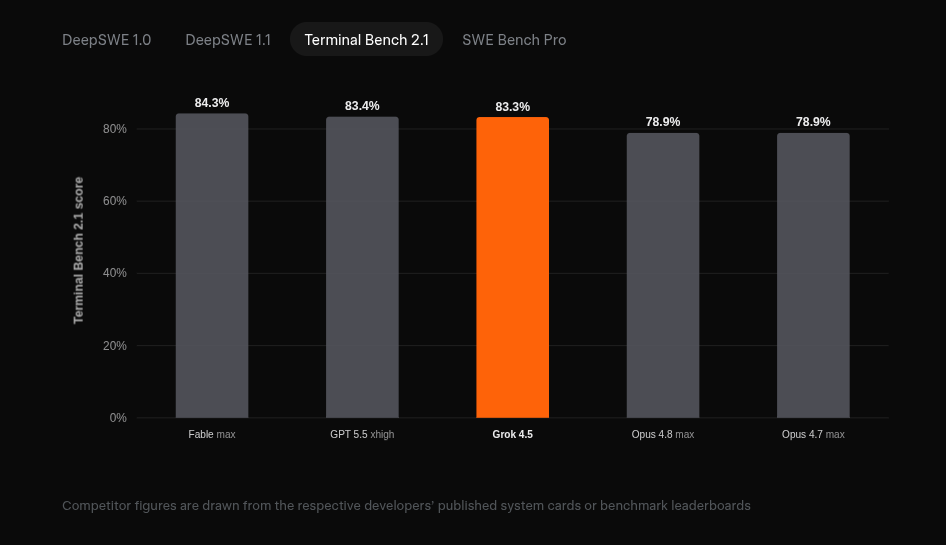
The cost story is real; the capability story needs a closer read. On coding evaluations SWE-1.7 lands just under the frontier - about 42.3% on Cognition's FrontierCode main set versus 43.0% for GPT-5.5 and 46.5% for Opus 4.8 [3]- close enough that price becomes the deciding factor. Grok 4.5's own numbers, including a reported 64.7% resolve rate on SWE-Bench Pro [2], tell a similar near-parity tale.

But the leaderboards carry caveats the vendors themselves disclose. Reviewers walking through Grok 4.5 on YouTube stopped on a printed note that the model has an advantage on Cursor's own benchmark because an earlier snapshot of the Cursor codebase was unintentionally included in training - a contamination flag developers on Reddit seized on within hours. The same community pointed out that launch pricing is a subsidized introductory deal rather than durable economics, and met the benchmark charts with open accusations of tuning for the test. The skepticism is itself the signal: buyers have learned to treat a one-day benchmark win as a marketing event until it survives real workloads.

The Floor Under Frontier Pricing Is Giving Way

Step back and the individual launches matter less than the trend line. When several challengers can match frontier coding scores at a fraction of the cost, the premium that labs charge for raw capability starts to erode - a dynamic industry watchers have begun calling an outright price war [6]. SiliconANGLE framed Grok 4.5's debut plainly, describing it as dramatically undercutting Anthropic and OpenAI on price [5].

Two forces will decide how far the floor drops. The first is speed of response: developers noted that OpenAI's next release was expected within a day, which makes any single model's cost-parity claim perishable - today's undercut is tomorrow's baseline. The second is reach. Grok 4.5 was not available in the European Union at launch [2], a reminder that aggressive pricing does not equal universal access. For now the safest bet is that the ceiling on what a coding model can charge is falling faster than the ceiling on what one can do.

Historical Context

2026-07-08
Launched Grok 4.5, priced at $2/$6 per million tokens and available in Cursor, Grok Build, and the xAI console.
2026-07-08
Released SWE-1.7 at about $1.97 per task, its most capable coding model to date, and added a Cerebras-served Lightning speed tier at around 1,000 tokens per second.

Power Map

Key Players
Subject

Cheap coding models: Grok 4.5 and SWE-1.7 undercut the frontier

XA

xAI

Builder of Grok 4.5. By pricing an Opus-class coding model at $2/$6 per million tokens, it pressures incumbents' pricing power and forces the pace of the cost war.

CU

Cursor

AI coding editor that co-trained Grok 4.5 on its own developer-session data and distributes it to users on every plan, gaining a flagship model built from its usage flywheel.

CO

Cognition

Maker of Devin and builder of SWE-1.7. It reframes cost as price-per-task and pushes the cost-performance curve with fast Cerebras-served inference.

AN

Anthropic (Claude Opus)

Premium incumbent whose Opus 4.8 pricing and coding quality are the explicit benchmark both challengers target and undercut.

OP

OpenAI (GPT-5.5/5.6)

Premium incumbent whose GPT-5.5-class coding performance is the bar SWE-1.7 claims to match at a fraction of the cost.

Fact Check

6 cited
  1. [1] Grok 4.5 in Cursor
  2. [2] xAI Releases Grok 4.5
  3. [3] Introducing SWE-1.7
  4. [4] Cognition's SWE-1.7 Matches GPT-5.5 on Coding Tasks at $1.97 Each
  5. [5] xAI's newest AI model Grok 4.5 dramatically undercuts Anthropic, OpenAI on price
  6. [6] The AI Price War: Frontier Models Are Getting Cheap

Source Articles

Top 1

THE SIGNAL.

Analysts

"Called Grok 4.5 an Opus-class model that is faster, more token-efficient, and lower cost, and said internal testing puts it roughly comparable to Claude Opus 4.7."

Elon Musk
Founder and CEO, xAI

"Says Grok 4.5 was co-trained on trillions of tokens of real developer-agent interactions captured from Cursor sessions rather than static code repositories."

Cursor
AI coding editor, Grok 4.5 co-developer

"Describes SWE-1.7 as frontier-adjacent quality at a fraction of the cost with fast inference, and the result of broad improvements across its reinforcement-learning pipeline."

Cognition
Maker of Devin, SWE-1.7 developer
The Crowd

"Grok 4.5 is now available in Cursor"

@u/lrobinson2011196

"Grok-4.5 on par with gpt-5.5-xhigh in coding at half the cost"

@u/NoFaithlessness951156

"Introducing SWE-1.7"

@u/morgantepell41
Broadcast
Vibe Coding With Grok 4.5

Vibe Coding With Grok 4.5

Grok Build + Grok 4.3 FULL Test – xAI's Claude Code & Codex Competitor!

Grok Build + Grok 4.3 FULL Test – xAI's Claude Code & Codex Competitor!

Windsurf SWE-1.5 First Test - The FASTEST Agentic Coding Model Ever?

Windsurf SWE-1.5 First Test - The FASTEST Agentic Coding Model Ever?