AI memory shortage forces Apple and Microsoft price hikes
TECH

AI memory shortage forces Apple and Microsoft price hikes

28+
Signals

Strategic Overview

  • 01.
    On June 25, 2026 Apple raised prices on Macs and iPads by up to $300, explicitly blaming the AI-driven memory chip shortage; the stock fell more than 6% after the announcement.
  • 02.
    Microsoft lifted Xbox console prices by $100 on the 512 GB model and $150 on the 1 TB model, saying console storage and memory costs have already risen more than 2.5x with another doubling expected by fall 2027.
  • 03.
    The shortage is structural rather than cyclical: memory makers are reallocating wafer capacity away from consumer DRAM and NAND toward high-margin HBM for AI accelerators, and data centers now consume an estimated 70% of all memory chips produced worldwide.
  • 04.
    Gartner estimates a roughly 130% combined DRAM and SSD price surge by the end of 2026, raising PC prices about 17% and smartphone prices about 13% versus 2025, and projects worldwide PC shipments to fall 10.4% and smartphones 8.4% this year.

Deep Analysis

The wafer war consumers were never told they joined

For two decades, memory was the part of your laptop you never had to think about - cheap, abundant, and deflationary by default. That assumption broke this year, and the break is structural rather than cyclical. DRAM prices rose roughly 172% across 2025 as channel inventory collapsed from twelve weeks to as little as two [9]. The three companies that control over 95% of global DRAM - Samsung, SK Hynix and Micron - have quietly redirected as much as 93% of their combined output toward high-bandwidth memory, the stacked DRAM that feeds AI accelerators [8][10]. IDC describes the shift bluntly as a potentially permanent, strategic reallocation rather than a temporary mismatch of supply and demand [6].

The economics behind that choice are unforgiving for anyone buying a phone or a PC. HBM commands margins three to five times those of conventional DRAM, and producing a single bit of it consumes roughly 300% more wafer capacity than DDR5 [7][10]. In other words, every wafer a maker pours into an HBM stack for an Nvidia GPU is a wafer it does not turn into the LPDDR5X module of a mid-range smartphone [6]. Data centers now absorb an estimated 70% of all memory chips produced worldwide, and HBM alone is set to take 23% of total DRAM wafer output in 2026, up from 19% in 2025 [6][8]. This is the mechanism that turned an AI capital-expenditure boom into a line item on consumer receipts.

Record profits upstream, unavoidable hikes downstream

What makes this episode unusual is that no one in the chain is hiding the pass-through. Apple raised prices across Macs and iPads by up to $300 on June 25 and named the memory shortage as the cause; Tim Cook had already told investors in May that the increases were unavoidable, calling the surge something he had never seen in over 40 years [1][2][3]. Microsoft followed by lifting Xbox prices $100 to $150, disclosing that console storage and memory costs are up more than 2.5x with another doubling expected by fall 2027 [1]. PC makers are absorbing the same shock further down: HP now reports memory at roughly 35% of a laptop's build cost, up from 15 to 18%, with the broader industry warning of 15 to 20% hikes [6].

The contrast at the top of the chain is stark. While device makers warn of margin compression - Apple's stock dropped more than 6% on the news and Cook flagged pressure on iPhone margins - the memory oligopoly is posting records, with SK Hynix logging an operating profit of 11.38 trillion won in Q3 2025 and its capacity booked through the end of 2026 [1][8][10]. Micron's Manish Bhatia calls it the most significant disconnect between demand and supply he has seen in 25 years, while Intel's Lip-Bu Tan flatly expects no relief until 2028 [5][8]. The value is being created at the wafer and captured at the wafer; the cost is being shipped to checkout.

By the numbers: the steepest memory repricing on record

By the numbers: the steepest memory repricing on record
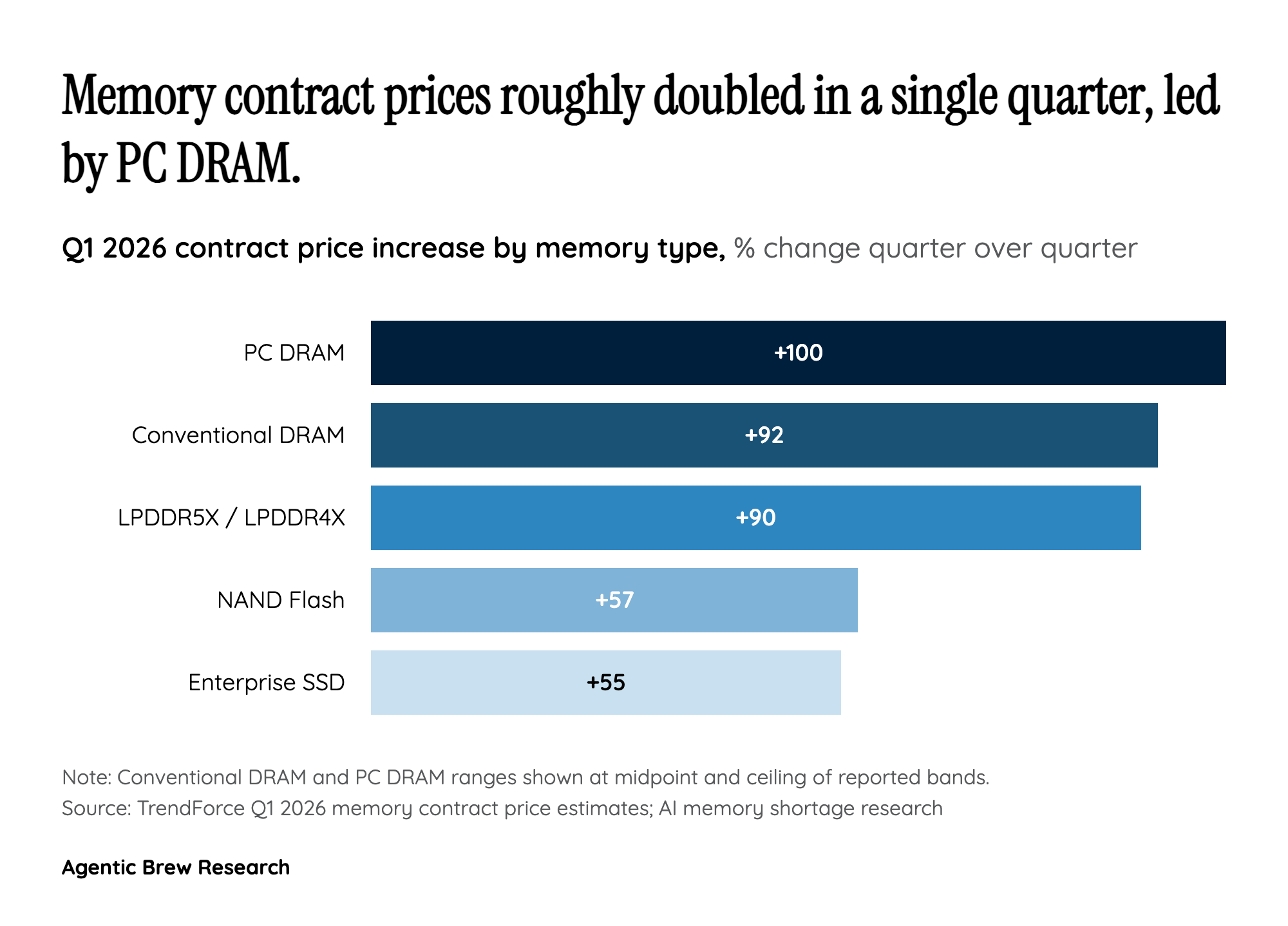
Q1 2026 memory contract prices surged across every category, with PC DRAM roughly doubling quarter over quarter.

The price moves are not incremental, and the data quantifies just how far outside historical norms this cycle sits. TrendForce pegged conventional DRAM contract prices up 90 to 95% quarter over quarter in Q1 2026, with PC DRAM jumping more than 100% and a further 58 to 63% increase forecast for the current quarter [2][7]. NAND Flash contract prices are expected to climb 55 to 60% quarter over quarter, enterprise SSDs a record 53 to 58%, and LPDDR5X and LPDDR4X surged roughly 90% quarter over quarter - the steepest moves in their history [7].

Those component spikes translate cleanly into device-level pain. Gartner projects a roughly 130% combined DRAM and SSD price surge by the end of 2026, pushing PC prices about 17% higher and smartphone prices about 13% higher than 2025, and expects worldwide PC shipments to contract 10.4% and smartphones 8.4% as a result [4]. Memory is also eating the bill of materials whole: DRAM could reach 30% of a low-end smartphone's BOM, roughly triple its early-2025 share [6][8]. On the winning side, the HBM market is forecast to expand from $35B in 2025 to $100B by 2028, with HBM demand growing about 70% year over year in 2026 [5][8].

The community read: cartel suspicion and a quiet retreat from upgrades

Among builders and enthusiasts, the reaction has hardened from sticker shock into something closer to resignation and suspicion. The dominant practical takeaway across communities is to hold and maintain aging machines and delay upgrades indefinitely, because the usual escape hatches are closing - even the long-relied-upon secondhand ex-datacenter memory route is drying up as modern blade-based hardware no longer fits consumer cases. A recurring theme is cartel suspicion, with users pointing to the concentration of supply among three vendors and a memorable history of DRAM price-fixing to argue the squeeze is too convenient to be purely organic.

There is also a more strategic anxiety running underneath the price complaints: a fear that big tech is content to price consumers out of owning powerful local hardware and nudge them toward subscription and cloud computing instead. That read is speculative, but it is not baseless given the supply math - the same wafers that would have gone into affordable consumer machines are now being routed to the data centers those cloud services run on [6]. Coverage outside the forums reinforces the structural framing, treating the crunch as a multi-year problem hitting phones, computers and TVs alike, with the clearest near-term winners being the memory makers gaining pricing power and the clearest losers being downstream consumer-hardware brands. The mood, in short, is less panic-buying than a slow, grudging step back from the upgrade cycle.

Historical Context

2025-07-01
AI and general server memory demand pushed the market into shortage in Q3 2025 after capacity began shifting toward HBM.
2025-12-31
DRAM prices rose roughly 172% across 2025 as inventory dropped from 12 weeks in October 2024 to 2 to 4 weeks by October 2025.
2026-03-01
Apple raised MacBook prices by as much as $400 in March, ahead of the broad June hike.
2026-05-01
On the Q2 earnings call Cook warned that price increases were unavoidable and would increasingly impact the business starting in June.
2026-06-25
Apple announced price hikes across Macs, iPads, HomePods, Vision Pro and Apple TV; the stock fell more than 6%.

Power Map

Key Players
Subject

AI memory shortage forces Apple and Microsoft price hikes

AP

Apple

Consumer device maker passing memory costs onto buyers; raised Mac, iPad, HomePod, Vision Pro and Apple TV prices on June 25, 2026, with CEO Tim Cook calling the hikes unavoidable.

MI

Microsoft

Raised Xbox console prices by $100 to $150, citing a 2.5x increase in console storage and memory costs with another doubling expected by fall 2027.

SA

Samsung, SK Hynix and Micron

Control over 95% of global DRAM; reallocated up to 93% of combined production toward HBM for AI, becoming the chief beneficiaries with record profits while consumer supply tightens, with SK Hynix booked to capacity through the end of 2026.

PC

PC makers (HP, Dell, Lenovo, Acer, ASUS)

Bearing surging bill-of-materials costs, with memory now about 35% of laptop build cost per HP, up from 15 to 18%, and warning of 15 to 20% price hikes and contract resets.

HY

Hyperscalers and OpenAI

Drive the underlying demand through AI data center buildout, with OpenAI's Stargate Project reportedly consuming roughly 40% of global DRAM supply.

Fact Check

10 cited
  1. [1] Apple, Microsoft hike prices over surging chip costs
  2. [2] Apple hikes the prices of MacBooks and iPads because of memory chip shortage
  3. [3] Apple CEO warns of memory crunch: We'll look at a range of options
  4. [4] Gartner says surging memory costs will reduce global PC and smartphone shipments in 2026
  5. [5] The DRAM shortage that won't end until 2028
  6. [6] Global memory shortage crisis: market analysis and impact on smartphones and PCs in 2026
  7. [7] TrendForce: memory contract prices surge across DRAM, NAND and LPDDR in Q1 2026
  8. [8] AI's insatiable demand for memory is driving a chip shortage crisis
  9. [9] 2025-present global memory supply shortage
  10. [10] Korean chipmakers ride HBM boom to record profits as DRAM tightens

Source Articles

Top 3

THE SIGNAL.

Analysts

"Called the price hikes unavoidable and described the memory demand surge as a once-in-a-century event unlike anything he has seen."

Tim Cook
CEO, Apple

"Describes the gap between supply and demand as the largest in his career, both in magnitude and in how long it will last."

Manish Bhatia
EVP, Micron Technology

"Sees no near-term relief from the memory crunch, expecting tightness to persist for years."

Lip-Bu Tan
CEO, Intel

"Frames the demand wave as unprecedented in scale, larger than any prior cycle the industry has faced."

Tim Archer
CEO, Lam Research

"Expects memory prices to peak in Q3 to Q4 2026 then slowly moderate, with tight conditions continuing through the second half of 2027 and the earliest inflection around Q4 2027."

Yang Wang
Analyst, Counterpoint Research
The Crowd

"Microsoft: "Unfortunately, console storage and memory prices have increased by more than 2.5x and we expect another doubling by the fall of 2027.""

@@wallstengine969

"It happened. Apple has dramatically raised the prices on almost ALL of their products This is only the beginning too. In Micron's earnings yesterday they announced memory price hikes for at least 4 more years I predicted 5 months ago prices of all computers would triple soon"

@@AlexFinn715

"JUST IN: Apple is lobbying the Trump administration to approve memory chips from CXMT, a Chinese company blacklisted by the Pentagon over alleged military ties. Apple is now seeking lower-cost memory chips as AI-driven demand has pushed memory prices higher."

@@CryptoTweets140

"32GB of DDR5 now costs $375 minimum — AI shortage continues to squeeze PC building"

@u/Logical_Welder34672000
Broadcast
The AI Memory Crisis Is Just Getting Started

The AI Memory Crisis Is Just Getting Started

Growing AI demand is driving computer RAM shortage

Growing AI demand is driving computer RAM shortage

The AI Memory Crisis Is Crushing Consumer Tech

The AI Memory Crisis Is Crushing Consumer Tech