AMD and Cerebras are combining AMD's Helios rack-scale AI systems with Cerebras's wafer-scale chips into a disaggregated inference platform, positioning the pairing as a joint challenger to Nvidia's dominance in AI data-center hardware.
TECH

AMD and Cerebras are combining AMD's Helios rack-scale AI systems with Cerebras's wafer-scale chips into a disaggregated inference platform, positioning the pairing as a joint challenger to Nvidia's dominance in AI data-center hardware.

36+
Signals

Strategic Overview

  • 01.
    AMD and Cerebras announced a technical partnership combining AMD Helios rack-scale systems with the Cerebras Wafer-Scale Engine into a single disaggregated AI inference workflow, aimed at ultra-low-latency, high-throughput serving.
  • 02.
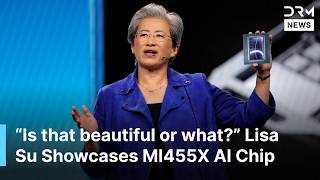
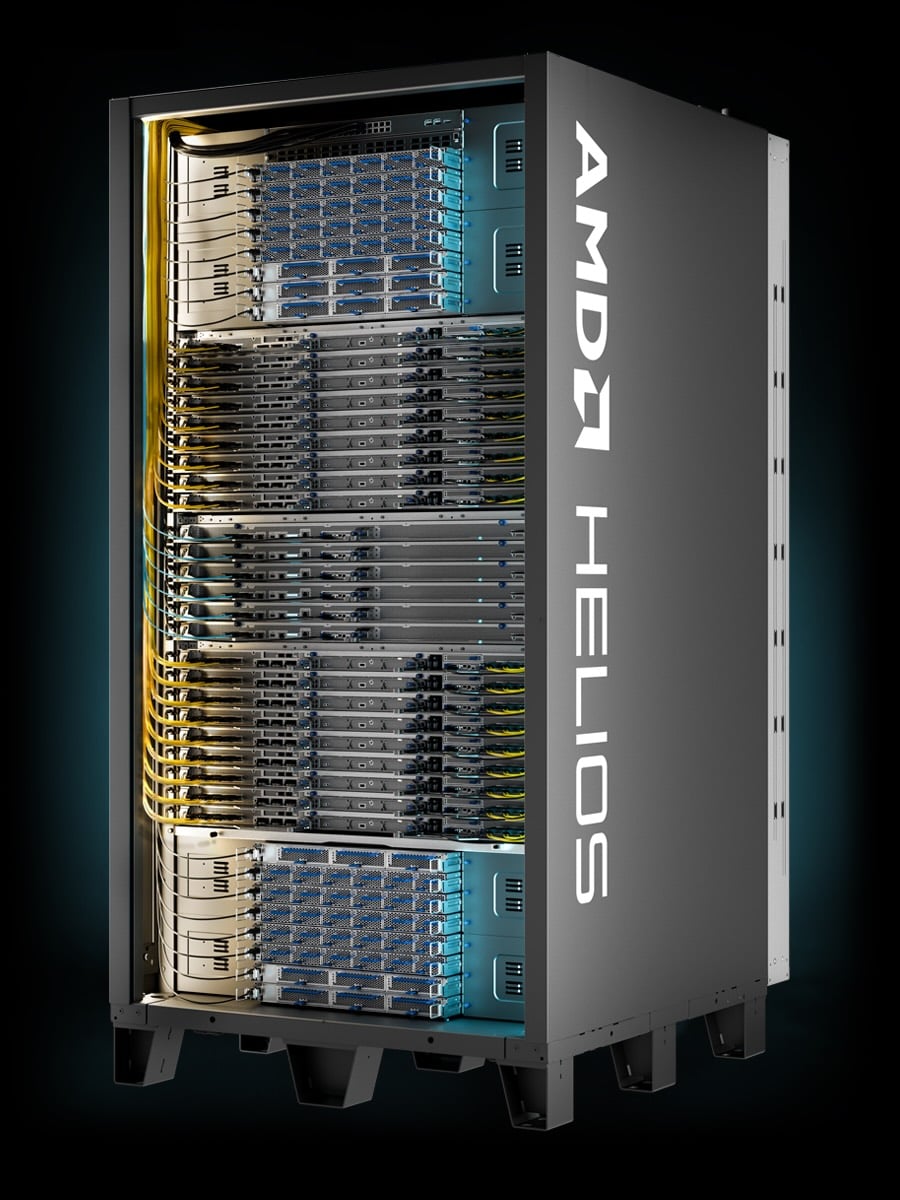
    AMD launched Helios into full production at its Advancing AI 2026 event on July 20-23, 2026; each rack packs 72 Instinct MI455X GPUs, 31TB of HBM4 memory, and up to 1.4PB/s aggregate bandwidth, comparable in GPU count to Nvidia's 72-GPU NVL72 racks.
  • 03.
    Microsoft announced it will deploy Helios racks at scale on Azure, becoming the first hyperscaler to publicly commit to Helios at scale, alongside new HDv2 and HXv2 VM families.
  • 04.
    AMD separately agreed to invest up to $5 billion in Anthropic, which committed to deploying up to 2 gigawatts of AMD Instinct MI450-series GPUs in Helios racks.
  • 05.
    AMD disclosed a total Helios deployment pipeline of roughly 20 gigawatts at Advancing AI 2026, spanning Microsoft, Anthropic, and other disclosed customers including OpenAI, Meta, and Oracle.
  • 06.
    The combined AMD-Cerebras solution is expected to deliver up to 5x higher tokens per second per watt versus a Cerebras-only configuration, a modeled (not measured) figure with no disclosed third-party validation.

Deep Analysis

Why AMD and Cerebras Split the Inference Pipeline in Half

AMD's Helios rack-scale platform and Cerebras's Wafer-Scale Engine (WSE) aren't being bolted together as a single monolithic chip - they're splitting the inference pipeline into two specialized stages. Helios handles prefill: the high-throughput, large-context-window prompt processing where 72 Instinct MI455X GPUs and 31TB of HBM4 memory shine. The Cerebras WSE takes over for decode: the memory-bandwidth-intensive token generation that determines how fast a chatbot or agent actually 'feels' to a user [1]. That division mirrors what production inference teams have learned the hard way - a single accelerator architecture is rarely optimal for both halves of the job, so disaggregating prefill and decode across purpose-built silicon is now the two companies' answer to ultra-low-latency serving at scale [1].

The Fine Print Behind the '5x' Claim

AMD and Cerebras are touting 'up to 5x higher tokens per second per watt' for the combined system, but the fine print matters more than the headline. That comparison is modeled, not measured: AMD Performance Labs and Cerebras produced the figure from a single simulated model - Kimi 2.6 1T - tested in July 2026, with no third-party benchmark validation disclosed [2]. Just as important, the baseline isn't Nvidia and isn't even an AMD-only rack - it's a Cerebras WSE-only configuration, meaning the number describes how much the Helios pairing improves on Cerebras alone, not how the joint system stacks up against the market leader it's positioned to challenge [2]. Real production numbers won't exist until the system ships through Cerebras Cloud in the second half of 2026 [2].

A Direct Answer to Nvidia's Purchase of Groq - Inside a Much Bigger AMD Week

The timing lines up with a specific provocation: Nvidia's acquisition of Groq, an inference-optimized LPU chipmaker, is widely read by industry press as the trigger for AMD and Cerebras joining forces on a competing low-latency inference stack, with Cerebras CEO Andrew Feldman predicting the combined product will beat a Groq-based Nvidia offering [3]. It's one piece of a much bigger week for AMD - the company also disclosed a roughly 20-gigawatt pipeline of committed Helios deployments spanning Microsoft Azure, Anthropic, and a broader set of customers including OpenAI, Meta, and Oracle [4], and separately agreed to invest up to $5 billion in Anthropic as the AI lab commits to deploying up to 2 gigawatts of AMD accelerators [5]. Against that scale, the Cerebras tie-up is narrower than it sounds: it's available only through Cerebras Cloud, not as an on-premises product, and only starting in the second half of 2026 [1].

Hardware Parity Doesn't Erase Nvidia's Software Moat

Even analysts sympathetic to AMD's progress note that chips are only half the battle. Counterpoint Research's Neil Shah says Helios is 'on par' with Nvidia on raw GPU and CPU performance, but argues Nvidia's CUDA software ecosystem remains a much bigger moat that AMD hasn't closed [6]. Futurum Group's Daniel Newman sees a credible path for AMD to capture 20-25% of the data-center GPU market - up from roughly 4.5% today - but that migration depends on developers actually porting workloads off CUDA, not just AMD matching specs on paper [6]. Markets seemed to register that skepticism in real time: Cerebras shares rose about 4-5% on the partnership news while AMD shares slipped roughly 2-3% the same day, suggesting investors are still separating the splashy hardware unveiling from proof that the software and workload-migration story actually holds up [7].

The Engineers Aren't as Sold as the Press Release

The official rollout on X leaned celebratory: Cerebras's own account called the pairing 'what agentic AI has been waiting for,' and Andrew Feldman framed it as a 'historic partnership' combining the best of both stacks. On Reddit, the technical crowd has been considerably more guarded. In r/CerebrasSystems, commenters questioned whether two genuinely different hardware and software stacks - AMD silicon plus Cerebras silicon - can be welded into one product on the tight timeline AMD and Cerebras have set, drawing comparisons to other heterogeneous-hardware bets like Nvidia's Groq acquisition, Cerebras's own AWS Trainium tie-up, and Intel's SambaNova deal as precedents that don't always integrate cleanly. A technical critic in that same thread raised wafer-scale yield and thermal-stress concerns, which another commenter pushed back on by pointing to Cerebras's own claims of having solved the wafer's defect-tolerance problem - a dispute that remains unresolved outside company messaging. Over in r/hardware, the bigger tangent wasn't about Cerebras at all: it was whether ROCm is mature enough to make AMD's hardware parity with Nvidia actually usable in production, with a separate thread of debate over whether the entire industry's data-center inference build-out - including Helios - is even correctly timed, given one highly-upvoted argument that Nvidia itself may be quietly hedging toward on-device inference as server GPU demand growth slows. Notably, several commenters in r/AMD_Stock read the deal as complementary rather than competitive, pointing out AMD has been an investor in Cerebras since a February 2026 Series H round - a detail that cuts against the 'joint challenger to Nvidia' framing and suggests some of the community sees this as much as portfolio management as it does a technical breakthrough.

Historical Context

2015-01-01
Founded by former SeaMicro head Andrew Feldman, pursuing a wafer-scale rather than chiplet approach to AI chip design.
2023-12-06
Released the Instinct MI300X, AMD's first GPU to win meaningful hyperscale adoption and establish it as a credible second source for AI training and inference.
2026-05-14
Went public via IPO, raising $5.55 billion and reaching a market cap above $66-95 billion on its first trading day, after more than a decade and two prior IPO attempts.
2026-07-20
AMD launched Helios into full production at Advancing AI 2026, with Microsoft announced as the newest Azure buyer alongside earlier customers Meta, OpenAI, and Oracle.
2026-07-22
AMD announced it will invest up to $5 billion in Anthropic as part of a deal in which Anthropic deploys up to 2 gigawatts of AMD accelerators.
2026-07-23
AMD and Cerebras jointly announced their Helios plus Wafer-Scale Engine disaggregated inference partnership at Advancing AI 2026; Cerebras shares rose roughly 4-5% while AMD shares slipped about 2-3%.

Power Map

Key Players
Subject

AMD and Cerebras are combining AMD's Helios rack-scale AI systems with Cerebras's wafer-scale chips into a disaggregated inference platform, positioning the pairing as a joint challenger to Nvidia's dominance in AI data-center hardware.

AM

AMD (Advanced Micro Devices)

Provider of the Helios rack-scale AI platform (Instinct MI455X GPUs, EPYC Venice CPUs, Pensando networking, ROCm software); positions itself as the flexible, open-standard challenger to Nvidia's integrated stack.

CE

Cerebras Systems

Maker of the Wafer-Scale Engine; pairs it with Helios for ultra-low-latency token generation and plans to deploy the joint system in its own data centers, offered first via Cerebras Cloud in H2 2026.

MI

Microsoft (Azure)

First hyperscaler to publicly commit to deploying Helios at scale on Azure, with new HDv2/HXv2 VM families for agentic AI and semiconductor design workloads.

AN

Anthropic

AI lab receiving up to $5 billion investment from AMD, committing to deploy up to 2 gigawatts of AMD Instinct MI450-series GPUs in Helios racks.

OP

OpenAI, Meta, Oracle, HUMAIN, Tensorwave, Vultr, Cirrascale

Additional Helios customers and deployment partners named alongside Microsoft and Anthropic in AMD's disclosed roughly 20-gigawatt Helios deployment pipeline at Advancing AI 2026.

NV

Nvidia

Incumbent AI chip market leader (roughly 80-95% of data-center GPU share); its own acquisition of inference-chip maker Groq is the direct competitive move the AMD-Cerebras partnership is framed as answering.

Fact Check

7 cited
  1. [1] AMD and Cerebras Announce Industry-Leading Ultra-Low-Latency and High-Throughput AI Inference Solution
  2. [2] AMD-Cerebras Disaggregated Inference: The 5x Claim, Explained
  3. [3] AMD and Cerebras Join Forces Against Nvidia's Groq LPUs
  4. [4] AAI 2026: AMD Delivers Full-Stack Compute for the Agentic AI Era
  5. [5] AMD to Invest Up to $5 Billion in Anthropic as Part of AI Chip Deal
  6. [6] AMD or Cerebras: One AI Stock Is a Buy, the Other Is Overvalued, Says Top Investor
  7. [7] Cerebras Stock Gains on AMD Partnership

Source Articles

Top 5

THE SIGNAL.

Analysts

"Frames AI inference as one of the largest infrastructure opportunities in AI and argues its diversity requires a more flexible approach than a single integrated vendor stack."

Dr. Lisa Su
Chair and CEO, AMD

"Positions Cerebras as delivering the world's fastest ultra-low-latency inference and says the combined AMD-Cerebras product will ship from Cerebras-owned data centers starting in Q4 2026, claiming it will beat Nvidia's Groq-based offering."

Andrew Feldman
CEO and Co-founder, Cerebras Systems

"Says AMD's Helios chips are competitive ('on par') with Nvidia GPUs and CPUs on hardware, but Nvidia retains a much bigger software ecosystem advantage via CUDA."

Neil Shah
Analyst, Counterpoint Research

"Sees a credible path for AMD to capture 20-25% of the data-center GPU market, up from roughly 4.5% today, representing hundreds of billions of dollars in revenue."

Daniel Newman
Analyst and CEO, Futurum Group
The Crowd

"Today, @AMD and Cerebras introduced a powerful disaggregated inference solution, pairing the right engine to each phase of the inference pipeline. This is what agentic AI has been waiting for: the fastest production inference at massive scale."

@@cerebras1679

"Today, @AMD and @cerebras announce a historic partnership. A new disaggregated inference architecture that combines the best of both worlds: AMD Helios for world-class prefill performance and the Cerebras Wafer-Scale Engine for the industry's fastest decode. For years, AI"

@@andrewdfeldman499

"$AMD unveils Helios, its MI450-powered AI system which CEO Lisa Su calls "the most powerful rack-scale AI infrastructure." Helios is already in full production with shipments beginning at the end of Q3 and ramping through Q4."

@@StockSavvyShay292

"AMD and Cerebras Announce Industry-Leading Ultra-Low-Latency and High Throughput AI Inference Solution"

@u/RadRunner3394
Broadcast
Helios Is AMD's First AI System To Rival Nvidia Vera Rubin — We Got An Exclusive, First Look

Helios Is AMD's First AI System To Rival Nvidia Vera Rubin — We Got An Exclusive, First Look

Cerebras: What You Need To Know About The Nvidia Competitor After Blockbuster IPO

Cerebras: What You Need To Know About The Nvidia Competitor After Blockbuster IPO

FULL REMARKS: AMD CEO Lisa Su Unveils MI455X AI Chip and Helios Rack at CES 2026 | AI1B

FULL REMARKS: AMD CEO Lisa Su Unveils MI455X AI Chip and Helios Rack at CES 2026 | AI1B