The Cash-Rich Raise Paradox: Why $80B When You Already Have $126B
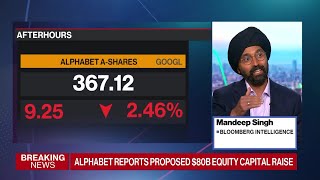
Alphabet had $126 billion in cash and marketable securities on its balance sheet as of March 31, 2026 [1]. It just announced an $80 billion equity raise — the largest in US corporate history [2]. Those two facts shouldn't fit together in a normal capital-allocation story, and short-seller Jim Chanos publicly flagged the dissonance, pointing to the cash pile as evidence the raise is harder to justify than the company is suggesting [1].
The arithmetic the company seems to be running is different. Q1 2026 capex was $35.7 billion, up 107% year over year, and full-year guidance now sits at $180-190 billion with 2027 expected to be materially higher [3]. Read against that capex curve, the raise is not really a contradiction with the cash position — it's an admission that AI capex has structurally outgrown internal cash generation, and that the cheapest dollar available right now is one printed in new shares.
Bloomberg Intelligence already projects Alphabet's 2027 capex at roughly $300 billion [4], which would require either another raise of this magnitude or a fundamental change in cloud unit economics.