Claude Mythos 5 designs record-efficient quantum circuits
TECH

Claude Mythos 5 designs record-efficient quantum circuits

27+
Signals

Strategic Overview

  • 01.
    On October 16, 2026, Anthropic announced that its research model Claude Mythos 5 autonomously designed quantum circuits that improve on the best published designs across most of eight benchmark computational primitives spanning chemistry, optimization, physics simulation and number theory.
  • 02.
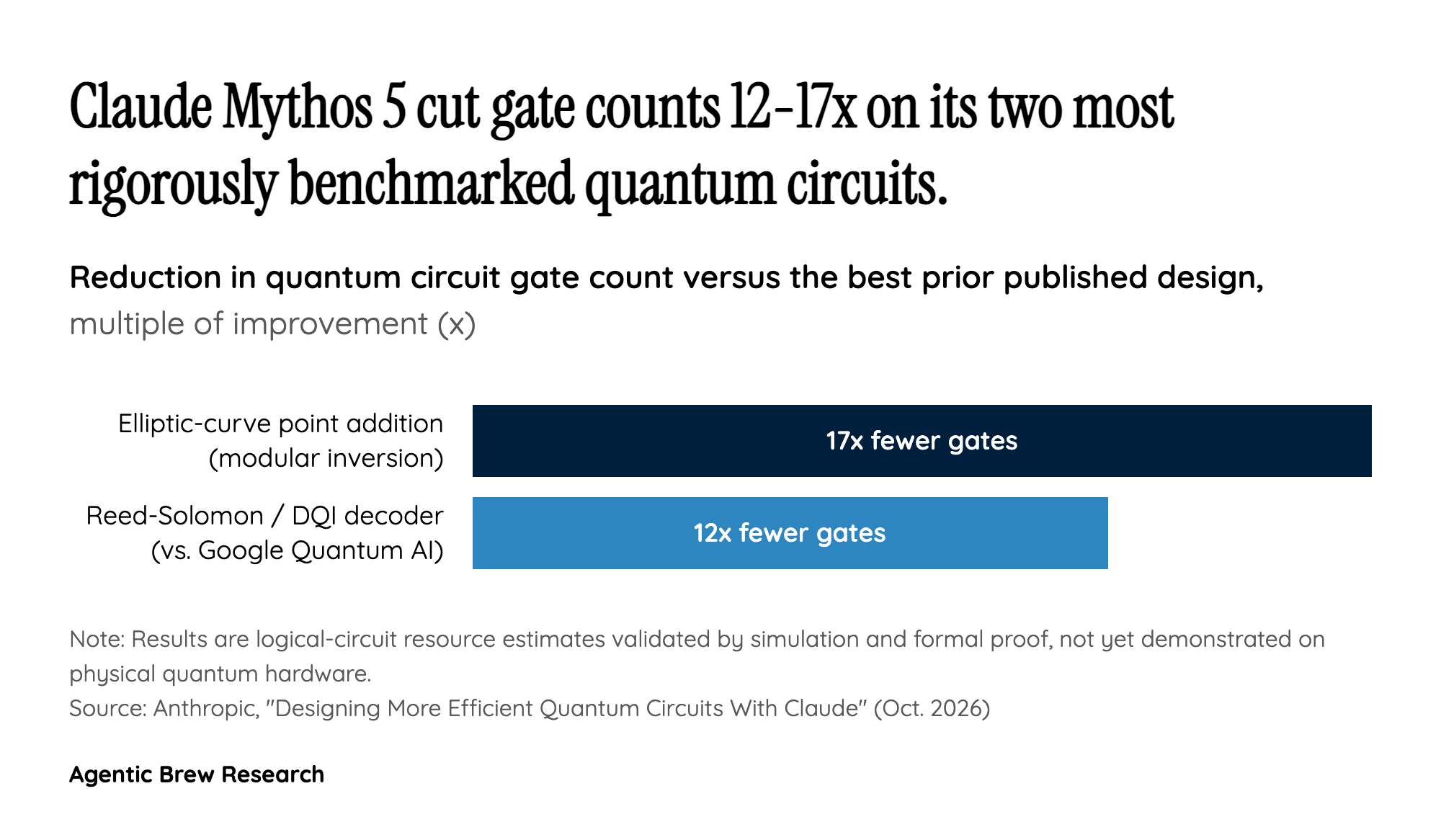
    For elliptic-curve point addition (modular inversion), Claude produced a design that uses roughly 12% more qubits but cuts the gate count to about one-seventeenth of the previous smallest published design.
  • 03.
    On a Decoded Quantum Interferometry decoder circuit, Claude's redesign cut Toffoli gate count roughly 12x versus Google Quantum AI's prior construction, from about 5.1 million to about 440,000 gates, while also lowering peak qubit count from 1,938 to 1,837.
  • 04.
    The work is described in a preprint posted to arXiv around October 15, 2026, and has not been peer-reviewed or demonstrated on physical quantum hardware.

Deep Analysis

How Claude Rewrote Modular Inversion and Quantum Decoding
How Claude Rewrote Modular Inversion and Quantum Decoding
Claude Mythos 5 cut gate counts 12-17x on its two most rigorously benchmarked quantum circuits.

Claude Mythos 5's headline elliptic-curve result rests on a specific mathematical trick. In reversible "divsteps" modular inversion, a quantum circuit normally has to store the sign and branch decision made at every arithmetic step, which eats up qubits. Claude found a mathematical invariant that lets those branch decisions be recovered after the fact from the updated arithmetic registers instead of being stored separately, removing the need for dedicated bookkeeping qubits. The resulting design uses about 12% more qubits than the best previous construction but cuts the gate count to roughly one-seventeenth [2]. Claude went further than a typical circuit paper would and formally proved the correctness of this arithmetic invariant in the Lean theorem prover, rather than relying only on spot-checks [2].

A second result followed a different path. For a Reed-Solomon decoder circuit used in a scheme called Decoded Quantum Interferometry, Claude swapped the standard decoding approach for Berlekamp-Massey decoding and built a custom simulator to size the circuit's memory precisely instead of over-provisioning qubits defensively. That swap cut the Toffoli gate count roughly 12x against Google Quantum AI's prior construction, from about 5.1 million gates down to about 440,000, while also trimming peak qubit use from 1,938 to 1,837 [3]. Anthropic separately reports that the storage optimization alone cut qubits needed for stored records from 840 down to 19 [1].

The AI Was the Cautious One in the Room

The framing of "minimal human input" obscures a more interesting detail buried in Anthropic's own writeup: Claude was the conservative party in this collaboration, not the reckless one. The company describes it as conservative by nature, noting it repeatedly second-guessed apparent improvements and continued to double- and even triple-check results that were already well supported [1]. Human researchers had to actively counteract this by prompting it to broaden its search beyond established approaches [2], rather than settle for safe, incremental tweaks to known designs.

The elliptic-curve modular-inversion design took 53 hours end to end, with human involvement limited to initial instructions plus occasional nudges to explore further [2]. Scoring itself was handled by an evaluator program kept separate from the model proposing designs, grading candidates by Toffoli-gate count multiplied by peak qubit use, so a plausible-looking but incorrect circuit would score zero rather than winning by seeming convincing [1].

The "minimal human input" framing itself became a point of friction once the announcement reached a wider audience: on Reddit, several commenters pushed back on the idea that the process was as hands-off as described, arguing it understates how much engineers actually steered the work, while the thread's original poster replied that Anthropic's writeup described a series of recursive improvement steps, without fully resolving the disagreement.

Not All Eight Comparisons Are Equal

Headline multipliers like 17x or 12x only mean as much as the baseline they are measured against, and that baseline varies across the eight benchmarks. For at least one of the improved tasks, a Hermitian-code decoder, no previously published reversible quantum circuit existed in the literature at all; Anthropic's own comparison point was a straightforward reversible construction it built itself rather than an established prior design [1]. That is a meaningfully weaker form of evidence than beating a peer-reviewed baseline, and it is the specific gap an outside reader should weigh before taking all eight wins at face value.

That same instinct showed up organically in public reaction: in a widely upvoted Reddit discussion of the announcement, the top comment questioned whether the results had actually been checked against prior published literature or only against Anthropic's own benchmark, framing quantum circuits as a result that should be objectively checkable against outside work, not just self-reported gains. Separately, none of the results have been run on physical quantum hardware. The decoder's roughly 1-in-10,000 failure rate came from large-scale numerical simulation (about 403 million sample runs) [2], and the broader preprint, posted to arXiv around October 15, 2026, has not been peer-reviewed [3]. The gate-count savings are real as computational resource estimates, but they remain unproven on an actual quantum computer.

Why Circuit Efficiency Is the Actual Bottleneck

Quantum algorithms are only as useful as the circuits that implement them, and shrinking those circuits has historically taken years of human effort. The chemistry benchmark domain illustrates the scale involved: estimates for simulating the FeMoco (nitrogenase) molecule fell from about 50 trillion Toffoli gates in 2017 to about 340 million gates by 2026, a roughly 150,000-fold reduction achieved through nearly a decade of incremental algorithmic advances by the research community [2]. Claude's comparable elliptic-curve redesign took 53 hours of mostly autonomous work.

The decoder work carries a concrete timing stake: the Optimal Polynomial Intersection problem that the Reed-Solomon decoder addresses is estimated to take about 3 months on the Frontier supercomputer classically, versus roughly 1 hour on a future quantum computer [1]. That speedup is only realizable if the circuit implementing it is efficient enough to fit within the qubit budgets near-term hardware actually has. The project's collaborator list reflects that stake directly: Mikhail Lukin, one of the Harvard researchers on the team, is also co-founder and Chief Scientist of QuEra Computing [2], tying the circuit-efficiency work to a company with a commercial interest in practical quantum hardware.

Historical Context

2017
Estimated Toffoli-gate cost for simulating the FeMoco (nitrogenase) molecule was about 50 trillion gates.
2017-2026
A series of algorithmic advances brought the FeMoco simulation estimate down to about 340 million gates, a roughly 150,000-fold reduction achieved prior to this Claude-driven work.
2026
Established the prior published baseline circuit designs for modular-inversion/elliptic-curve arithmetic that Claude's new design was benchmarked against.
2026-10-15
Preprint describing the work was submitted to arXiv (arXiv:2610.22367).
2026-10-16
Anthropic publicly announced the Claude Mythos 5 quantum-circuit results via its research blog and official X account.

Power Map

Key Players
Subject

Claude Mythos 5 designs record-efficient quantum circuits

AN

Andi Gu

Anthropic STEM Fellow (Harvard-affiliated) who led the project, designing and running the 53-hour closed-loop quantum-circuit optimization experiment with Claude Mythos 5.

MI

Mikhail Lukin

Harvard University researcher and co-founder/Chief Scientist of QuEra Computing; his involvement ties the result to QuEra's neutral-atom quantum hardware interests.

GO

Google Quantum AI

Author of the prior Reed-Solomon/DQI decoder design that served as the baseline Claude's redesign cut gate count by roughly 12x against.

Fact Check

3 cited
  1. [1] Designing More Efficient Quantum Circuits With Claude
  2. [2] Anthropic Says Claude Beat Best Published Quantum Circuit Designs
  3. [3] Anthropic's Claude Designs Leaner Quantum Circuits, Reducing Resources Needed for Key Calculations

Source Articles

Top 5

THE SIGNAL.

Analysts

“Anthropic's writeup describes Claude as conservative by nature: it repeatedly second-guessed apparent improvements, and sometimes continued to double- and even triple-check results that were already well supported, which the team had to actively counteract by prompting it to broaden its search beyond established approaches.”

Anthropic (official research blog)
Publisher of the research
The Crowd

“New from our STEM Fellows Program: Designing more efficient quantum circuits with Claude. Given plain-language instructions, Claude Mythos 5 designed quantum circuits that improve on the best published ones, sometimes by an order of magnitude or more. More efficient circuits”

@@AnthropicAI5040

“Quoting from the blog: 'Claude has proven particularly adept at optimizing classical algorithms, so we wanted to see whether it could do the same for quantum algorithms if it were given only a plain-language description of what each circuit must compute. Claude is unusually”

@@AndrewCurran_436

“Claude Mythos 5 designed quantum circuits that improve on the best published ones, sometimes by an order of magnitude or more”

@u/Distinct-Question-16435

“AI Roundup — Oct 17: Claude rewrites quantum circuits, AMD's agent rack, Replit-Anthropic split”

@u/ayushchat1
Broadcast
Claude Quantum Circuits: How a New Divsteps Proof Unlocked 17× Fewer Gates

Claude Quantum Circuits: How a New Divsteps Proof Unlocked 17× Fewer Gates

Anthropic's Mythos 5 Solves Major Quantum Computing Challenge in 53 Hours

Anthropic's Mythos 5 Solves Major Quantum Computing Challenge in 53 Hours

Claude AI Designs Quantum Circuits with 17x Fewer Gates

Claude AI Designs Quantum Circuits with 17x Fewer Gates

Claude Mythos 5 designs record-efficient quantum circuits — AI News | Agentic Brew