Early data on AI's impact on jobs proves awkward
TECH

Early data on AI's impact on jobs proves awkward

20+
Signals

Strategic Overview

  • 01.
    Despite widespread fears of an AI jobs apocalypse, there is still scant evidence of a large-scale hit to the US labor market - unemployment in the occupations most exposed to AI is actually lower than in less-exposed jobs.
  • 02.
    Only about one in five US companies use AI in any business function, according to US Census data.
  • 03.
    Workers aged 22 to 25 in the most AI-exposed occupations experienced a roughly 16% relative decline in employment after generative AI spread, even as aggregate employment held steady.
  • 04.
    The disruption is showing up as reduced hiring of junior workers rather than mass layoffs - fewer pathways into the workforce, not a sudden wave of job cuts.

The calm surface, the quiet squeeze

The most striking thing about the early AI-jobs evidence is how contradictory it is at two altitudes. Zoom out to the whole economy and there is still scant sign of a large-scale AI shock: unemployment in the occupations most exposed to AI is actually lower than in less-exposed jobs, and only about one in five US firms use AI in any business function at all [1]. Zoom in on young workers and the picture inverts. Workers aged 22 to 25 in the most AI-exposed occupations saw a roughly 16% relative decline in employment after generative AI spread, even as aggregate employment held steady [1]. Stanford's Digital Economy Lab lands on the same awkward straddle: the overall impact on aggregate employment is likely small right now, yet entry-level effects are real and studies conflict on how large [3]. As former BLS Commissioner Erika McEntarfer put it, 'It could be disruptive, but the data is telling us right now that disruption is not yet here, and we have time to plan' [1]. The apocalypse and the all-clear are both, in a narrow sense, supported by the numbers - which is exactly why the story refuses to resolve into a clean headline.

Why entry-level, and the pipeline time bomb

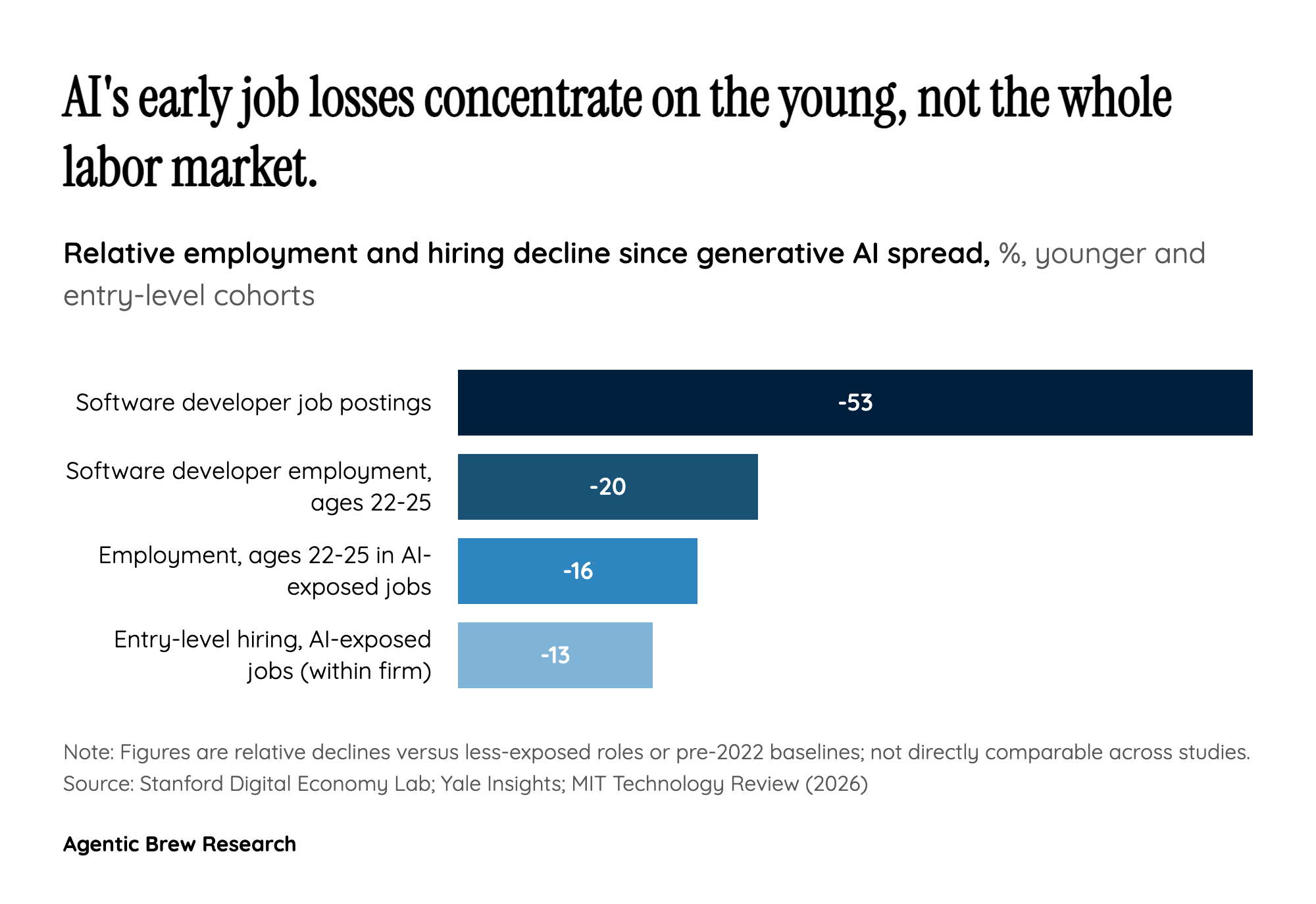
The mechanism explains why the damage concentrates on the young. Entry-level roles are structurally easier to automate than senior ones: AI can substitute for new graduates who bring book-learning but no experience, while complementing experienced workers whose value lies in tacit knowledge [1][4]. So the disruption arrives 'not as layoffs but as fewer pathways into the workforce' [4]. The signature already sits in the data - within AI-exposed firms, entry-level hiring fell 13% relative to less-exposed jobs, and software-developer employment among 22-to-25-year-olds dropped nearly 20% from its late-2022 peak as software-development job postings collapsed 53% [3][4]. Clinton Free of the University of Sydney Business School calls 'a decline in entry-level jobs' the clearest early signal of AI disruption [5]. The deeper worry, which surfaces repeatedly in community discussion, is a pipeline problem: if firms stop hiring juniors, they starve the pipeline that produces tomorrow's senior talent - the very experienced workers AI currently complements rather than replaces.

Flying blind: why nobody can cleanly blame AI

The awkwardness is not just in the findings - it is baked into the measurement. Harvard economist David Deming is blunt: 'We're sort of flying blind' [1]. Firm-adoption estimates swing wildly, from roughly 10% in Census data to about 44% in the Ramp AI Index, and international coverage barely exists [3]. Attribution is muddied further by confounding macro forces: broad hiring freezes driven by interest-rate hikes and economic uncertainty overlap with AI adoption, and UBS chief economist Paul Donovan argues 'the U.S. pattern more convincingly fits a broader hiring freeze narrative, affecting new entrants to the workforce' [7]. The studies themselves come pre-loaded with caveats. Anthropic's own research found no unemployment increase for exposed workers and only tentative evidence that hiring slowed for 22-to-25-year-olds - but critics note its empirical core is drawn from its own product's usage data, and the company itself concedes 'AI is far from reaching its theoretical capability: actual coverage remains a fraction of what's feasible' [2]. Cutting the other way, a firm-level study circulating on X across 21,000 US businesses found that heavy AI adopters actually grew headcount around 10% over two years. When Erik Brynjolfsson notes 'we're not investing even 1% of that on understanding the transition,' the flying-blind problem is not an accident - it is a funding choice [1].

By the age line: what the numbers actually say

By the age line: what the numbers actually say
The AI job squeeze concentrates on young and entry-level workers, with software roles hit hardest.

Strip away the narrative and the quantitative story lines up around one fault line - age and seniority. Among 22-to-25-year-olds in the most AI-exposed occupations, employment fell roughly 16% in relative terms and the job-finding rate dropped about 14% versus 2022 [1][2]. Within firms, entry-level hiring in AI-exposed jobs declined 13% relative to less-exposed roles, and software-developer employment for that age band fell nearly 20% from its late-2022 peak [3][4]. Recent-graduate unemployment now sits around 5.6-6%, roughly twice the economy-wide rate of about 4%, with CS majors at 7.0% and computer engineering at 7.8%, and 42.5% of recent grads underemployed [4][5]. Goldman Sachs pegs AI as a steady drag of about 16,000 lost US jobs per month [4]. Yet the aggregate stays placid because blue-collar work absorbed the slack - blue-collar employment added roughly 1 million more jobs than white-collar roles over three years [5]. And there is a wage paradox: employment in AI-exposed sectors trails the rest of the economy while wages in those same sectors outpace national averages, exactly what you would expect if AI is substituting for juniors while augmenting the experienced [6]. For contrast, the WEF's 2025 forecast still projects a net gain - 92 million jobs displaced by 2030 against 170 million created [8].

Historical Context

2016
High-profile predictions that later missed - that radiologists would be obsolete and driverless trucks would eliminate 2.2 to 3.1 million jobs - echoed earlier waves of unfounded technological-unemployment fears.
2022-11-30
ChatGPT launched and reached over 100 million users within two months, marking the inflection point after which entry-level employment declines start showing up in the data.
2025
The Future of Jobs Report 2025 projected 92 million jobs displaced by 2030 against 170 million created, a net gain of 78 million.
2026-05-26
Published a reality check arguing the AI jobs hysteria outruns the evidence, with exposed occupations showing lower unemployment even as young workers quietly lose ground.

Power Map

Key Players
Subject

Early data on AI's impact on jobs proves awkward

AN

Anthropic

Published a March 2026 study introducing an 'observed exposure' measure built from Claude conversation and API traffic; it found no unemployment increase for exposed workers but tentative evidence of a hiring slowdown for 22-to-25-year-olds. Critics note its empirical core is its own product's usage data.

ST

Stanford Digital Economy Lab

Produced the research documenting employment declines concentrated among 22-to-25-year-old workers in AI-exposed jobs, and catalogs what is and isn't known about AI's labor impact.

GO

Goldman Sachs

Estimates AI is acting as a steady drag, reducing US employment by roughly 16,000 jobs per month over the past year, with young and entry-level workers absorbing most of the impact.

US

US Census Bureau / BLS

Provide the adoption and employment baselines - roughly one in five firms using AI, and occupational unemployment data showing exposed jobs are not yet worse off in aggregate.

Fact Check

8 cited
  1. [1] A reality check on the AI jobs hysteria
  2. [2] Anthropic: Labor market impacts of AI
  3. [3] AI and Labor Markets: What We Know and Don't Know
  4. [4] The Real Job Destruction From AI Is Hitting Before Careers Can Start
  5. [5] Employment data shows the early signs of AI job disruption are already here
  6. [6] Dallas Fed: AI exposure and the labor market
  7. [7] AI Job Loss Statistics
  8. [8] AI, jobs and International Workers' Day

Source Articles

Top 1

THE SIGNAL.

Analysts

"Argues the data does not yet show large-scale disruption, leaving a window to plan: 'It could be disruptive, but the data is telling us right now that disruption is not yet here, and we have time to plan.'"

Erika McEntarfer
Stanford Institute for Economic Policy Research; former BLS Commissioner

"Says the data on AI's true labor impact is so thin that analysts are essentially guessing: 'We're sort of flying blind.'"

David Deming
Harvard economist

"Notes vast sums flow into deploying AI but almost nothing into understanding the labor transition it triggers: 'we're not investing even 1% of that on understanding the transition.'"

Erik Brynjolfsson
Director, Stanford Digital Economy Lab

"Argues the US pattern 'more convincingly fits a broader hiring freeze narrative, affecting new entrants to the workforce' rather than an AI-specific one."

Paul Donovan
Chief Economist, UBS

"Calls 'a decline in entry-level jobs' the clearest early signal of AI disruption, with graduate underemployment already elevated."

Clinton Free
Academic Director, University of Sydney Business School
The Crowd

"We can finally say AI isn't killing jobs. A new paper from me, @tryramp, and @RevelioLabs uses firm-level spend and workforce data across 21K U.S. businesses to measure AI's impact on jobs. Firms that adopt AI heavily grow headcount 10% over two years following adoption. Low"

@@arakharazian2730

"People who say that AI will create more jobs can't say what those jobs will be. AI will be cheaper and better than every human worker at everything. Why would an employer hire you when they can get a better AI worker for 1% of the cost? Why would you pay 100X more for less?"

@@davidpattersonx152

"Why AI makes jobs instead of loses them. 1. There are more profitable ideas/projects than time, talent, and general resources there are to realize them. 2. AI lowers the talent and resources bar substantially leading to more ideas becoming reality. 3. Successful idea/project ="

@@bubbleboi107

"Employers who laid off workers citing AI are already starting to regret it"

@u/ieight915484
Broadcast
Will AI Actually Take Your Job? Here's What the Data Say.

Will AI Actually Take Your Job? Here's What the Data Say.

Is AI Really Taking Software Jobs? What the Data Actually Says

Is AI Really Taking Software Jobs? What the Data Actually Says

AI and Jobs: What Data and History Say

AI and Jobs: What Data and History Say