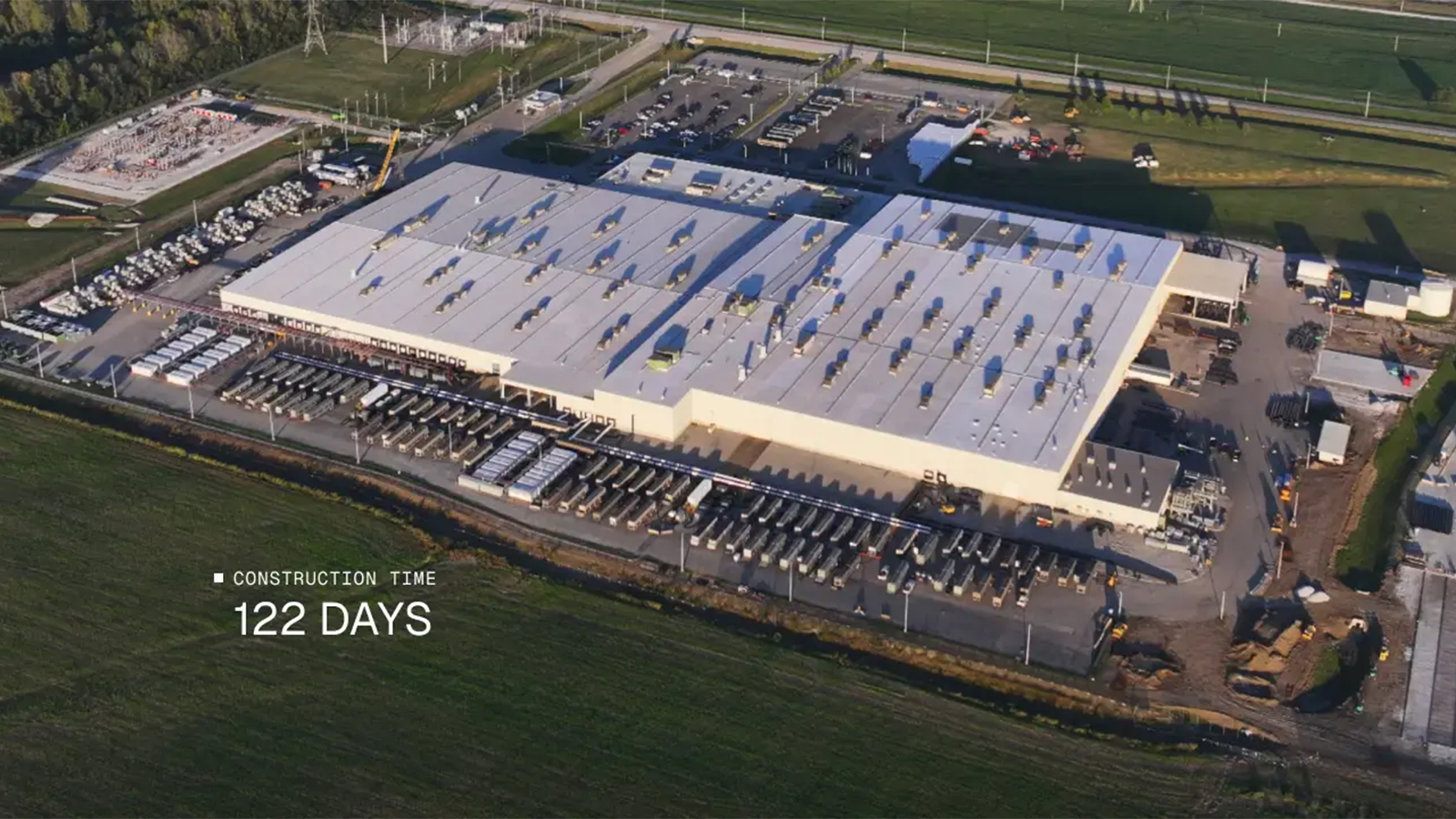
SpaceX orbital AI compute and the AI1 satellite
TECH

SpaceX orbital AI compute and the AI1 satellite

30+
Signals

Strategic Overview

  • 01.
    SpaceX unveiled AI1, its first-generation AI satellite, with a 150 kW peak (120 kW average) compute payload and a 70-meter deployed wingspan, roughly the compute of a single GB300-class server rack placed in orbit.
  • 02.
    In a May 20, 2026 S-1 filing, SpaceX recast itself as a vertically integrated AI infrastructure company trading on Nasdaq under ticker SPCX, with orbital compute satellites targeted for deployment as early as 2028.
  • 03.
    SpaceX is already renting terrestrial GPU capacity at scale, drawing roughly $1.25 billion a month from Anthropic and about $920 million a month from Google.
  • 04.
    Elon Musk announced TeraFab, a roughly $20 billion chip factory to manufacture space-hardened D3 chips, and SpaceX filed with the FCC for a constellation of up to one million orbital data-center satellites.

Deep Analysis

The Rocket Company That Filed an AI Manifesto

When SpaceX filed its S-1 with the SEC on May 20, 2026, the headline read 'space IPO' but the document described something else entirely: the most vertically integrated artificial-intelligence infrastructure bet ever attempted [1]. xAI is now folded into SpaceX as an operating segment, and the filing disclosed $12.7 billion in AI capital expenditure in 2025 alone, more than the company spent on launch and Starlink combined [1]. The company will trade on Nasdaq under the ticker SPCX at a valuation near $1.5 trillion, in what would rank among the largest public offerings ever [2].

The logic threaded through the prospectus is vertical integration as a moat. SpaceX already owns the launch vehicle in Starship, the satellites, and an energy story in orbital solar, and now it wants to own the compute and the chips too. Where rivals rent capacity from cloud providers, Musk is betting that controlling every layer of the stack, from the rocket to the GPU to the AI training software, is how you win the compute race. The offering is framed not as a liquidity event for a mature rocket business but as the funding mechanism for a capital-growth phase measured in hundreds of billions of dollars [2].

Follow the Money: SpaceX Is Already an AI Cloud Company

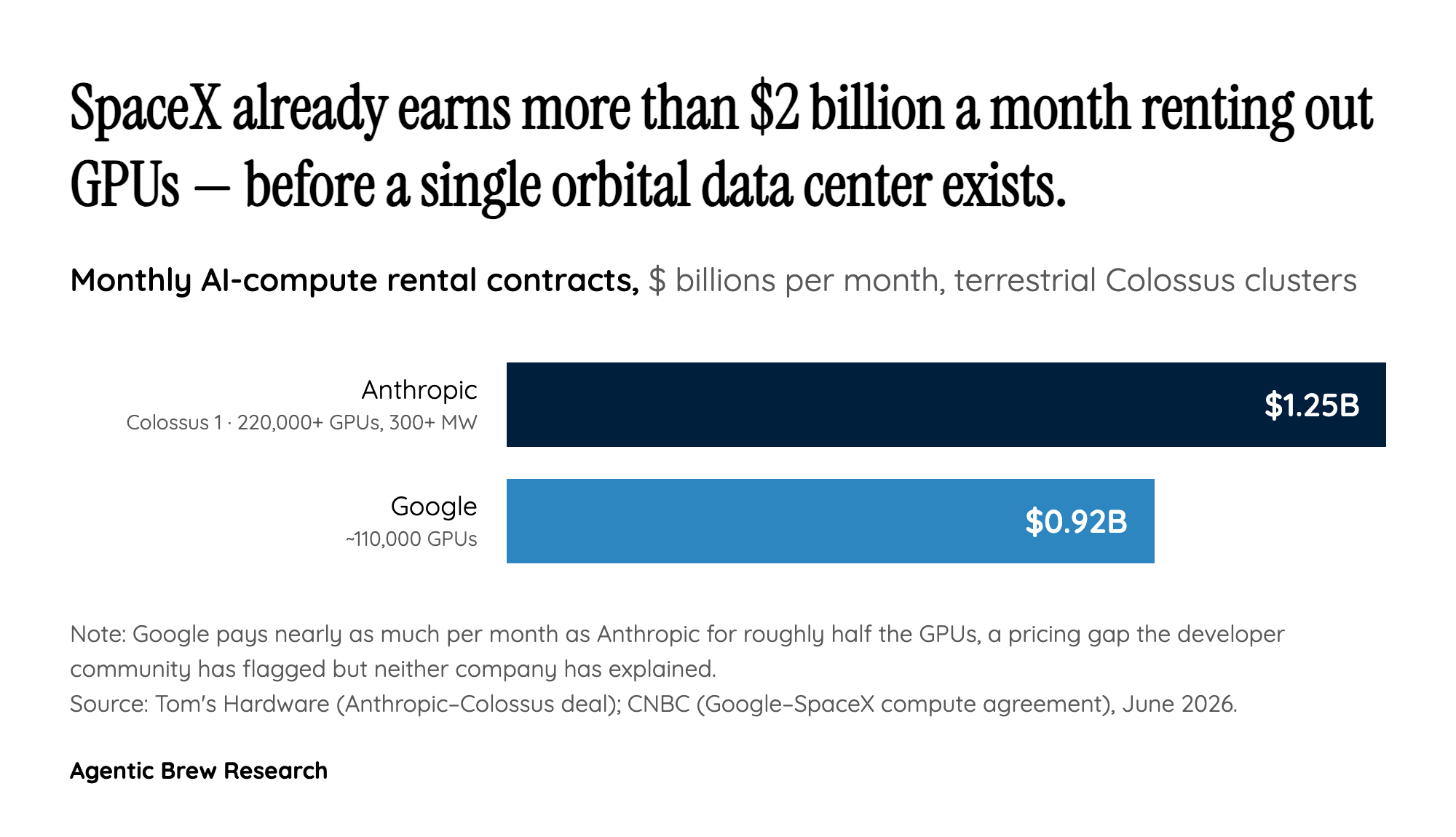
Follow the Money: SpaceX Is Already an AI Cloud Company
SpaceX's monthly GPU-rental contracts with Anthropic and Google already exceed $2 billion combined.

Strip away the orbital ambitions and a more immediate truth emerges: SpaceX is already one of the largest AI compute landlords on Earth, and that business is what underwrites everything else. Anthropic agreed to rent effectively all available capacity from the Colossus 1 cluster, more than 220,000 NVIDIA GPUs and over 300 megawatts of power, at a reported $1.25 billion per month [3]. Separately, Google committed to roughly $920 million per month for access to about 110,000 GPUs [4]. Together that is over $2 billion a month in compute rental revenue flowing into a company that, on paper, sells rockets.

The numbers also contain a puzzle the developer community seized on: Google is paying nearly as much per month as Anthropic for roughly half the GPUs. The likeliest explanations, newer Blackwell-class silicon in Google's allocation, reservation pricing in a supply-constrained market, or throughput rather than raw chip count, are plausible but unconfirmed, and the gap has fueled speculation that the contracts are as much about financial optics ahead of the IPO as about raw compute. Underneath the rentals, SpaceX is building its own edge: a bare-metal AI training stack written in C and mapped exactly to 220,000 GB300 GPUs over 800G network cards, pitched as materially faster for large training runs than the frameworks rivals use [5].

The Physics Fight Over Whether Any of This Should Be in Orbit

The orbital half of the strategy runs straight into a wall of skepticism from engineers and energy analysts. The core objection is deceptively simple: as critics put it, why should a watt or a flop be more valuable 250 miles up than on the surface [7]? In orbit, a compute satellite must reject enormous waste heat through radiators alone, with no air or water for convective cooling, while swinging between roughly +120C in sunlight and -250C in shadow each orbit. Radiation degrades chips far faster than on the atmosphere-shielded ground, and GPUs depreciate every few years, meaning a fleet in space implies a permanent and expensive cadence of launches and robotic servicing just to stay current. The Breakthrough Institute argued that even a successful demonstration would only be a first step and would not show that large-scale orbital data centers are feasible, noting the entire model depends on a still-in-development Starship and continued declines in launch cost [6].

Musk's rebuttal is characteristically blunt. He has dismissed 'a bizarre debate about radiators in space' and insists the binding constraint is terrestrial power, not orbital cooling [8]. Notably, even the enthusiast corners of the internet are not taking the claims on faith: when the AI1 reveal circulated, the most engaged technical threads were not cheerleading but working through the Stefan-Boltzmann radiative-cooling math line by line, treating the thermal budget as the real test of the concept.

What AI1 Actually Is, and the Trillion-Chip Bet Behind It

For all the grandeur, AI1 itself is modest: a 150-kilowatt peak (120-kilowatt average) compute payload at 70 kilowatts per ton, with a 70-meter deployed wingspan, roughly the compute of a single modern GB300-class server rack placed in orbit [9]. SpaceX describes the platform, internally nicknamed 'AI Sat Mini,' as operating at 600 to 800 km altitude with a roughly 100-square-meter radiator, linked by laser mesh or through Starlink [8]. AI1 is a demonstrator, not the destination. The destination is staggering in scale: SpaceX filed with the FCC in January 2026 for a constellation of up to one million satellites to function as an orbital AI data center [8], with the first orbital compute satellites targeted for deployment as early as 2028 [1].

The hidden keystone is silicon. Musk announced TeraFab, a roughly $20 billion vertically integrated chip factory that would manufacture logic and memory plus packaging, with the bulk of output earmarked for a space-hardened chip called D3 designed to run hotter and survive radiation [10]. The bet is that no existing supplier can produce space-rated chips at the volume an orbital data-center empire would require, so SpaceX intends to build that capacity itself. It is the same vertical-integration instinct that runs through the entire strategy, extended all the way down to the transistor.

Historical Context

2026-01
Filed an application with the FCC for a constellation of up to one million satellites to serve as an orbital AI data center.
2026-03-21
Announced TeraFab, a roughly $20 billion vertically integrated chip factory targeting space-hardened D3 chips.
2026-05-06
Agreed to take all available compute from the Colossus 1 cluster (220,000+ GPUs, 300+ MW) and expressed interest in orbital AI compute.
2026-05-20
Filed its S-1 with the SEC, recasting itself as an AI infrastructure company under ticker SPCX.
2026-06-05
Agreed to pay SpaceX roughly $920 million a month for about 110,000 GPUs of xAI compute capacity.

Power Map

Key Players
Subject

SpaceX orbital AI compute and the AI1 satellite

SP

SpaceX / xAI

Builder of AI1, the terrestrial Colossus GPU clusters, a custom AI training stack, the TeraFab chip factory, and the planned orbital constellation; pursuing what would be the largest IPO ever to fund it.

EL

Elon Musk

Architect of the space-and-AI strategy; pitched orbital compute at the JPMorgan investor event and retains supervoting control through a dual-class share structure.

AN

Anthropic

Agreed to rent effectively all available Colossus 1 compute (220,000+ GPUs, 300+ MW) at a reported $1.25 billion per month and is reportedly interested in orbital compute; Musk said it passed his 'evil detector.'

GO

Google

Committed to roughly $920 million per month for access to about 110,000 GPUs of xAI compute capacity, making it one of SpaceX's largest compute customers.

NV

NVIDIA

Supplies the GB300 / Blackwell GPUs that underpin both the terrestrial Colossus clusters and the orbital AI satellite payloads, making it the silicon backbone of the entire plan.

Fact Check

10 cited
  1. [1] SpaceX IPO Filing Recasts Company as AI Infrastructure Giant
  2. [2] The SpaceX IPO filing: AI bets, Starship dreams, and Elon Musk
  3. [3] Musk's SpaceX has rented out access to its supercomputers to rival Anthropic
  4. [4] Google to pay SpaceX $920 million a month for xAI compute capacity
  5. [5] SpaceX Builds Custom AI Training Stack for 220,000 GPUs
  6. [6] Data Centers Won't Be in Space Anytime Soon
  7. [7] Could data centers in space help avoid an AI energy crisis? Experts are torn
  8. [8] SpaceX offers details on orbital data center satellites
  9. [9] SpaceX/xAI details gigawatt-scale AI data centers in LEO
  10. [10] Elon Musk announces TeraFab, $20bn factory will make chips for SpaceX orbital data centers and Tesla vehicles

Source Articles

Top 5

THE SIGNAL.

Analysts

"Dismisses skepticism over orbital cooling as 'a bizarre debate about radiators in space,' arguing the binding constraint on AI is terrestrial power, not heat rejection in orbit."

Elon Musk
CEO, SpaceX / xAI

"Argues that even a successful demonstration would not prove large-scale orbital data centers are feasible, with viability hinging on a still-in-development Starship and continued launch-cost declines."

Breakthrough Institute
Energy and technology think tank

"Question why a watt or a flop should be more valuable 250 miles up than on the surface, citing launch cost, rapid GPU depreciation, and the difficulty of servicing hardware in orbit."

Data-center and AI infrastructure analysts
Aggregated industry critics

"Reversed earlier criticism of Anthropic after meeting its leadership, framing the compute deal around AI that benefits humanity and saying 'no one set off my evil detector.'"

Elon Musk
CEO, SpaceX / xAI
The Crowd

"As the recently expanded partnership with @AnthropicAI demonstrates, @SpaceX is offering AI compute as a service at significant scale. We are in discussions with other companies to do the same. Over time, especially with orbital data centers, we expect to serve AI at extremely"

@@elonmusk72378

"SpaceX has just officially unveiled its AI1 satellite, the first generation of its AI satellite. Overall Specs: • 150 kW peak compute payload • 120 kW average compute payload • 70 kW per ton • Compute provider interchangeable Dimensions: • Wingspan: 70 meters • Deployed"

@@SawyerMerritt4628

"Watch @ElonMusk provide a technical update on SpaceX's capability to manufacture, launch, and operate AI satellites at scale → https://t.co/PSCyWrNsOg"

@@SpaceX5793

"SpaceX Quietly Became an AI Cloud Company and Google Is Paying Almost $1B/Month for GPU Compute"

@u/tke2485400
Broadcast
Elon's Master Plan Just Leaked In The SpaceX S-1

Elon's Master Plan Just Leaked In The SpaceX S-1

SpaceX's IPO and the most ambitious AI bet ever attempted — 5/21/2026

SpaceX's IPO and the most ambitious AI bet ever attempted — 5/21/2026

Spaceflight Weekly News: Elon Debuts Massive "AI Sat Mini" For Space-Based Data Center Constellation

Spaceflight Weekly News: Elon Debuts Massive "AI Sat Mini" For Space-Based Data Center Constellation