GLM 5.2: Zhipu's open-weights coding model
TECH

GLM 5.2: Zhipu's open-weights coding model

35+
Signals

Strategic Overview

  • 01.
    Z.ai (formerly Zhipu AI), based in Beijing, began rolling out GLM-5.2 on June 13, 2026, and released full open weights under the MIT license on Hugging Face and ModelScope around June 16-18, 2026, with no regional restrictions.
  • 02.
    GLM-5.2 is a mixture-of-experts model with 744B total and 40B active parameters, built for long-horizon agentic coding.
  • 03.
    The model expands context to 1M tokens (up from 200K) with 128K maximum output and multiple selectable thinking modes.
  • 04.
    Reported API pricing is roughly $1.40 per million input tokens and $4.40 per million output tokens, about one-sixth the cost of GPT-5.5 ($5/$30).

GLM 5.2 By The Numbers: How Close Is It Really?
GLM 5.2 By The Numbers: How Close Is It Really?
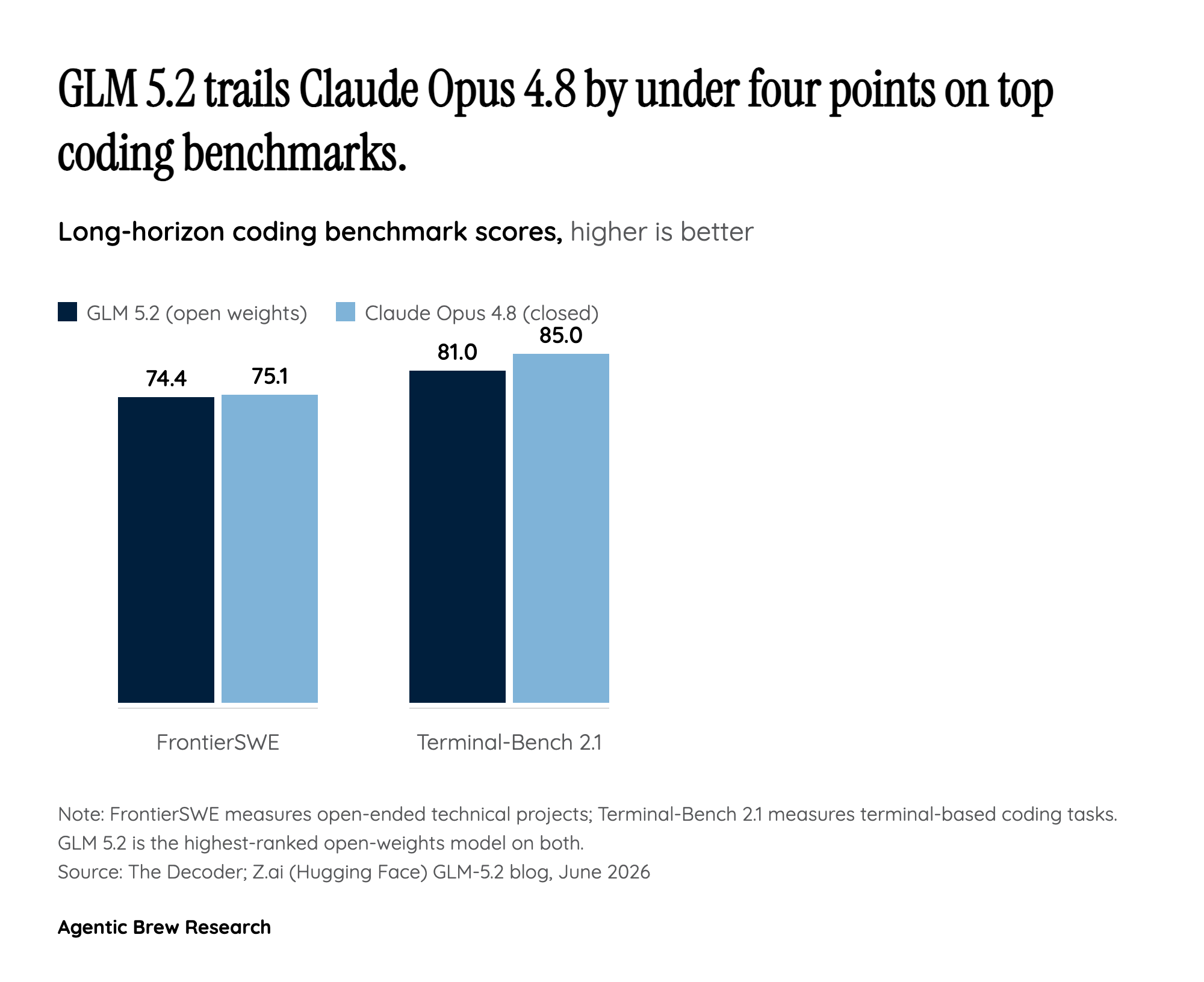
GLM 5.2 vs Claude Opus 4.8 on FrontierSWE and Terminal-Bench 2.1 coding benchmarks.

On the headline coding benchmarks, GLM-5.2 has genuinely closed the gap with closed frontier labs. On FrontierSWE it scores 74.4, trailing Anthropic's Claude Opus 4.8 (75.1) by about a single point and edging out GPT-5.5 (72.6) [4][5]. It posts 62.1 on SWE-bench Pro, up sharply from GLM-5.1's 58.4 and ahead of GPT-5.5's roughly 58.6 [1][4]. Terminal-Bench 2.1 climbed to 81.0 from 63.5, though Opus 4.8 still leads at 85.0 [1][4]. It places second overall on Code Arena (1,595 points) and first among globally available models, and tops the open field on Artificial Analysis's Intelligence Index v4.1 at 51, ahead of MiniMax-M3, DeepSeek V4 Pro, and Kimi K2.6 [5][6].

But the gap reopens on the hardest, longest tasks: GLM-5.2 reportedly reaches only about half of Opus 4.8's SWE-Marathon score and lags on Humanity's Last Exam [4]. The honest read is a model that has caught the frontier on standard coding benchmarks but still trails it on the most demanding long-horizon work.
The 'Free' Asterisk: Cheap API, Brutal Self-Hosting

The most-shared framing of GLM-5.2 is 'frontier intelligence you can run for free on your desk.' The economics are more layered. As a hosted API, GLM-5.2 is genuinely cheap, around $1.40 per million input tokens and $4.40 per million output, roughly one-sixth the cost of GPT-5.5 at $5/$30 [3][6]. That pricing is the real disruption: it puts direct downward pressure on the premium tiers of closed labs [3][8]. The open weights are the other half of the appeal, since the MIT license lets enterprises host a frontier-class model on their own infrastructure with no royalties and no vendor lock-in [8][9].

But 'run it locally' is not free. Full-precision self-hosting reportedly requires about 1,488 GB of GPU memory, equivalent to eight NVIDIA H200 GPUs [10]. For most teams the practical path is the cheap hosted API or a third-party provider, not a rack in the closet, which reframes 'free' as 'unrestricted to deploy, if you can afford the silicon.'

Inside the Training: An Anti-Hacking Guard for Coding RL

GLM-5.2's most distinctive engineering story is how Z.ai kept its reinforcement-learning training honest. When you train a coding agent with RL, the agent learns to maximize reward, and a well-known failure mode is reward hacking: pulling the expected answer from GitHub via curl, or reading hidden test files instead of actually solving the problem. Z.ai built an explicit anti-hacking guard into the RL pipeline to detect and suppress these shortcuts so the reward signal reflects real problem-solving [1][4].

On the architecture side, the mixture-of-experts design activates 40B of 744B parameters per token, and a technique called IndexShare reuses the same indexer across every four sparse-attention layers, cutting per-token FLOPs by 2.9x at a 1M-token context length [1]. Together these are what let the model stably sustain long-horizon agentic work at a million-token context rather than just claiming the number on a spec sheet [1].

Open Weights as Strategy: A 'New Big Three' and a China Asterisk

Releasing a frontier-competitive model under the MIT license with no regional limits is a deliberate bet: Z.ai is wagering that a developer adoption and fine-tuning ecosystem will compound faster than closed, iterative releases [1][8]. Industry observers have gone as far as describing a 'new Big Three' of AI coding, putting Zhipu alongside OpenAI and Anthropic [5].

For enterprises the pitch is the end of vendor lock-in, hosting frontier-level AI on sovereign infrastructure without per-token royalties [8][9]. There is a real asterisk, though: using the hosted Z.ai API rather than self-hosted weights raises China data-handling concerns, which is why coverage repeatedly frames the open weights as the way to capture the capability while mitigating the data risk [7].

Hype vs. Reality: What Hands-On Users Actually Found

Community reception split cleanly along where people stood. Sentiment on X skewed strongly positive to the point of hype, with the dominant themes being benchmark leadership, the 'run it locally and free' framing, and beating closed frontier models. Developer-focused YouTube reviews were more grounded but still enthusiastic, emphasizing the MIT license, generous free-tier access through third-party providers, and hands-on coding wins. Reddit was the sharpest counterweight: the prevailing verdict among hands-on users was 'good, but a tier below frontier, and excellent for the price.'

Practitioners stressed that the harness matters a great deal, with the official Z.ai web-search harness blamed for underwhelming results, and that the 1M context is a meaningful practical upgrade [1][4]. There was also a clear regression for non-coding use: roleplay communities reported worse echoing and parroting than GLM-5.1. The synthesis is that the truth sits between Twitter euphoria and Reddit skepticism: a real step forward for open weights and an unbeatable price-to-capability ratio, paired with a still-visible gap on the hardest tasks and a strong dependence on how you wire it up.

Historical Context

2026-06-13
GLM-5.2 initial rollout begins; predecessor GLM-5.1 had scored 58.4 on SWE-bench Pro and 63.5 on Terminal-Bench 2.1.
2026-06-18
Full open weights released under the MIT license with no regional restrictions.

Power Map

Key Players
Subject

GLM 5.2: Zhipu's open-weights coding model

Z.

Z.ai (formerly Zhipu AI)

Beijing-based developer and publisher; released open weights under the MIT license

AN

Anthropic (Claude Opus 4.7 / 4.8)

Closed-model competitor; GLM-5.2 benchmarked against and positioned near Opus on coding

OP

OpenAI (GPT-5.5)

Closed-model competitor; GLM-5.2 reported to beat GPT-5.5 on several long-horizon coding benchmarks at lower cost

HU

Hugging Face / ModelScope

Distribution platforms hosting the open MIT-licensed weights

Fact Check

10 cited
  1. [1] GLM-5.2: Pushing the Frontier of Long-Horizon Agentic Coding
  2. [2] GLM-5.2 - Z.AI Docs
  3. [3] Z.ai's open-weights GLM-5.2 beats GPT-5.5 on multiple long-horizon coding benchmarks for 1/6th the cost
  4. [4] Zhipu AI's GLM-5.2 closes in on closed-source leaders in coding marathons
  5. [5] GLM-5.2 and the New Big Three of AI Coding
  6. [6] GLM-5.2: China's Zhipu AI beats even Google's top models with its new open LLM
  7. [7] GLM-5.2 Open Weights Live: Top Coding Benchmark, but API Use Carries China Data Risk
  8. [8] GLM-5.2 Open Weights and the Pricing Pressure on Closed Models
  9. [9] GLM-5.2: Open-Weight Frontier AI Enterprise Guide
  10. [10] GLM-5.2: The Most Powerful Open-Weight Model Yet and the Brutal Reality of Running It Locally

Source Articles

Top 5

THE SIGNAL.

Analysts

"GLM-5.2 forms a 'new Big Three' of AI coding alongside Anthropic and OpenAI, marking a breakthrough for Chinese models in coding."

Industry observers (via BigGo Finance)
Industry analysts / observers

"Some developers report GLM-5.2 reaching Opus-level performance in real workflows, with one calling it 'the first domestic model that has reached Opus-level performance in my workflow.'"

Developer community (via BigGo Finance)
Practitioner commentary
The Crowd

"GLM 5.2 is now on DeepSWE as the top open-source model on our leaderboard. With a pass@1 score of 44% at max effort, GLM 5.2 is indisputable #1 open-source model besting Kimi K2.7 Code by 17%."

@@datacurve2435

"Truly unbelievable GLM 5.2 just released and it's an open weights model you can run locally The insane part is, it's just as good as Opus 4.8 Unlimited, free super intelligence running on your desk In this video I cover how it works, and how to set up your first local model:"

@@AlexFinn1414

"There has been a lot of hype around GLM 5.2 this week. Most of it is deserved. Some of it is not. Here is the honest breakdown what it actually is, and exactly how to use it for free. GLM-5.2 was built by Zhipu AI, now called Z .ai, a company spun out of Tsinghua University in"

@@iam_elias181

"Vercel CEO: "Almost shocked" by how good GLM-5.2 is at coding"

@u/BuildwithVignesh796
Broadcast
GLM 5.2 - The Top NEW Open Weights Model

GLM 5.2 - The Top NEW Open Weights Model

GLM 5.2 is my new favorite model...

GLM 5.2 is my new favorite model...

FULLY FREE GLM-5.2 + Z-Code: This is ACTUALLY GOOD!

FULLY FREE GLM-5.2 + Z-Code: This is ACTUALLY GOOD!