Ornith-1.5: DeepReinforce's self-improving open-weight model vs. Claude Opus 4.8
TECH

Ornith-1.5: DeepReinforce's self-improving open-weight model vs. Claude Opus 4.8

26+
Signals

Strategic Overview

  • 01.
    DeepReinforce released Ornith-1.5 in August 2026, an open-weight model family spanning 9B, 35B mixture-of-experts, and 397B mixture-of-experts variants, all under an MIT license.
  • 02.
    The release is built around what DeepReinforce calls a self-improving reinforcement learning loop, in which the model generates and scores its own training signal rather than training purely on a static human-curated dataset.
  • 03.
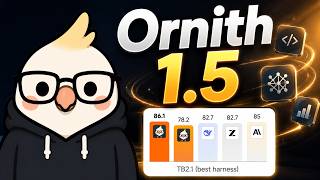
    DeepReinforce's flagship 397B variant reports 86.1 on Terminal-Bench 2.1 versus Claude Opus 4.8's 85.0, 86.0 on SWE-Bench Verified versus Opus 4.8's 85.8, and 80.8 on WideSearch versus Opus 4.8's 72.9.
  • 04.
    Separate coverage of the release cites a broader claimed evaluation suite - including GPQA Diamond, BrowseComp, and a DeepSWE benchmark progression - that DeepReinforce points to as evidence the self-improvement loop compounds gains over training runs.
  • 05.
    That same trade coverage also reports a benchmark where Ornith-1.5 trails: the 397B flagship scores 13.5 on Frontier-Bench v0.1, versus Claude Opus 4.8's 21.1.

How the Self-Improvement Loop Actually Works

DeepReinforce built Ornith-1.5 around what it calls a self-improving reinforcement learning loop: instead of training purely against a static, human-curated dataset, the model generates candidate solutions, scores them, and folds the highest-quality examples back into its own next training pass [1]. That's a meaningful step past the label DeepReinforce used for its prior generation of models - self-scaffolding - where the model could write and revise its own tool-calling code but the reward signal itself still came from a fixed, human-defined rubric [2]. The distinction DeepReinforce is drawing matters for where the bottleneck on future capability gains sits: with self-scaffolding, a lab is still limited by how much human-labeled reward data it can produce; with self-improvement, the model's own scoring becomes part of the training loop, at least in theory decoupling capability gains from the pace of human annotation.

The family ships in three sizes - 9B, a 35B mixture-of-experts, and a flagship 397B mixture-of-experts - all under an MIT license, notable because prior frontier-adjacent open-weight releases have more often shipped under research-only or custom commercial terms that restrict production use [3]. An MIT license on a 397B model that claims to compete with a closed frontier model is itself part of the story: it puts every one of DeepReinforce's benchmark claims in a position to be independently reproduced, which is exactly what happened within days of release.


Beats Opus 4.8 - Depending Which Benchmark You Trust

DeepReinforce's own numbers are unambiguous on paper: the 397B flagship scores 86.1 on Terminal-Bench 2.1 against Claude Opus 4.8's 85.0, 86.0 on SWE-Bench Verified against Opus 4.8's 85.8, and 80.8 on WideSearch against Opus 4.8's 72.9 [1][4]. Separate trade coverage of the launch cites a broader suite - GPQA Diamond, BrowseComp, and a DeepSWE score that climbed from 8.0 in Ornith-1.0 to 56.0 in Ornith-1.5, a 48-point gain - that DeepReinforce points to as evidence the self-improvement loop compounds gains across training runs rather than producing a one-off high score [3][5].

Independent testing has been less clean. A community benchmark comparison circulating on X, built around a suite its author calls One-Spark, put the smaller Ornith-1.5-35B variant at 88.7 overall against a same-class Qwen3.8-27B model's 89.4 - Qwen took the overall crown by less than a point. The split by category is the more interesting part: Ornith came out ahead on code generation, long-context handling, agentic workflows, and tool use, while Qwen won on safety, robustness, and planning. Reddit's own community-assembled benchmark table tells a similar story from a different angle - it shows Qwen3.8-27B leading on Terminal-Bench 2.1, SWE-bench Pro, DeepSWE, and HLE, the very DeepSWE metric DeepReinforce cites as proof of its self-improvement gains, while Ornith-1.5's 35B-A3B variant wins on NL2Repo and ties on GPQA Diamond. None of this makes DeepReinforce's numbers false - they're reproducible on the benchmarks DeepReinforce chose to publish - but it means 'beats Opus 4.8' depends heavily on which suite, which size, and whose reproduction you're reading.

Cracks in the Release - the Untrained Head and the Identity Problem

The most concrete technical problem surfaced fast: Ornith-1.5's multi-token-prediction (MTP) decode head - the component responsible for its faster inference - shipped effectively untrained, causing garbled or repetitive output in several quantized builds until the community patched around it. That single bug did more to slow real-world adoption than any benchmark dispute, because it hit exactly the audience most likely to actually run the weights rather than just read about them.

There's also a quieter question about what Ornith-1.5 actually is under the hood. Community reverse-engineering points to a Qwen 3.5/3.6 base rather than a from-scratch model - the model's own config file reportedly names a Qwen 3.5 MoE architecture - and one Reddit analysis noted Ornith could not have fine-tuned Qwen3.8-27B directly, since Qwen never publicly released that specific base checkpoint (only an instruct-tuned version). That doesn't invalidate the self-improvement claims, but it reframes them: the loop may be doing real work on top of an existing capable base rather than building capability from nothing, a different and more modest claim than 'self-improving from scratch.'

The sharpest complaints, though, are about basic reliability rather than provenance. One Reddit user reported that the 397B model, quantized to Q8, collapsed and failed utterly on a set of hard tests where comparably sized DeepSeek V4 and Qwen3.8-27B both recovered and completed the task. Another described the model as functionally broken in practice - failing roughly all of a batch of basic tool calls, including simple file read/write operations, and in some cases attempting to write to restricted system paths. Benchmark disputes are one thing; reports of a model failing its most basic agentic function are a different order of problem, and they sit uncomfortably next to a launch built entirely around agentic-coding superiority.

From Self-Scaffolding to Self-Improvement - Why DeepReinforce Needed This to Land

Calling this release 'self-improvement' rather than reusing DeepReinforce's own prior label for the line it follows - 'self-scaffolding' [1]- is a deliberate narrative escalation: it's the difference between 'the model can edit its own tools' and 'the model can make itself better,' and the second claim is the one that actually threatens the pricing and moat of closed frontier labs if it holds up.

That's also why the stakes of getting caught overstating the comparison are higher than usual. DeepReinforce chose to benchmark itself explicitly against Claude Opus 4.8 [1]rather than against other open-weight releases, which means every gap between its reported numbers and what the community reproduces reads as a direct challenge to Anthropic's frontier positioning - and every contradiction (the One-Spark split decision, the Reddit DeepSWE table, the dysfunction reports) reads as evidence against the open-weight-can-match-closed thesis more broadly, not just against this one release. An MIT license makes that scrutiny unavoidable: DeepReinforce doesn't get to control who tests the claim or how.

Historical Context

2026
DeepReinforce's earlier Ornith models were built around self-scaffolding - agents that could write and revise their own tool-calling code - but still trained against a fixed, human-defined reward signal.
2026-08
DeepReinforce released Ornith-1.5 in August 2026 as its first family framed explicitly around self-improvement rather than self-scaffolding, shipping 9B, 35B MoE, and 397B MoE weights under an MIT license.

Power Map

Key Players
Subject

Ornith-1.5: DeepReinforce's self-improving open-weight model vs. Claude Opus 4.8

DE

DeepReinforce

The model's creator and license-setter; choosing to ship all three Ornith-1.5 sizes under MIT, rather than a research-only or custom commercial license, is what makes the benchmark dispute a community-adjudicated question rather than a closed one.

AN

Anthropic (Claude Opus 4.8)

The incumbent closed frontier model that Ornith-1.5's entire benchmark narrative is built against; every headline number DeepReinforce publishes is framed as a comparison to Opus 4.8, making Anthropic's positioning the yardstick the release lives or dies by.

TH

The open-weight developer community (Hugging Face, r/LocalLLaMA)

As the party actually running the weights outside DeepReinforce's own test harness, this community is where the 'beats Opus 4.8' claim gets stress-tested - and where the untrained decode head, benchmark discrepancies, and hands-on failure reports complicating the launch have all surfaced.

Fact Check

5 cited
  1. [1] Ornith-1.5 official release page
  2. [2] Ornith-1.5: Self-Improving Open-Weight Model
  3. [3] Ornith-1.5: Self-Improving Open Source Agentic Model
  4. [4] Ornith-1.5-397B on Hugging Face
  5. [5] DeepReinforce releases open source Ornith-1.5 family of models with solid benchmarks and MIT license

Source Articles

Top 5

THE SIGNAL.

Analysts

Independent testing found Ornith-1.5-35B scored roughly half of Qwen3.8-27B on DeepSWE, a benchmark considered more resistant to gaming than single-file patch benchmarks, contradicting Ornith's official figures.

Unnamed Hacker News commenter (via explainx.ai)
Independent benchmarker

Assesses the self-improvement mechanism as mechanically real, not marketing spin, but flags unverified base-model lineage, unconfirmed founder attribution, and an 'identity contamination' issue where the model sometimes claims to be Claude. In their words: "The self-improvement loop is mechanically real, not marketing spin."

explainx.ai
AI industry analysis

Ornith-1.5's benchmark claims lack independent third-party verification, echoing broader skepticism toward recursive self-improvement narratives generally. In their words: "Ornith-1.5's benchmarks haven't had independent third-party verification yet."

byteiota.com
AI industry analysis

Highlighted Ornith-1.5 as a notable open-source release beating Claude Opus 4.8 on four benchmarks despite being open-weight.

Rohan Paul
AI commentator, X/Twitter
The Crowd

Aloha! Introducing Ornith-1.5, a family of open-source LLMs spanning 9B Dense, 35B MoE, and 397B MoE, trained with self-improving strategies. It achieves state-of-the-art performance among open-source models of comparable size and delivers performance comparable to Claude Opus [4.8]...

@@ornith_6451

One-Spark benchmark results: Qwen3.8-27B: 89.4 Ornith 1.5 35B: 88.7 Ornith wins: Code 85.8 Long context 70.6 Agentic 95.2 Tool use 82.9 Qwen wins: Safety 97.3 Robustness 100 Planning 95.5 Qwen takes the overall crown by just 0.7. All verifiable and repeatable...

@@WescheNex1q212

Ornith-1.5 is taking open-source AI to another level. Self-improving models, strong reasoning/coding performance, and releases ranging from 9B to 397B MoE all under MIT. The self-improvement loop is especially interesting.

@@this_is_tasnim75

We have Q3.8 35B at home: 3x new Ornith 1.5 released

@u/AppealSame4367455
Broadcast
Ornith 1.5 35B-A3B: Self-Improving Model Goes General-Purpose: Run Locally

Ornith 1.5 35B-A3B: Self-Improving Model Goes General-Purpose: Run Locally

Run Ornith 1.5 35B Locally: 155 Tokens/Sec on Your GPU?

Run Ornith 1.5 35B Locally: 155 Tokens/Sec on Your GPU?

Ornith 1.5 (FREE) - The AI Agent That Trains Itself & BEATS Opus 4.8 & GLM 5.2!

Ornith 1.5 (FREE) - The AI Agent That Trains Itself & BEATS Opus 4.8 & GLM 5.2!

Ornith-1.5: DeepReinforce's self-improving open-weight model vs. Claude Opus 4.8 — AI News | Agentic Brew