OpenAI Codex expands into knowledge-work platform with role plugins, Sites, and Annotations
TECH

OpenAI Codex expands into knowledge-work platform with role plugins, Sites, and Annotations

38+
Signals

Strategic Overview

  • 01.
    On June 2, 2026, OpenAI used its 'Intelligence at Work' livestream to reposition Codex from a coding assistant into a horizontal knowledge-work platform, launching six role-specific plugins, a Sites feature for hosted interactive workspaces, and Annotations for targeted in-place edits.
  • 02.
    The six plugins cover data analytics, creative production, sales, product design, public equity investing, and investment banking, bundling 62 popular apps and 110 skills.
  • 03.
    Sites lets Codex create, save, deploy, and inspect websites, dashboards, internal tools, web apps, and games hosted by OpenAI on Cloudflare Worker-compatible infrastructure with D1 and R2 backing storage, while Annotations let users point the agent at a specific document, slide, spreadsheet, or site section for targeted edits.
  • 04.
    Codex now has 5M+ weekly active users (up more than 6x since the February 2026 desktop launch), with non-developers accounting for ~20% of users and growing three times faster than developers; data analytics usage is up 110% week-over-week.

From Coding Agent to the Knowledge-Work Seat

Codex's June 2 update is less a feature drop than a category shift. The product that started life in 2021 as a GPT-3-fine-tuned code completer [13]— and was reanimated last year as an autonomous repo-editing agent [14]— now ships six role-specific plugins for analysts, designers, sellers, marketers, public-equity investors, and investment bankers, bundling 62 popular apps and 110 skills [5]. Alongside the plugins, Sites lets Codex stand up hosted dashboards, internal tools, and web apps, while Annotations lets users point the agent at a specific cell, slide region, or page section and edit just that [5]. OpenAI also said Codex will be embedded inside the ChatGPT app within weeks [6]. The framing is no longer 'AI for engineers' — it's a horizontal workspace builder that happens to write code under the hood. CRO Denise Dresser made the strategy explicit, telling TechCrunch the challenge is now 'helping companies integrate these systems into the infrastructure and workflows that power their businesses' [4].

By the Numbers: Knowledge Work Has Caught Up to Coding Inside Codex

By the Numbers: Knowledge Work Has Caught Up to Coding Inside Codex
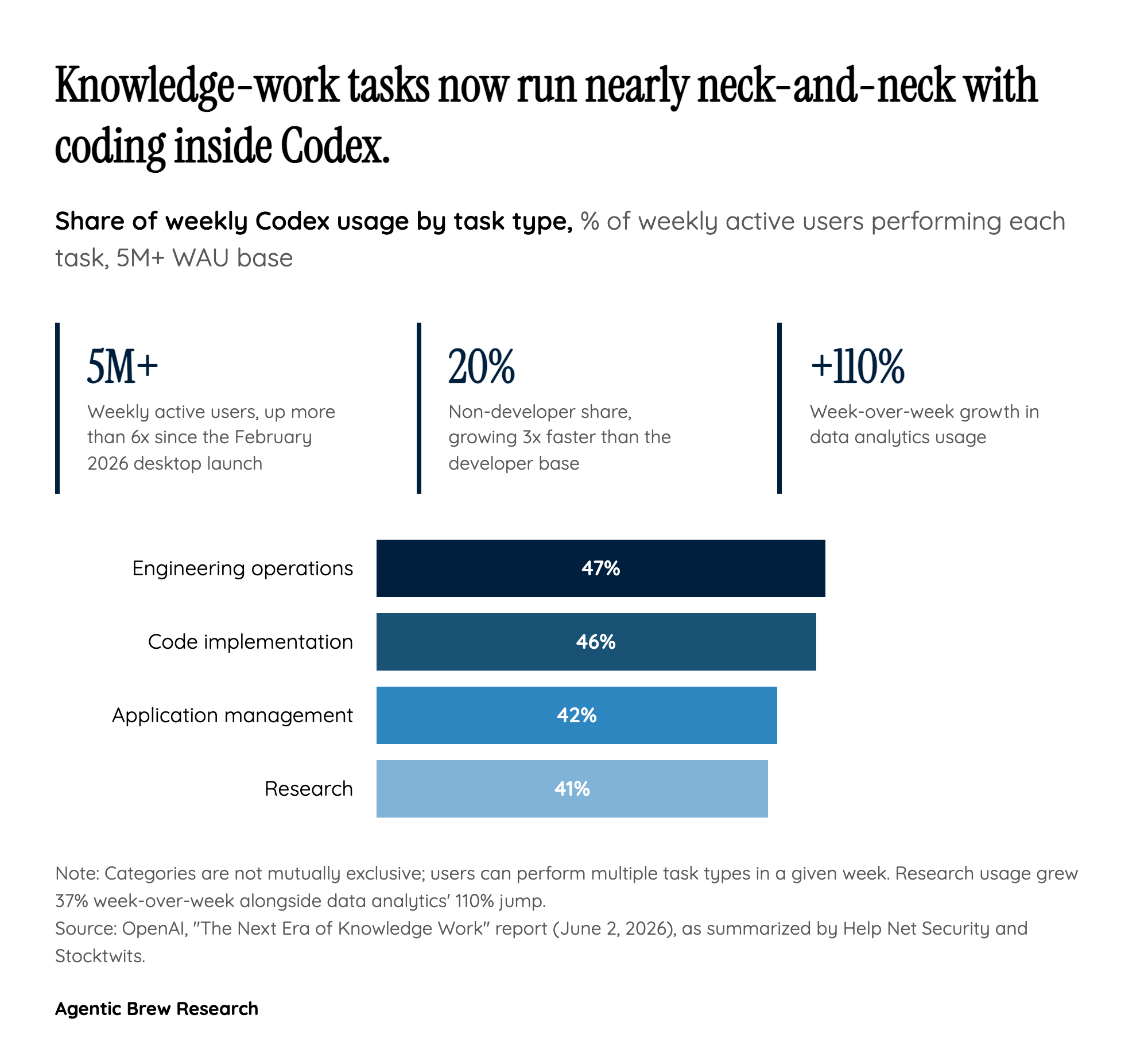
Knowledge-work tasks (application management, research) now run nearly even with coding tasks inside Codex, with data analytics usage growing 110% week-over-week. Source: OpenAI 'The Next Era of Knowledge Work' report via Help Net Security and Stocktwits.

The headline 5M+ weekly active users figure — up more than 6x since Codex's February desktop app launch [8]— buries the more interesting story. Non-developers are now about 20% of weekly users and growing three times faster than the developer base [4]. Data analytics usage is up 110% week-over-week [11]and research usage is up 37% [9]. Most strikingly, the weekly usage mix shows knowledge-work tasks running nearly neck-and-neck with traditional coding: engineering ops 47%, code implementation 46%, application management 42%, research 41% [9]. OpenAI itself reports that 72% of knowledge-worker users now produce artifacts — reports, spreadsheets, presentations, contracts — each week [9], and roughly half of all Codex users run multiple tasks in parallel, up from under a third in mid-April [9]. The plugin launch isn't bringing knowledge workers to Codex; it's formalizing a shift that already happened.

Who Got Co-Opted, Who Got Squeezed

Read the partner list as a strategy map. The data analytics plugin pulls from Snowflake, Databricks Genie, Hex, and Tableau [6]; the sales plugin wires in Salesforce, HubSpot, Slack, Outreach, Clay, Rox, and Actively [6]; the two finance plugins draw on Moody's, Daloopa, Datasite, FactSet, LSEG, S&P, PitchBook, and Hebbia [12]. These are systems of record OpenAI cannot rebuild and doesn't want to fight — so it absorbed them as turnkey context layers. The squeeze lands one layer up. Sites can produce live dashboards, scenario planners, internal tools, and project boards from a prompt, encroaching on the BI dashboarding and no-code internal-tools categories [1][5]. Tellingly, OpenAI named Wix, Webflow, Replit, Lovable, Base44, Vercel, and Emergent as Sites partners [1][4]— co-opting the deployment and design layer rather than building it from scratch, at least for now. TheNextWeb also flags that Sites is rolling out first to Business and Enterprise plans as a preview [7], which is where the BI and internal-tools incumbents make most of their money.

The Counter-Punch to Claude Cowork and Microsoft Copilot

Constellation Research read the announcement plainly as a competitive counter, noting both OpenAI and Anthropic are also preparing for public market debuts and need visible enterprise traction [8]. Anthropic's Claude Cowork and Microsoft's Copilot push are both aimed at the same enterprise knowledge-work seat OpenAI is now openly claiming. The Decoder framed the trajectory more broadly, arguing the role-plugin architecture turns Codex into a general-purpose app and a candidate ChatGPT super-app, with 'the non-developer group — analysts, designers, and bankers — growing three times faster than the developer base' [10]. The community read on YouTube matches: the second-most-watched explainer of the launch literally titled itself 'Claude Cowork Killer.' The wider competitive arc — Microsoft owns the distribution into Office and Teams, Anthropic owns the trust narrative around safety and long-horizon agents, OpenAI now owns the artifact-production surface — sets up the rest of 2026 as a fight over whose plugin marketplace becomes the default.

What the Skeptics Are Saying

The pushback splits cleanly along role lines. On r/codex, power users praised Annotations as a direct-manipulation breakthrough but flagged token cost as the brake on heavy use. The Sites announcement landed less cleanly — top comments framed it as 'not great for our jobs when users can now develop and host trivially,' balanced by defenders calling it 'free hosting for non-production apps.' The deeper plugin discussion on the subreddit tracked one-to-one with what OpenAI just formalized: developers debating whether third-party skills are worth it, with a vocal 'no plugin is the best plugin' camp, while non-coders embraced curated plugin packs. Beyond sentiment, there's a real governance surface to manage: Sites support workspace authentication, RBAC, and secret and environment-variable management [2], but enterprises now need to govern agent-deployed apps and plugin scopes spanning Salesforce, Snowflake, FactSet, and Datasite simultaneously [3][5]. Plugin sharing via marketplace is already live for ChatGPT Business with Enterprise coming, letting teams package reusable bundles with skills, integrations, MCP servers, and lifecycle hooks [3]— meaning the distribution and audit story is forming faster than most security teams will be ready for.

Historical Context

2021-08
Original Codex launched as a GPT-3 descendant fine-tuned on public GitHub code; powered the first GitHub Copilot beta.
2025-05
OpenAI revived the Codex brand as an autonomous software-engineering agent (Codex-1) able to clone a repo, edit files, run tests, and open PRs in a sandbox.
2026-02
Codex desktop app launched; weekly active users have since grown more than 6x to over 5 million.
2026-06
The 'Intelligence at Work' livestream announces Sites, Annotations, six role-specific plugins, and Codex inside the ChatGPT app.

Power Map

Key Players
Subject

OpenAI Codex expands into knowledge-work platform with role plugins, Sites, and Annotations

OP

OpenAI

Product owner reframing Codex from a developer agent into a horizontal knowledge-work platform competing with Anthropic Cowork and Microsoft Copilot.

SI

Sites partner ecosystem (Vercel, Wix, Base44, Replit, Lovable, Figma, Webflow, Emergent)

Early partners building toward a Codex Sites deployment and design ecosystem rather than being directly displaced.

DA

Data analytics plugin partners (Snowflake, Databricks Genie, Hex, Tableau)

Provide the underlying analytics data planes Codex queries to answer business questions and build dashboards.

SA

Sales plugin partners (Salesforce, HubSpot, Slack, Outreach, Clay, Rox, Actively)

CRM and revenue tooling integrated so Codex can automate follow-ups, close plans, and account-risk reviews.

CR

Creative and product-design plugin partners (Figma, Canva, Shutterstock, Picsart, Fal)

Power asset generation, campaign boards, ad variations, and prototyping flows for marketing and design teams.

FI

Finance plugin partners (Moody's, Daloopa, Datasite, FactSet, LSEG, S&P, PitchBook, Hebbia)

Supply trusted market, earnings, comps, and diligence data for the public equity investing and investment banking plugins.

AN

Anthropic and Microsoft Copilot

Direct competitive pressure — the release is widely read as a counter to Anthropic's Claude Cowork and Microsoft's Copilot push into enterprise knowledge work.

Fact Check

14 cited
  1. [1] Codex for every role, tool, and workflow
  2. [2] Sites in Codex
  3. [3] Codex changelog
  4. [4] OpenAI launches new Codex tools for white-collar work
  5. [5] OpenAI's Codex Targets Knowledge Workers With New Plugins, Sites and Annotations
  6. [6] OpenAI is putting Codex inside the ChatGPT app, and releasing 6 business plugins
  7. [7] OpenAI expands Codex with enterprise plugins, Sites, and Annotations for non-developers
  8. [8] OpenAI touts broadening Codex usage, 5 million weekly active users
  9. [9] OpenAI's The Next Era of Knowledge Work report on Codex usage
  10. [10] OpenAI expands Codex with role-specific plugins to build a general-purpose app for non-developers
  11. [11] OpenAI Launches New Codex Tools For Non-Developers, Sees 110% Growth In Data Analytics
  12. [12] OpenAI launches Codex plugins for finance pros
  13. [13] Under the hood: Exploring the AI models powering GitHub Copilot
  14. [14] OpenAI Codex: from 2021 code model to a 2025 autonomous coding agent

Source Articles

Top 5

THE SIGNAL.

Analysts

"Frames the launch as moving past capability demos toward enterprise integration — Codex needs to plug into the systems where work actually happens. Quoted as saying: 'AI is becoming capable of doing increasingly meaningful work inside organizations. The challenge now is helping companies integrate these systems into the infrastructure and workflows that power their businesses.'"

Denise Dresser
Chief Revenue Officer, OpenAI

"Describes Codex usage as already centered on artifact production for knowledge workers, not just code: 'Knowledge workers primarily use Codex to create reports, spreadsheets, presentations, contracts, and other work products. They are also increasingly using it for research, data analysis, workflow automation, and building lightweight tools that previously required engineering support.'"

OpenAI
Company blog / press materials

"Reads the move as Codex evolving toward a general-purpose app and a potential ChatGPT super-app strategy, with the non-developer cohort growing fastest: 'The non-developer group—analysts, designers, and bankers—is growing three times faster than the developer base.'"

Matthias Bastian
Editor, The Decoder
The Crowd

"We're making Codex more useful for your work by expanding plugins beyond individual tools. These plugins turn Codex into a specialist for a specific role with a single install, no coding required. Codex can access 62 popular apps and 110 skills for work across sales, data"

@@OpenAI2665

"OPENAI: Codex on macOS now supports Appshots, allowing users to quickly add context from any app directly to the prompt. Besides that, a new annotation editor is now available in the browser, the/goal command is enabled by default, and Plugins are now shareable."

@@testingcatalog271

"OpenAI released Sites for Codex, a new feature that lets teams turn work, ideas, and plans into interactive websites or apps with a shareable URL. The feature is rolling out first to Business and Enterprise plans before expanding more broadly."

@@WesRoth16

"Best Codex plugins?"

@u/Danieboy167
Broadcast
Learn 95% of Codex in 30 minutes

Learn 95% of Codex in 30 minutes

OpenAI Codex Explained for Normal People ("Claude Cowork Killer")

OpenAI Codex Explained for Normal People ("Claude Cowork Killer")

Codex for Everyday Work: AI Agents Beyond Coding

Codex for Everyday Work: AI Agents Beyond Coding