
Micron's blowout AI-driven earnings
TECH

Micron's blowout AI-driven earnings

46+
Signals

Strategic Overview

  • 01.
    Micron reported record fiscal Q3 FY2026 revenue of $41.46 billion, up roughly 4x from $9.30 billion a year earlier, with non-GAAP diluted EPS of $25.11 beating the ~$20.49 forecast.
  • 02.
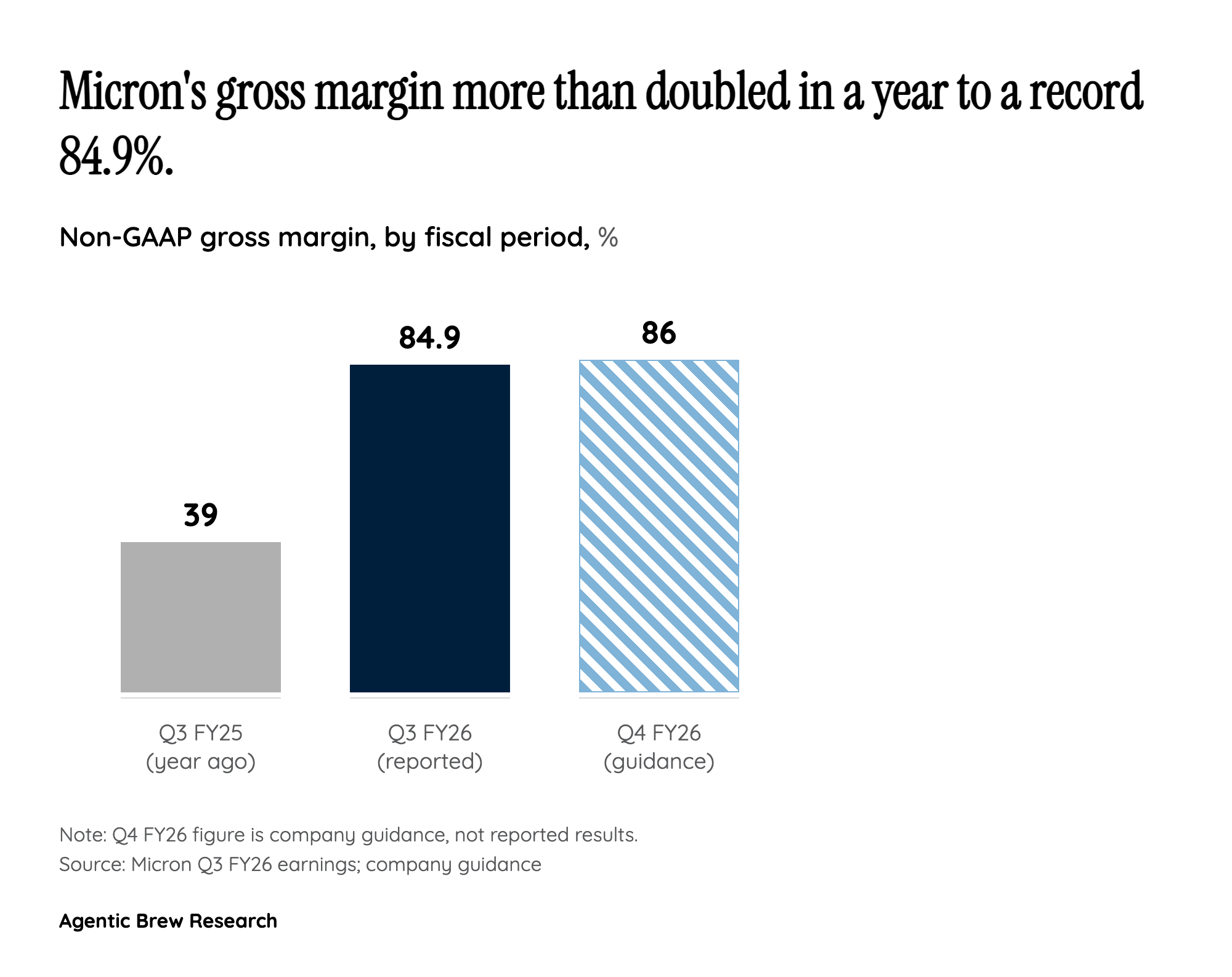
    Non-GAAP gross margin hit a company-record 84.9%, more than double the year-ago level and the highest in Micron data going back to 1990.
  • 03.
    Micron signed 16 multi-year take-or-pay Strategic Customer Agreements representing ~$100 billion in minimum contracted revenue and ~$22 billion in upfront customer cash, covering roughly 20% of DRAM and a third of NAND shipments through 2030.
  • 04.
    Shares surged roughly 15-19% to a fresh intraday record high, the company's 40th record of 2026, lifting the broader chip sector after a recent semiconductor selloff.

Deep Analysis

Why HBM Is a Real Bottleneck, Not Just a Hot Product

The single most consequential fact in Micron's quarter is not the revenue figure but the physics underneath it. High-bandwidth memory is the component that feeds data into AI accelerators, and it has become the binding constraint on how fast the industry can build AI infrastructure [5]. The scarcity is structural rather than temporary: a single bit of HBM requires roughly 300% more wafer capacity than ordinary DDR5 memory [5]. That means every wafer a memory maker pours into HBM is three wafers it cannot pour into commodity memory, so ramping HBM actively tightens the broader market. Compounding this, only three companies - Micron, SK Hynix, and Samsung - can manufacture HBM at meaningful scale, an oligopoly that caps how much new capacity can plausibly come online [5][6]. The result is that Micron can fill only roughly half to two-thirds of its customers' demand [5]. Micron itself shipped over $1 billion in HBM4 revenue, with its 12-high HBM4 ramp tracking about twice as fast as the prior HBM3E generation, and both generations are fully booked through calendar 2027 with demand extending into 2028 [5].

The $100 Billion Contract Shift and the Death of the Commodity Cycle

The $100 Billion Contract Shift and the Death of the Commodity Cycle
Micron non-GAAP gross margin: 39% a year ago, a record 84.9% in Q3 FY26, and roughly 86% guided for Q4 FY26.

Memory has been the textbook commodity business for forty years, a brutal boom-and-bust cycle where pricing power evaporates the moment supply catches up. Micron's quarter contains the clearest evidence yet that this pattern may be breaking. The company signed 16 multi-year take-or-pay Strategic Customer Agreements representing roughly $100 billion in minimum contracted revenue and about $22 billion in upfront customer cash [2][3], locking in around 20% of DRAM and a third of NAND shipments through 2030 [3]. The structural insight is who now carries the risk. In a take-or-pay deal with price floors, the buyer is obligated to pay even if it does not take delivery, which means hyperscalers - not Micron - now absorb the cyclical downside [3]. Futurum's Shay Boloor argues this makes the old cyclical-commodity label 'offsides,' since customers are prepaying billions to treat memory as a strategic resource to secure years in advance [4]. Susquehanna's Mehdi Hosseini calls it a 'structural change in memory' and lifted his target from $600 to $1,750 [6]. The numbers reinforce the thesis: Micron guided Q4 to $50.0 billion in revenue with gross margin accelerating to roughly 86% and free cash flow expected to top $30 billion [1].

The Bear Case: Selling Shovels for Mines That May Never Open

For all the euphoria, a credible skeptical strand runs underneath the story, and it is worth taking seriously. The bull thesis depends entirely on hyperscaler capex staying elevated, and memory pricing remains cyclical by nature [5]. The sharpest version of the bear case, surfaced in community discussion on Reddit, frames Micron as selling shovels for mines that may open only 'soon' - chips ship and book revenue today regardless of whether the data centers they are destined for ever get powered on. That tension was visible in the market itself: shares had dipped roughly 11% into the print before the beat, and online debate split between celebration of the results and deep doubt about the durability of AI demand. There is also a real-world cost to the shortage that cuts against the clean growth narrative: rising DRAM and NAND prices are pushing up RAM and SSD prices for ordinary consumers [5]. Even the contract structure has a counterpoint - take-or-pay floors protect Micron's margins, but they only matter if the counterparties remain solvent and committed through 2030, which is the very assumption bears question.

The Ripple Effect: One Print Resets the Entire AI Trade

Micron's report did not move in isolation - it functioned as a referendum on the whole AI infrastructure thesis. The stock surged to its 40th record high of 2026 and dragged the broader semiconductor sector up with it, reigniting the AI memory trade just days after the Philadelphia Semiconductor Index had suffered its second-worst session of the past year [2]. The timing matters: coming directly after a sharp chip selloff, the beat served as a real-time stress test of whether AI demand was cooling, and the market read it as confirmation that the buildout still has room to run. Analyst conviction followed the tape, with Needham's Quinn Bolton reiterating a Buy and tripling his price target to $1,550 from $500 [7]. Deepwater's Gene Munster went further on the demand side, projecting hyperscaler capex could grow 40-60% next year against a Street consensus near 22% [4]. The through-line is that memory, long treated as the unglamorous back of the chip stack, has become a leading indicator for the AI capital cycle - which is exactly why a single earnings print could lift an entire sector and why the bears' skepticism about that same cycle carries real weight.

Historical Context

1990
Micron's Q3 FY26 84.9% gross margin is the highest in data going back to 1990, underscoring how far the AI cycle has broken from decades of commodity-memory economics.
2025-12
Earlier in the supercycle, Micron's Q2 revenue surged 196% year over year with a gross margin of 74.9% and HBM capacity already sold out through 2026.
2026-06-24
Micron reported record Q3 FY2026 results, sending shares to a record high and resetting the AI memory trade after a semiconductor selloff days earlier.

Power Map

Key Players
Subject

Micron's blowout AI-driven earnings

MI

Micron Technology (CEO Sanjay Mehrotra)

Memory maker reporting record results; framed memory as strategically scarce in the AI era and locked in demand via $100B of multi-year contracts.

NV

Nvidia

Primary HBM customer using Micron HBM in AI accelerators; HBM has become the binding constraint on its AI infrastructure expansion. Micron has the thinnest share of Nvidia's HBM4 allocations among the three suppliers.

SK

SK Hynix and Samsung

The only two other HBM suppliers at meaningful scale; the three-supplier oligopoly is central to the structural-shortage thesis.

HY

Hyperscalers / AI cloud customers

Counterparties to the 16 take-or-pay agreements; absorbing cyclical downside risk and prepaying ~$22B to secure supply.

GO

Google

Named as an HBM4 customer for its latest AI accelerators alongside Nvidia.

Fact Check

7 cited
  1. [1] Micron Technology Reports Record Results for the Third Quarter
  2. [2] Micron's blowout earnings just reset the AI memory trade
  3. [3] Micron Shatters Record 84.9% Margin, Cements AI Memory Crunch Through 2027
  4. [4] Is Micron Still Cheap Post-Earnings? How $100 Billion In Contracts Is Making Cyclical Skeptics Offsides
  5. [5] Micron Q3 FY2026 earnings: revenue, HBM, AI memory
  6. [6] Micron: AI Bottlenecks End The Commodity Cycle
  7. [7] Micron (MU) earnings report Q3 2026

Source Articles

Top 5

THE SIGNAL.

Analysts

"Sees a structural change in memory and raised his price target from $600 to $1,750. 'The market is witnessing a structural change in memory.'"

Mehdi Hosseini
Analyst, Susquehanna

"Argues the $100 billion contract shift makes the traditional cyclical-commodity label 'offsides' because customers are now absorbing the cyclical downside risk."

Shay Boloor
Chief Market Strategist, Futurum Equities

"Predicts hyperscaler capex growth could reach 40-60% next year versus the Street's 22% expectation."

Gene Munster
Managing Partner, Deepwater Asset Management

"Reiterated a Buy rating on Micron and raised his price target to $1,550 from $500."

Quinn Bolton
Analyst, Needham

"Frames the results as reflecting the strategic value of memory in the AI era. 'Micron's record fiscal Q3 financial results and even stronger outlook for Q4 reflect the strategic value of memory in the AI era.'"

Sanjay Mehrotra
CEO, Micron
The Crowd

"BREAKING: Micron just delivered one of the biggest earnings beats in semiconductor history. - Revenue: $41.46 billion vs $36.3 billion expected - Adjusted EPS: $25.11 vs $21.05 expected - Gross Margin: 84.6%, up from 37.7% a year ago Micron shares surged +15% in after-hours"

@@BullTheoryio1699

"$MU Micron just dropped earnings. They are extraordinary. Revenue: $41.46 billion. Up 346% year on year. Beat estimates by over $6 billion. EPS: $25.11 vs $20.60 expected. Beat by 22%. Operating cash flow: $25.39 billion. Free cash flow: $18.3 billion. Q4 guidance: $50 billion"

@@2147mill42

"$MU customers are basically telling Micron that memory is no longer something they can casually buy later because AI has turned it into a strategic resource that needs to be secured years in advance. When customers put down deposits, sign multi-year agreements and accept minimum"

@@StockSavvyShay38

"Micron shatters earnings expectations with $41.5B Q3 revenue"

@u/TrendSpider181
Broadcast
Micron's Blowout Earnings Just Reset the AI Trade | Stock Market Live

Micron's Blowout Earnings Just Reset the AI Trade | Stock Market Live

EARNINGS ALERT: MU

EARNINGS ALERT: MU

Micron Sales Forecast Shatters Estimates on AI Demand

Micron Sales Forecast Shatters Estimates on AI Demand