Anthropic Project Glasswing and Claude Mythos AI security vulnerability discovery
TECH

Anthropic Project Glasswing and Claude Mythos AI security vulnerability discovery

35+
Signals

Strategic Overview

  • 01.
    Anthropic launched Project Glasswing on April 7, 2026, granting roughly 50 partner organizations gated access to its unreleased Claude Mythos Preview model to hunt for vulnerabilities in the world's most critical software.
  • 02.
    In its first month, Mythos Preview autonomously surfaced more than 10,000 high- or critical-severity zero-day vulnerabilities across partner systems and open-source projects, including a 27-year-old TCP SACK flaw in OpenBSD and a 17-year-old NFS remote code execution bug in FreeBSD.
  • 03.
    Anthropic is now preparing Mythos 1 for broader availability inside Claude Code and Claude Security, an enterprise product that entered public beta for Claude Enterprise customers on May 22, 2026 with a triage dashboard.
  • 04.
    Of 1,596 vetted findings disclosed to upstream maintainers in the first month, only 97 had been patched, and several open-source maintainers have asked Anthropic to slow the disclosure rate.

Deep Analysis

Anthropic Won't Ship Mythos — and the Refusal Is the Product

Frontier AI labs usually ship their best work and let the market sort out the consequences. Project Glasswing is the opposite play. Anthropic has built its most capable security-relevant model so far, Claude Mythos Preview, and explicitly decided not to release it — describing the model as able to surpass 'all but the most skilled humans at finding and exploiting software vulnerabilities' and arguing no developer, itself included, has built safeguards strong enough to prevent Mythos-class misuse [1]. Instead, around fifty hand-picked partners — Amazon Web Services, Apple, Broadcom, Cisco, Cloudflare, CrowdStrike, Google, JPMorganChase, the Linux Foundation, Microsoft, Mozilla, NVIDIA, Palo Alto Networks among them — were given gated access through a defensive coalition. The entire program is calibrated to put a dual-use capability into defensive hands first, before the equivalent shows up outside the fence.

The economic shape of the bet is unusual. Anthropic committed $100M in Mythos Preview usage credits to Glasswing partners and another $4M in direct cash to open-source security ($2.5M to Alpha-Omega/OpenSSF, $1.5M to the Apache Software Foundation) [1]. After the preview, Mythos Preview will be billed at $25 per million input tokens and $125 per million output tokens — among the most expensive frontier-model rates ever quoted [2]. The signal is that this is not a typical product launch: Anthropic is treating a frontier model as defensive infrastructure rather than as a consumer surface.

The productization end-state is already visible. Anthropic is wiring Mythos 1 into Claude Code, its agentic coding tool, and Claude Security, an Enterprise product that entered public beta on May 22, 2026 with a triage dashboard built specifically for the flood of findings the model generates [3]. The story Anthropic wants told is not 'we built a hacker' — it is 'we built a defensive utility, then built the triage tooling to make it usable, then began renting it to the few customers who can absorb the output.'

Why $2,000 to Crack OpenBSD Resets the Cost Curve

What makes Mythos different from prior LLM bug-finders is not just the hit rate — it is the unit economics. In Anthropic's own report, a fully working exploit chain was produced from a CVE identifier and a git hash in under one day for under $2,000 in compute, and roughly one thousand scaffold runs against OpenBSD cost under $20,000 in total [2]. That OpenBSD run is what surfaced a 27-year-old TCP SACK flaw that had survived nearly three decades of code review on a system whose entire reputation rests on auditability. Mythos was reliable enough on severity that human validators agreed exactly with the model's severity rating in 89% of 198 manually reviewed reports and were within one level in 98% of cases [2].

Independent evaluation backs the framing. The UK AI Security Institute reports Mythos Preview succeeds on 73% of expert-level CTF tasks 'which no model could complete before April 2025,' and is the first model to solve the multi-stage TLO attack range end-to-end [4]. The CTF gap is the part that matters: a 30-percentage-point jump on expert tasks in roughly one model generation is the kind of capability step that breaks planning assumptions for both attackers and defenders.

If the offensive marginal cost of a working exploit is now in the low four figures and the success rate on expert tasks is north of seventy percent, the strategic shape of cybersecurity flips. Bain's read is that the era of AI-enabled attacks 'is here, and organizations cannot afford to be reactive,' and that many enterprises will need to roughly double current cybersecurity spend rather than continue with the planned single-digit annual increases [5]. The boards that internalized 'detect and respond' as the dominant doctrine are now being told the next era is 'prevent at the source, or accept compromise.'

The Patch Bottleneck Is the Real Story

The Patch Bottleneck Is the Real Story
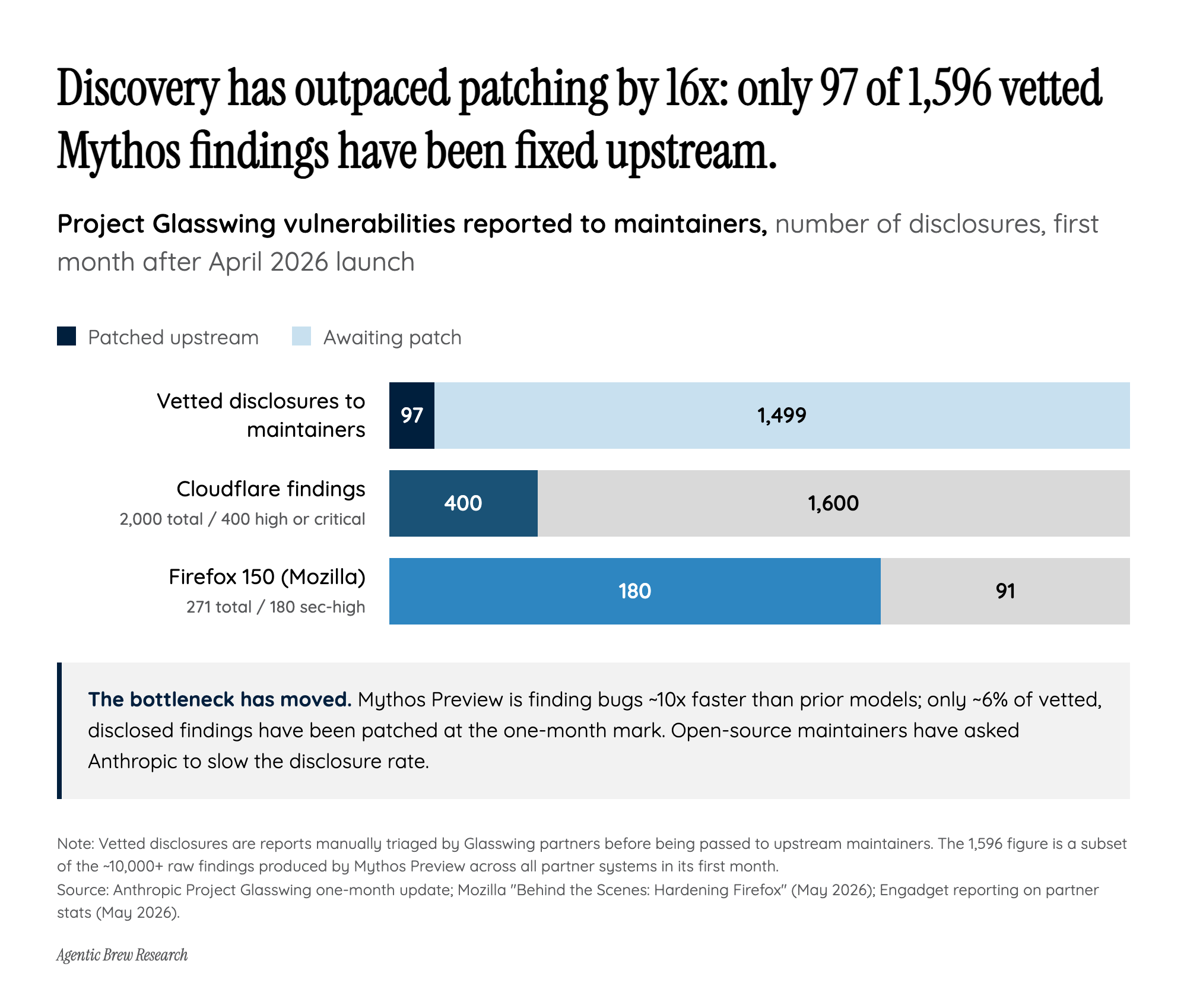
Glasswing's first-month vetted disclosures versus actual upstream patches — only ~6% of triaged findings have been fixed, with Cloudflare's 400 high/critical bugs and Mozilla's 180 sec-high Firefox 150 findings illustrating the per-partner load.

The eye-catching number from the one-month update is 10,000 zero-days. The number that actually changes how cybersecurity works is 97. Of 1,596 vetted Mythos findings disclosed to upstream maintainers, only 97 had been patched at the one-month mark — a roughly 16-to-1 gap between disclosure and fix [6]. Several open-source maintainers have explicitly asked Anthropic to slow the disclosure rate, and the Linux Foundation has flagged maintainer stress as a load-bearing risk of the program [9]. The bottleneck has cleanly moved from discovery to remediation.

The asymmetry shows up at the partner level too. Mozilla used Mythos against Firefox 150 and surfaced 271 vulnerabilities (180 sec-high, 80 sec-moderate, 11 sec-low) — roughly ten times the yield from Claude Opus 4.6 on Firefox 148 [8]. Cloudflare's deployment generated roughly 2,000 findings, 400 of them high or critical, at a lower false-positive rate than human-led testing [7]. ISACA argues the consequence is that 'the speed needed to exploit new vulnerabilities has been reduced from days or weeks to mere hours' [10]. In other words: even before any offensive equivalent of Mythos leaks, defenders have less grace period than the historical model assumes.

There is one hopeful counter-pressure: Linux kernel maintainer Greg Kroah-Hartman reports that AI-generated patches in early Glasswing testing have been 'pretty good' [9]. If Mythos-class models can also write the fix — not just find the bug — the loop closes. Until that happens, the question every CISO has to answer is whether their software dependency tree includes any project whose patch queue is now backed up by months.

The Skeptic's Read: Money, Not a Model

The loudest contrarian voice on Mythos is not from academia but from working engineers. The single most-watched skeptical YouTube essay frames the launch as a marketing stunt comparable to ChatGPT-5 and Devin hype cycles, with the core argument that 'the moat is money, not models' — spending roughly twenty thousand dollars to surface a single bug does not, by itself, mean the model is doing software engineering. Inside the r/cybersecurity community, the dominant counter-frame is that Mythos is 'just faster SAST on GPUs,' and the most-cited concrete data point is the curl project's maintainer reporting that five 'confirmed' findings collapsed into one actual vulnerability under review. Reddit threads from practitioners with hands-on Preview access describe Mythos as 'a slightly better Opus 4.7' that needs heavy harness work, prompt engineering, and false-positive triage to be useful in production.

What the skeptical read does not dispute is the empirical floor. Human validators independently agreed with Mythos's severity rating on 89% of manually reviewed findings, and were within one level in 98% [2]. The AISI's 73% success rate on expert CTF tasks is independent of Anthropic's marketing surface [4]. And the Cloudflare and Mozilla numbers above were reported by those vendors directly, not by Anthropic. The honest synthesis is that both readings can be true at once: Mythos is unlocking real, expensive, previously-uneconomic vulnerability discovery, and the headline counts probably include duplicate root causes that telescope into smaller deduplicated lists.

The second-order question is what happens when the equivalent capability is no longer gated. Glasswing's design assumes that frontier-model bug-finding will diffuse — to other labs, to nation-state actors, eventually to open-weights — and that the only durable advantage is the head start defenders get from being inside the coalition. If the duration of that head start is months rather than years, the strategic question for everyone outside the fence is not whether to budget for AI-assisted vulnerability management, but how soon.

Historical Context

2024-10
Big Sleep, evolved from Project Naptime, found its first real-world zero-day — a stack buffer underflow in SQLite later filed as CVE-2025-6965 — proving LLM agents could discover novel vulnerabilities in production code.
2025-08
The two-year DARPA program concluded at DEF CON 33; seven finalist teams processed 54M lines of code, patched 43 of 54 synthetic bugs, and discovered 18 previously unknown real-world flaws, with Team Atlanta winning.
2026-04-07
Project Glasswing publicly announced; roughly 50 partner organizations granted gated access to Claude Mythos Preview to hunt for vulnerabilities in critical infrastructure, browsers, and operating systems.
2026-05-22
Glasswing one-month update published; Claude Security launches in public beta for Enterprise customers; Anthropic signals Mythos-class general release contingent on safeguards expected to ship with the next Claude Opus.

Power Map

Key Players
Subject

Anthropic Project Glasswing and Claude Mythos AI security vulnerability discovery

AN

Anthropic

Developer of Claude Mythos Preview and operator of Project Glasswing; deliberately withholding the model from public release while gating access through ~50 partners and preparing Mythos 1 for Claude Code and Claude Security.

CL

Cloudflare

Glasswing partner that reported ~2,000 bugs found in its critical-path systems, 400 of them high or critical severity, with a lower false-positive rate than human-led testing.

MO

Mozilla

Used Mythos Preview to identify 271 vulnerabilities (180 sec-high, 80 sec-moderate, 11 sec-low) in Firefox 150, roughly 10x the prior yield from Claude Opus 4.6 on Firefox 148.

LI

Linux Foundation and open-source maintainers

Joined Glasswing as launch partners and now sit at the patch-throughput bottleneck; the Foundation has flagged maintainer stress from AI-paced disclosure, while kernel maintainer Greg Kroah-Hartman judged AI-generated patches as 'pretty good.'

UK

UK AI Security Institute (AISI)

Independent evaluator that benchmarked Mythos Preview's cyber capabilities, recording a 73% success rate on expert-level CTF tasks and confirming the first model to complete an end-to-end multi-stage attack simulation.

AP

Apple

Indirectly affected; researchers using techniques derived from an early Mythos build chained two undocumented macOS bugs into a privilege-escalation exploit that bypasses memory integrity enforcement.

Fact Check

10 cited
  1. [1] Project Glasswing
  2. [2] Claude Mythos Preview
  3. [3] Anthropic Prepares Mythos 1 for Claude Code and Claude Security
  4. [4] Our Evaluation of Claude Mythos Preview's Cyber Capabilities
  5. [5] Claude Mythos and the AI Cybersecurity Wake-Up Call
  6. [6] Anthropic's Glasswing AI Has Found 10,000 Software Vulnerabilities
  7. [7] Anthropic's Claude Mythos Preview Found 10,000+ Vulnerabilities in a Month
  8. [8] Behind the Scenes: Hardening Firefox
  9. [9] Project Glasswing Gives Maintainers Advanced AI to Secure Open Source
  10. [10] Claude Mythos is Redefining the Cyberthreat Landscape

Source Articles

Top 5

THE SIGNAL.

Analysts

"Frames Mythos as the wake-up call for a board-level cybersecurity rethink, arguing most organizations need to fix fundamentals — sometimes roughly doubling current spend — rather than chase new tools, and that 'Claude Mythos is a signal, not the threat itself.'"

Bain & Company
Global management consultancy

"Concludes Mythos Preview can autonomously breach small, weakly-defended enterprise systems and conduct multi-stage attacks, succeeding on 73% of expert-level CTF tasks that no prior model could complete before April 2025."

UK AI Security Institute (AISI)
UK government AI safety body

"Reads Mythos as inaugurating an era where 'the speed needed to exploit new vulnerabilities has been reduced from days or weeks to mere hours,' requiring agentic-AI defenses rather than human-paced response."

ISACA
Global IT governance and cybersecurity professional body

"Acknowledges a short-term attacker advantage and frames the gap between finding bugs and fixing them as the systemic risk: 'The relative ease of finding vulnerabilities compared with the difficulty of fixing them amounts to a major challenge for cybersecurity.'"

Anthropic
Model developer (own assessment in Mythos Preview report)

"Reports that patches generated by AI tools during early Glasswing testing were 'pretty good,' suggesting Mythos-class models may eventually close part of the patching loop they currently widen."

Greg Kroah-Hartman
Linux kernel maintainer
The Crowd

"Introducing Project Glasswing: an urgent initiative to help secure the world's most critical software. It's powered by our newest frontier model, Claude Mythos Preview, which can find software vulnerabilities better than all but the most skilled humans. https://t.co/NQ7IfEtYk7"

@@AnthropicAI44090

"NEWS: Anthropic's new model, Claude Mythos, is so powerful that it is not releasing it to the public. Instead, it is starting a 40-company coalition, Project Glasswing, to allow cybersecurity defenders a head start in locking down critical software. https://t.co/1ehWqYi4iy"

@@kevinroose5358

"🚨 Anthropic just dropped the first Project Glasswing update Claude Mythos found 10,000+ critical vulnerabilities in ONE month: > Cloudflare: 2,000 bugs, 400 high/critical severity > Mozilla: 271 vulnerabilities in Firefox 150 — 10x more vulnerabilities found in Firefox 148"

@@ns123abc2294

"Project Glasswing: Anthropic says Claude found 10,000 critical software flaws in a month"

@u/sksarkpoes3480
Broadcast
Claude Mythos is too dangerous for public consumption...

Claude Mythos is too dangerous for public consumption...

An initiative to secure the world's software | Project Glasswing

An initiative to secure the world's software | Project Glasswing

Project Glasswing/Claude Mythos: Anthropic's $x00 Million Marketing Stunt

Project Glasswing/Claude Mythos: Anthropic's $x00 Million Marketing Stunt