The Three Pillars and the Money Math
Built Together is structured around three pillars Amazon says communities themselves identified as priorities: education and workforce pathways, energy affordability and water solutions, and flexible funding for local priorities [1]. The workforce piece is the most concrete commitment in the package - Amazon says it will connect more than 300,000 students to free community college and degree pathways over five years in fields like electrical trades, HVAC, fiber optics, IT, and advanced manufacturing, and will scale its Modular Training Centers from three currently operating to 25 by the end of 2028, with a stated goal of training up to 100,000 workers annually [2]. On the utility side, energy-efficiency grants are aimed at more than 300 schools and community buildings and over 30,000 homes, with Amazon projecting bill reductions of 20 to 40 percent, or roughly $700 per household a year [2].
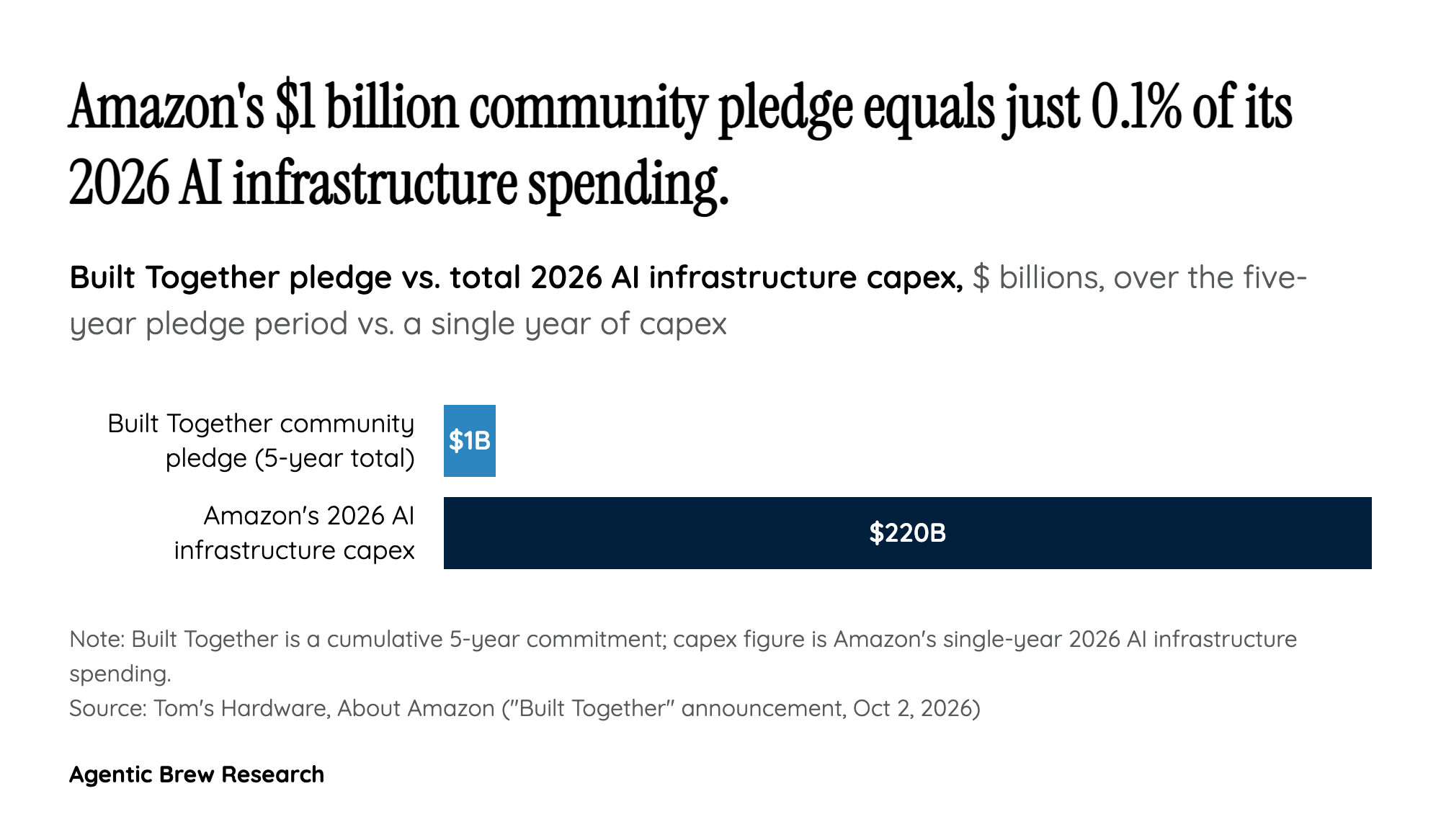
Set against those headline figures is the math critics did almost immediately: the $1 billion, five-year pledge works out to roughly 0.1 percent of Amazon's approximately $220 billion in expected 2026 capital expenditures, most of it funneled into data centers and chips [3]. That ratio is the single number doing the most damage to the announcement's credibility - it reframes a headline-grabbing nine-figure commitment as a rounding error against the scale of the buildout that produced the backlash in the first place.