OpenAI Presence enterprise AI agent launch
TECH

OpenAI Presence enterprise AI agent launch

28+
Signals

Strategic Overview

  • 01.
    OpenAI launched Presence, an enterprise product that helps organizations deploy trusted AI voice and chat agents for customer support, sales development, procurement, IT, and HR workflows.
  • 02.
    Presence bundles the components teams need to run agents in production into one platform: policies and standard operating procedures, guardrails, approved actions, simulations, evaluation tools, and a Codex-powered improvement process.
  • 03.
    Presence is not self-serve. It is being offered to eligible enterprise customers through a limited general availability program and is deployed with support from OpenAI Forward Deployed Engineers and selected global systems integrators.
  • 04.
    OpenAI already runs Presence on its own English-language phone support line, where it handles open-ended requests, verifies callers, uses account context, and takes approved actions - resolving 75% of issues without human intervention.
  • 05.
    Early adopters named at launch include BBVA (voice support for everyday banking in Mexico), SoftBank (natural Japanese-language conversations), and IAG (support during high-demand events such as severe weather and insurance claims).

Deep Analysis

Wall Street's Same-Day Verdict on Agentic Software
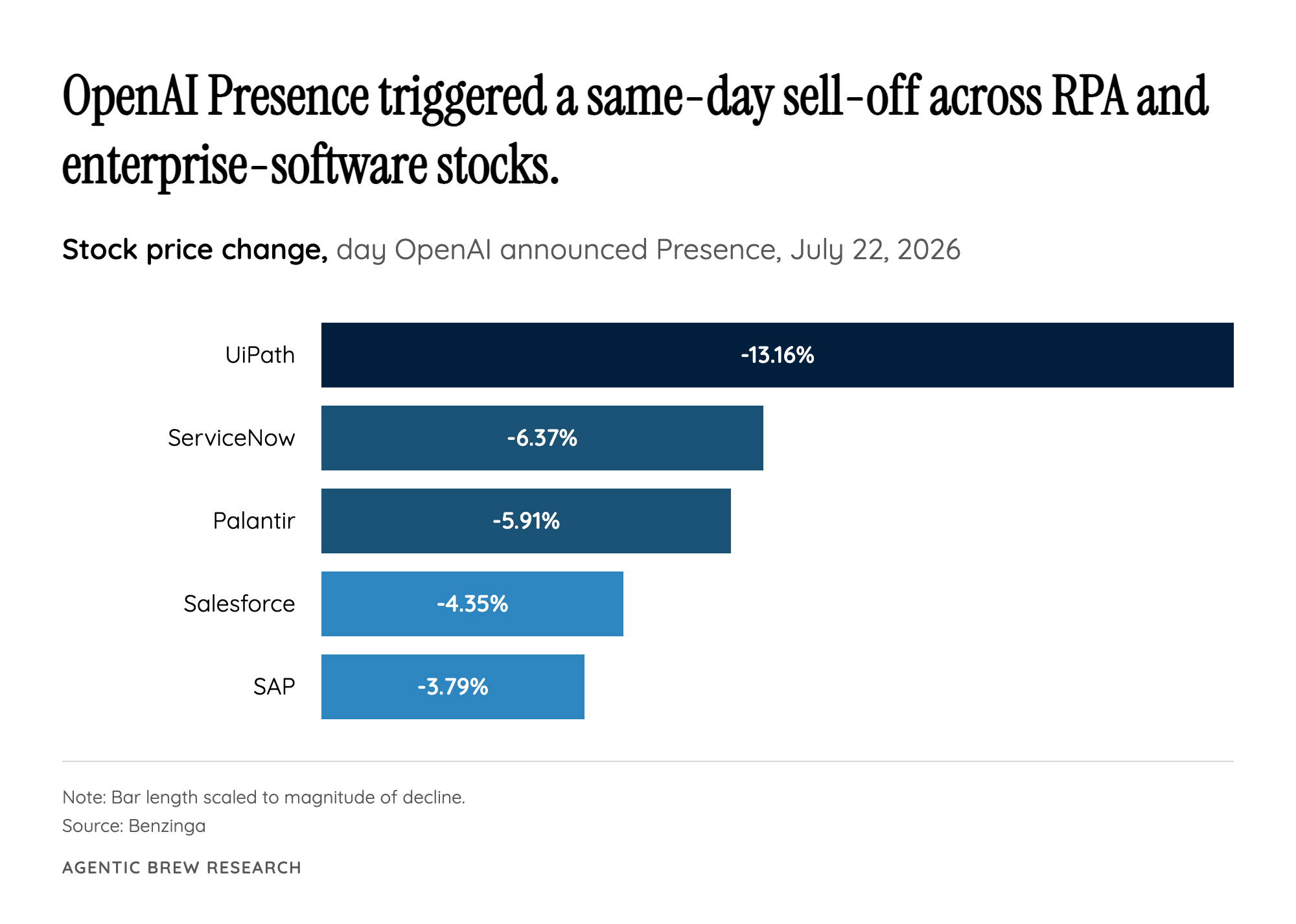
Wall Street's Same-Day Verdict on Agentic Software
Same-day stock price change for RPA and enterprise-software vendors following the OpenAI Presence announcement, July 22, 2026. Source: Benzinga.

When OpenAI introduced Presence, investors treated it less like a routine product update and more like a threat to the enterprise software stack. UiPath shares fell 13.16% to $10.45 the same day [1], while ServiceNow, Salesforce, SAP, and Palantir also declined 6.37%, 4.35%, 3.79%, and 5.91% respectively [1]- a broad repricing of RPA and workflow-automation vendors whose businesses assume that connecting AI to enterprise systems requires their middleware. The market's message was blunt: an agent platform built directly into the model provider's own stack, with policies, permissions, and approved actions baked in, cuts out a layer that software incumbents had long assumed was durable. OpenAI's own framing of the launch stayed measured - agents that answer questions, take approved actions, and escalate to people when needed, improving over time - but outside coverage read it more pointedly: Business Insider characterized Presence as OpenAI expanding beyond model development into business software territory, the exact encroachment that sent RPA and CX vendors' shares down the same day.

OpenAI's Palantir Playbook: Consulting, Not Self-Serve Software

Presence is deliberately not a sign-up-and-go product. OpenAI is rolling it out through a limited general availability program, deployed with OpenAI's own Forward Deployed Engineers and a small set of global systems integrators rather than as self-serve software [2]. Those engineers work alongside each customer to select workflows, connect internal systems, establish permissions, configure policies, test agents, and move them into production [3]- a high-touch, boots-on-the-ground model that echoes a Palantir-style enterprise playbook far more than a typical SaaS launch; press coverage framed it explicitly as OpenAI's pivot toward higher-margin, consulting-style enterprise pricing as the underlying model layer commoditizes. The tiering looks deliberate: Presence launched alongside a separate, lighter self-serve program, 'ChatGPT for Small Businesses,' aimed at SMBs - reserving the high-touch Forward Deployed Engineer treatment for large enterprise accounts. Community reaction on Reddit's r/accelerate cross-post captured the delivery model bluntly, describing Presence as a 'call us for a quote' product rather than something you sign up for. It signals OpenAI is chasing services-level margins and deep account control as the underlying model layer commoditizes, rather than settling for API revenue alone.

The Self-Improving Support Loop

The most technically distinct piece of Presence is its use of Codex, OpenAI's coding agent, which reviews production interactions and proposes improvements to a deployed agent's behavior; staff must test and approve those changes before they ship [2]. On OpenAI's own English-language phone support line, that loop underpins a 75% resolution rate without human intervention [4], and it reportedly cut human handoffs by 15 percentage points within just 10 days of deployment [3]. The pitch to enterprises is that Presence agents don't just launch and plateau - they compound in accuracy the longer they run in production.

Entering a Market Sierra and Decagon Already Built

OpenAI isn't creating the AI customer-experience agent category, it's entering one already worth tens of billions in private valuation. Sierra, founded by Bret Taylor along with Clay Bavor, reached $150M in annual recurring revenue by February 2026 and closed a $950M Series C at a $15.8B valuation in May 2026 [5]; rival Decagon was valued at $4.5B the same period [5]. Presence arrives as this category's newest and best-capitalized entrant, carrying the built-in advantages of OpenAI's own model access and, now, its own production usage data from its live phone support line as a proof point [4].

Is 75% Actually Better Than the Baseline - and Can Most Enterprises Even Use It?

OpenAI's headline resolution figure faced immediate pushback in the community discussion beneath OpenAI's own announcement. In the r/OpenAI thread on Presence (220 upvotes, 64 comments), one skeptical commenter questioned whether 75% is actually ahead of what off-the-shelf RAG-based support tools already achieve, pegging existing deflection rates from tools like Retool and Fin/Intercom in the 60-65% range with far less workflow engineering. Another commenter, describing his own experience building a RAG-based insurance chat agent, argued that a governed agent platform like Presence won't displace customer-service SaaS in the short term because most enterprises, even large ones, lack the unified data and API infrastructure needed to plug into it. Because Presence ships through Forward Deployed Engineers rather than self-serve [2], that infrastructure gap becomes a real gating factor on how fast adoption can actually spread - and the same skepticism echoed further on r/technology, where one dismissive thread quipped that OpenAI 'can't safely contain their own models but sure ready for the enterprise.'

Historical Context

2023
Sierra was founded by Bret Taylor and Clay Bavor as a rival AI customer-experience agent platform.
2026-01
Decagon, another AI customer-support agent startup, reached a $4.5B valuation.
2026-05
Sierra closed a $950M Series C round at a $15.8B valuation, underscoring investor appetite for AI customer-support agent platforms ahead of OpenAI's Presence launch.
2026-07-22
OpenAI officially introduced Presence as an enterprise deployment platform for AI voice and chat agents.

Power Map

Key Players
Subject

OpenAI Presence enterprise AI agent launch

OP

OpenAI

Creator and operator of Presence; also its first production user, running it on its own English-language phone support line.

BB

BBVA

Early adopter exploring AI-powered voice support for everyday banking needs in Mexico.

SO

SoftBank

Early adopter testing natural Japanese-language customer conversations via Presence.

IA

IAG

Early adopter exploring timely support during high-demand events such as severe weather and emergency claims processing.

UI

UiPath

Competing RPA/automation vendor whose shares fell sharply the day Presence launched on fears it threatens traditional automation software demand.

SE

ServiceNow, Salesforce, SAP, Palantir

Enterprise software vendors whose shares also declined the same day amid competitive concerns tied to OpenAI's enterprise agent push.

SI

Sierra

Rival AI customer-experience agent platform founded by Bret Taylor and Clay Bavor; reached $150M ARR and a $15.8B valuation ahead of Presence's launch.

DE

Decagon

Rival AI customer-support agent startup valued at $4.5B, competing for the same enterprise support-automation use case as Presence.

Fact Check

5 cited
  1. [1] Why Is UiPath Stock Falling Wednesday?
  2. [2] OpenAI Presence: AI agent platform for the enterprise
  3. [3] OpenAI Launches Presence: An Enterprise AI Agent Platform for Voice and Chat Workflows
  4. [4] Introducing OpenAI Presence
  5. [5] Decagon vs Sierra

Source Articles

Top 5

THE SIGNAL.

Analysts

"Argues human oversight should remain a checkpoint rather than the entire CX assurance system."

Sushil Kumar
CEO, Cyara

"Commenting on AI safety concerns around agent platforms, argues safety requires open, collaborative effort rather than single-company secrecy."

Clem Delangue
Co-founder and CEO, Hugging Face
The Crowd

"New for enterprises: OpenAI Presence helps companies deploy trusted voice and chat agents across customer and internal workflows. AI agents can answer questions, use company systems, take approved actions, and escalate to people when needed—while improving over time."

@@OpenAI1716

"OpenAI's latest software, Presence, targets adding more AI to the workplace. This positions the company beyond AI model development into business software realms."

@@BusinessInsider6

"Introducing OpenAI Presence"

@u/Sassy_Allen220

"Introducing OpenAI Presence"

@u/Sassy_Allen16
Broadcast
OpenAI Launches Agent Platform 'OpenAI Presence' as NVIDIA Accelerates the Gigascale AI Era

OpenAI Launches Agent Platform 'OpenAI Presence' as NVIDIA Accelerates the Gigascale AI Era

RERIGHT · OpenAI unveils Presence, a new platform that lets enterprises launch and manage realtime voice agents and chatbots

RERIGHT · OpenAI unveils Presence, a new platform that lets enterprises launch and manage realtime voice agents and chatbots

RERIGHT · OpenAI tries the consulting path with 'Presence', charging enterprises boots-on-the-ground prices to deploy agents

RERIGHT · OpenAI tries the consulting path with 'Presence', charging enterprises boots-on-the-ground prices to deploy agents