Chinese AI's cost and chip challenge to US labs
TECH

Chinese AI's cost and chip challenge to US labs

30+
Signals

Strategic Overview

  • 01.
    DeepSeek is developing its own AI chip optimized for inference to cut its reliance on Nvidia and Huawei, according to a July 2026 Reuters report citing three people familiar with the matter.
  • 02.
    US enterprises are shifting workloads to cheaper Chinese models, with DeepSeek's share of tokens on Vercel climbing from under 1% to 17% in May 2026.
  • 03.
    AI startup Lindy moved 100% of its traffic from Anthropic's Claude to DeepSeek to cut costs.
  • 04.
    Z.ai's GLM-5.2 performed within a percentage point of Anthropic's Opus 4.8 on a leading agentic benchmark at roughly a fifth of the cost.

Deep Analysis

Sanctions Wrote DeepSeek's Chip Roadmap

On July 7, 2026, Reuters reported that DeepSeek is designing its own AI chip [1], and the detail that matters is what the chip is for: inference, the stage where a trained model actually answers users, rather than training. According to the report, the effort began about a year ago and now has the Hangzhou startup in talks with chip-design, foundry, and memory suppliers while it hires silicon engineers [1].

This is less a strategic flourish than a forced move. US export controls bar DeepSeek from Nvidia's most advanced processors, and the company has leaned on Huawei's Ascend accelerators for inference - a dependency it now signals it wants to escape. Washington has spent three years tightening the screws, from the first 2022 performance-threshold rules to the 2025 Foundry Rule that blocks Chinese AI firms from advanced TSMC capacity [2], which pushes domestic champions to build their own alternatives. The timing tracks a broader compute shift too: Barclays estimates that roughly 70% of AI compute demand will come from inference by 2026 [6], making a cheap, home-grown inference chip the single most valuable piece of silicon DeepSeek could own.

American Firms Are Voting With Their Budgets

The chip is the supply-side story; the demand side is already here. US developers and enterprises are quietly routing work to lower-cost Chinese models, and the migration is measurable - DeepSeek's share of tokens on Vercel jumped from under 1% to 17% in May 2026 [4]. The clearest signal came from AI startup Lindy, which moved 100% of its traffic off Anthropic's Claude and onto DeepSeek, a switch its leadership says will save millions [3].

What changed is not model quality alone but the calculus around it. As OpenAI and Anthropic prices climbed, buyers grew cost-conscious and began sending any task that doesn't strictly need a frontier model to the cheapest option that clears the bar [3]. On developer YouTube, the highest-viewed explainers frame China's momentum as a hardware-and-cost story rather than a single model release, and that framing - cheaper, good-enough, available in volume - is exactly the argument enterprise buyers are now making with their invoices.

The Price Gap, By The Numbers

The Price Gap, By The Numbers
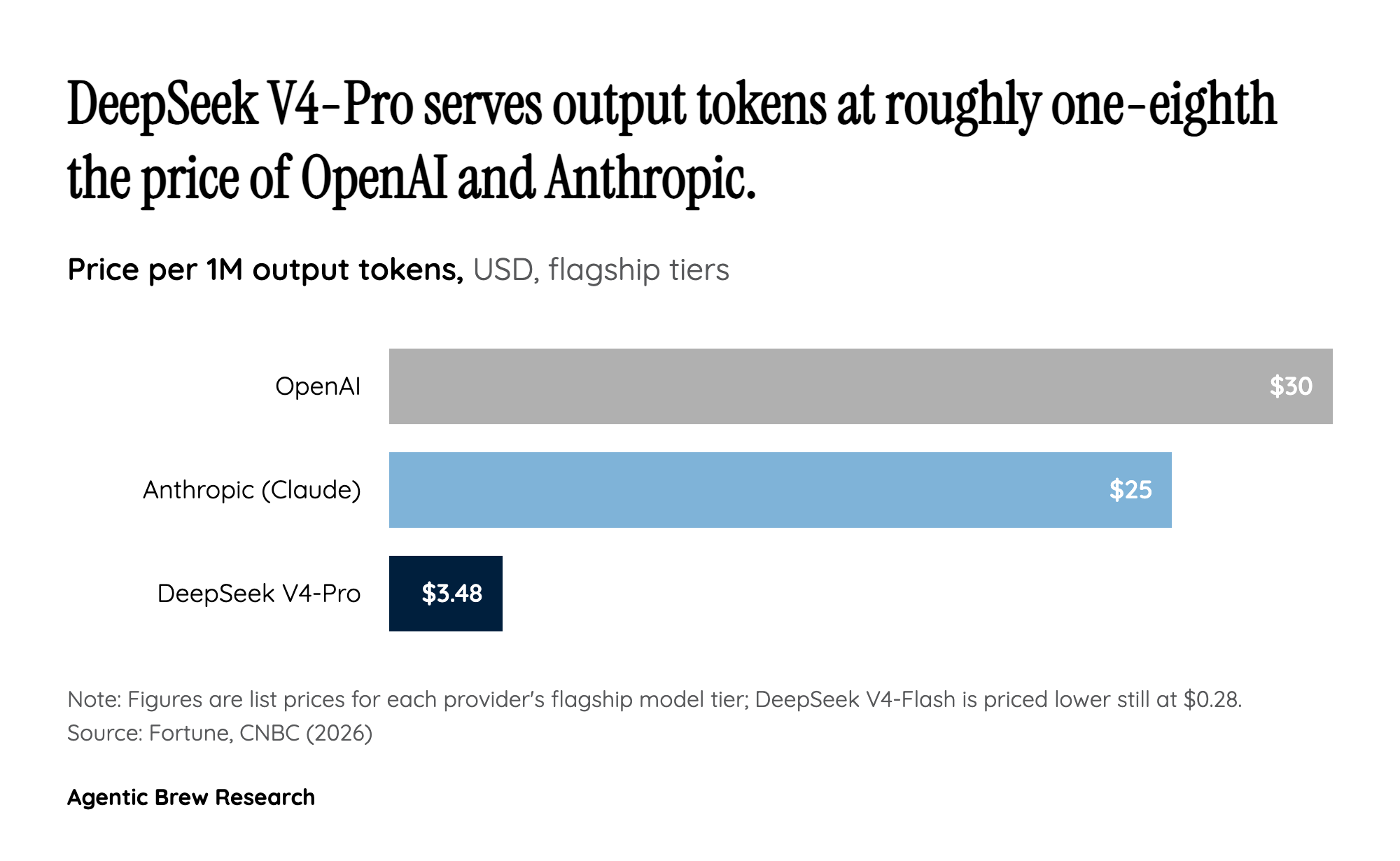
DeepSeek's flagship tier undercuts US labs by roughly 8x on output-token pricing.

The gap is stark enough to reorder budgets. DeepSeek's V4-Pro lists at about $3.48 per million output tokens against roughly $25 for Anthropic and $30 for OpenAI [5], and the cheaper V4-Flash tier goes lower still. Translated into daily work, one developer told Rest of World that an hourlong coding session runs near $10 on Claude versus under 50 cents on DeepSeek [4].

Cost is no longer buying a worse product. Z.ai's GLM-5.2 landed within a percentage point of Anthropic's Opus 4.8 on a key agentic benchmark at roughly a fifth of the cost [3], and developer explainers dissecting DeepSeek's V4 attribute the low price to genuine engineering on how the model stores and serves long contexts, not just subsidies. When the quality delta narrows to a rounding error and the price delta is nearly an order of magnitude, the switching math gets hard to argue with.

Why the Threat Might Stall

None of this guarantees DeepSeek wins. Designing a competitive inference chip takes years and heavy capital, and the same export controls that motivated the project also restrict Chinese access to advanced foundries and the high-bandwidth memory that inference silicon depends on [1], a bottleneck Beijing's self-sufficiency push has not yet closed [2]. On the demand side, data-security and geopolitical worries keep Chinese models out of regulated industries, and US firms including Airbnb and Anysphere have already faced congressional scrutiny for disclosing use of Chinese open models [4].

There is also the treadmill problem. Analysts caution it is too soon to call the race, since China's open models are themselves learning from US frontier labs and no single player stays ahead for long [7]. The likeliest near-term outcome is not a clean handoff of leadership but a squeeze: cheaper Chinese options capping what US labs can charge just as OpenAI and Anthropic head toward public markets.

Historical Context

2022-10
Initial US export controls restricted advanced AI chip sales to China by performance thresholds, prompting Nvidia to ship degraded A800/H800 variants.
2023-10
Updated thresholds closed loopholes and blocked the A800/H800 exports Nvidia had been selling into China.
2024
DeepSeek's founder said in a rare interview that chip export controls were a challenge for the company.
2025-01
The finalized Foundry Rule established a white-list system making it hard for Chinese AI firms to access TSMC capacity for chips above export-control thresholds.
2025-02
Huawei's founder described leading a network of more than 2,000 Chinese companies working toward over 70% semiconductor self-sufficiency by 2028.
2026-04-24
DeepSeek released V4 in preview, co-engineered with Huawei's Ascend chips, at rock-bottom prices that undercut US labs.

Power Map

Key Players
Subject

Chinese AI's cost and chip challenge to US labs

DE

DeepSeek

The Hangzhou startup driving both the low-cost model wave and the in-house inference chip push; its moves set the pace for the cost pressure US labs now face.

NV

Nvidia

The supplier DeepSeek is trying to move away from; barred by US export controls from selling its most advanced chips into China, its position in the market is what the chip effort seeks to route around.

HU

Huawei

Supplies the Ascend accelerators DeepSeek currently leans on for inference and holds roughly half of China's domestic AI chip market, making it both a fallback and a dependency DeepSeek wants to reduce.

OP

OpenAI and Anthropic

The US frontier labs facing pricing pressure; both are reportedly weighing token price cuts as cheaper Chinese models erode their enterprise share ahead of public-market debuts.

Z.

Z.ai

The Beijing startup whose GLM-5.2 rivals leading US models on agentic benchmarks at a fraction of the cost, broadening the Chinese challenge beyond DeepSeek alone.

LI

Lindy

A US AI startup that switched all of its traffic from Claude to DeepSeek, a real-world proof point for the cost-driven migration away from US labs.

Fact Check

7 cited
  1. [1] China's DeepSeek developing its own AI chip, sources say
  2. [2] DeepSeek, Huawei, Export Controls, and the Future of the U.S.-China AI Race
  3. [3] Chinese AI models are gaining ground with U.S. companies as OpenAI, Anthropic costs surge
  4. [4] When Americans choose Chinese AI
  5. [5] DeepSeek's V4 undercuts OpenAI and Anthropic on price
  6. [6] China's DeepSeek developing own AI chip
  7. [7] Chinese AI models led by DeepSeek catch up with US rivals with lower prices

Source Articles

Top 5

THE SIGNAL.

Analysts

"Chinese models are especially attractive to American companies now that AI costs are skyrocketing and buyers have turned more cost-conscious."

Kyle Chan
Fellow, John L. Thornton China Center, Brookings

"Price is the deciding factor; when a task doesn't need the best model, teams route it to the cheapest one that is good enough, and recent Chinese models are winning that trade."

Harpreet Arora
Head of agentic infrastructure, Vercel

"Switching from Claude to DeepSeek made the company's cost curve crash to the ground and is expected to save millions within months."

Flo Crivello
CEO, Lindy

"Chinese models already handle the bulk of routine work at far lower cost, and if they become frontier and cheaper he will switch fully."

Ruben Garcia Jr.
Developer, quoted by Rest of World
The Crowd

"$NVDA Nvidia is down in the premarket because DeepSeek is reportedly looking to reduce their reliance on Nvidia and Huawei by developing their own chips. - DeepSeek has increased hiring of chip-design engineers in recent months - New chip would be designed for inference"

@@amitisinvesting487

"DeepSeek is reportedly developing its own AI chip, per Reuters. The chip is being designed for inference, not training, as DeepSeek looks to reduce reliance on Nvidia and Huawei chips. DeepSeek is reportedly in talks with foundries, memory suppliers and chip-design firms, while"

@@wallstengine108

"Exclusive: Chinese startup DeepSeek is developing its own AI chip, according to three people familiar with the matter, a push that could reduce its reliance on Nvidia and Huawei chips, which it has depended on to train and run its globally popular models https://t.co/z6WccU8N4B"

@@Reuters26
Broadcast
China's Next AI Shock Is Hardware

China's Next AI Shock Is Hardware

How Did DeepSeek Make V4 So Cheap?

How Did DeepSeek Make V4 So Cheap?

Is China's DeepSeek the end of Nvidia's AI dominance?

Is China's DeepSeek the end of Nvidia's AI dominance?