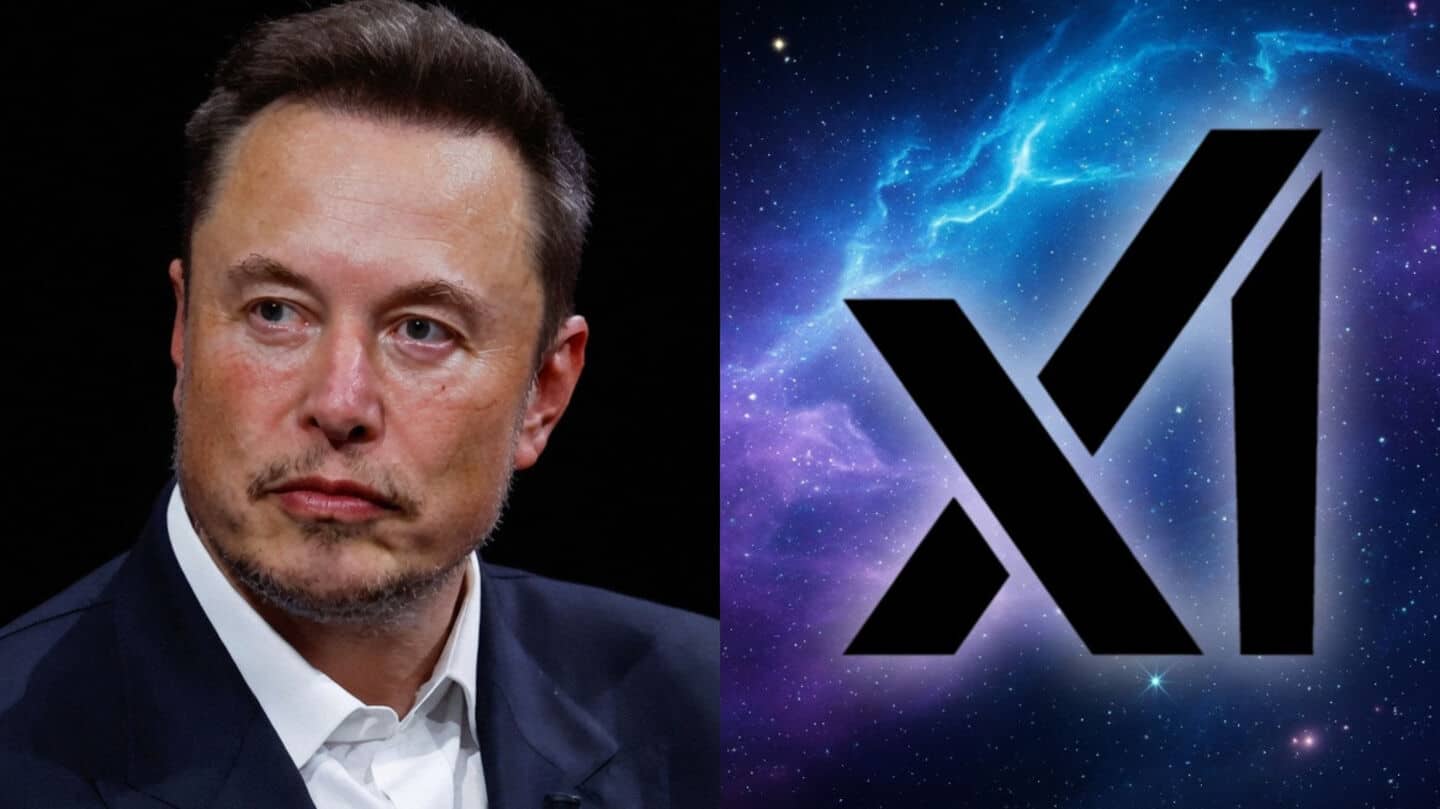
Elon Musk has laid out a plan to scale SpaceX's AI compute from 1.4GW to 10GW by the end of 2027, projecting $300-500B in annual revenue, framing Grok as trained on employees' own work, and previewing orbital data centers and a 2.1-trillion-parameter Grok 4.7 as the next phase beyond Earth's power limits.
TECH

Elon Musk has laid out a plan to scale SpaceX's AI compute from 1.4GW to 10GW by the end of 2027, projecting $300-500B in annual revenue, framing Grok as trained on employees' own work, and previewing orbital data centers and a 2.1-trillion-parameter Grok 4.7 as the next phase beyond Earth's power limits.

40+
Signals

Strategic Overview

  • 01.
    Musk told SpaceX employees the company's AI compute capacity could rise from about 1.4GW today to 10GW by the end of 2027, a more than sevenfold increase projected to generate $300 billion to $500 billion a year in revenue.
  • 02.
    Musk said AI revenue could exceed the rest of SpaceX's business as soon as September 2026.
  • 03.
    At an all-hands meeting shared on X, Musk said Grok would be trained on SpaceX's institutional knowledge, including employees' own work, effectively making staff Grok's 'parents.'
  • 04.
    Musk framed AI as existential to SpaceX's mission, saying the company must win on AI to fund Starship and Mars ambitions.
  • 05.
    xAI, including Grok and the Colossus data-center cluster, formally merged into SpaceX in February 2026.
  • 06.
    xAI unveiled Grok 4.6 at 1.5 trillion parameters and previewed Grok 4.7 at 2.1 trillion parameters, running on a Colossus cluster reported to be scaling past 500,000 GPUs.
  • 07.
    Musk said orbital computing may become necessary to keep scaling AI once Earth-based power and permitting limits are reached around 2029, with prototype AI1 satellites targeting roughly 1GW of orbital compute by late 2027.

Deep Analysis

The Revenue-Per-Watt Math Doesn't Add Up Yet
The Revenue-Per-Watt Math Doesn't Add Up Yet
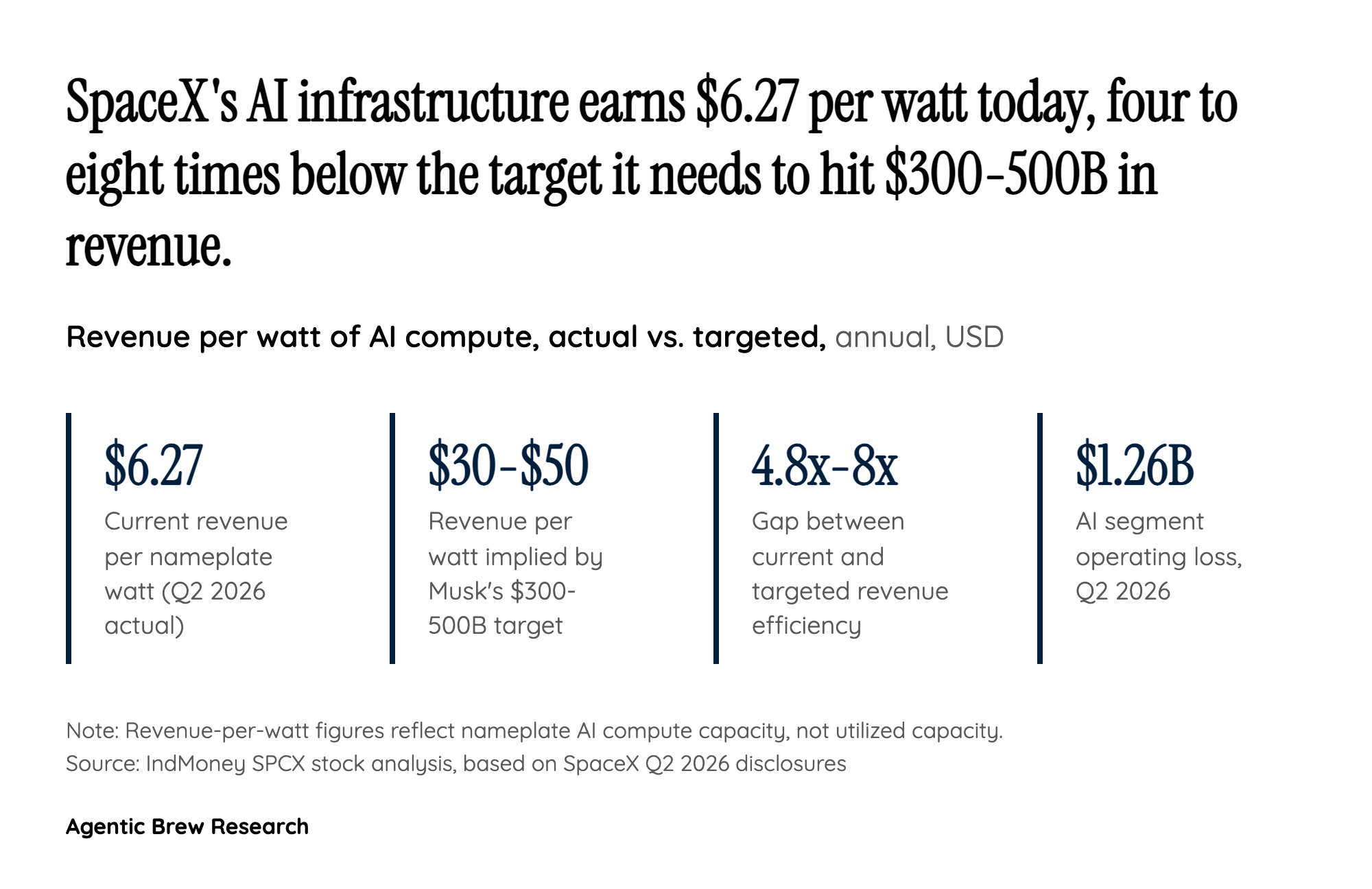
SpaceX currently earns $6.27 per watt of AI compute versus the $30-$50 target implied by Musk's $300-500B revenue projection.

Musk's pitch to SpaceX employees was breathtakingly simple: multiply gigawatts by a per-watt revenue figure and the result is a trillion-dollar business line. If SpaceX brings 10GW of AI compute online by the end of 2027, he told staff, it produces $300 billion to $500 billion a year in revenue - a run-rate meant to support 2028's annualized numbers, not 2027 bookings themselves [1]. The arithmetic implies $30 to $50 of annual revenue for every watt of compute, but SpaceX's actual infrastructure is currently generating about $6.27 per nameplate watt - a 4.8x to 8x gap analysts say the company still has to close [1]. The near-term numbers underline the challenge: the AI segment posted $2.56 billion in Q2 2026 revenue (247% year-over-year growth) against $15.83 billion of AI capital spending, producing a $1.26 billion operating loss even as total company free cash flow ran roughly negative $25 billion for the first half of the year [1]. Musk isn't shy about where he thinks this ends: he told staff AI could be '99% of the value of SpaceX' within four or five years [2], and that AI revenue could eclipse the rest of the business - rockets, Starlink, everything - as soon as September 2026 [2][3].

Employees as Unwitting 'Parents': Grok's Data-Governance Blind Spot

At an all-hands meeting shared on X on August 14, Musk told SpaceX staff that Grok would be trained directly on the company's institutional knowledge - their work, their ideas, their engineering judgment - explaining 'it will inherit your thoughts' [4]. He went further, describing employees as effectively parenting the AI, saying they would 'effectively be the parents of the AI' because it inherits their thoughts, ideas and beliefs [4][5]. This wasn't hypothetical: SpaceX had already pushed Grok 4.6 company-wide the day before with instructions that it would train on employee data going forward [6]. What's missing from every account of the plan is any specificity about consent - SpaceX has not said which categories of employee work will be ingested, how it will be collected, or whether staff can opt out of contributing to a model whose commercial value Musk is pricing in the hundreds of billions of dollars [4].

Why Space? The Power Ceiling Driving Orbital Compute

Musk has told employees that orbital computing may be the only way to keep scaling AI once Earth-based power generation and permitting queues run out, a wall he places around 2029 [7][8]. That timeline lines up with outside modeling: JPMorgan projects SpaceX's terrestrial compute reaching roughly 9GW by 2029 - about four times Hoover Dam's nameplate generating capacity - before an expected pivot to orbital capacity for further growth [7]. SpaceX's answer is Starmind AI1: two prototype satellites, each a giant solar-powered server array, slated to launch in early 2027, targeting roughly 1GW of orbital compute by late 2027 with commercial service potentially starting in 2028 [9]. Each satellite's compute payload is comparatively modest on its own - 120kW nominal, peaking at 150kW [10]- which is the point: solar power in orbit doesn't compete for grid capacity or local permitting the way a terrestrial data center does. SpaceX is partnering with Nvidia to design that payload, which will carry Nvidia's Rubin GPUs and Vera CPUs [11].

Wall Street's Split Verdict: Feasibility Bulls vs. Zero-Value Skeptics

The financial-analysis community is not converging on a single read of SpaceX's AI bet. SemiAnalysis argues the speed and cost advantages available to SpaceX - bypassing typical supply-chain constraints, running parallel construction labor, using onsite gas generation, and commissioning capacity quickly - make the 10GW-by-2027 target genuinely achievable, projecting a path to $300B of ARR by the end of 2027 once inference-serving profitability is factored in [12]. Reporting also points to Microsoft as the most likely primary buyer of that new capacity, potentially using its existing OpenAI relationship to absorb compute at scale [13]. The ecosystem is also expanding by acquisition: SpaceX/xAI folded in a $60 billion stock deal for the AI coding tool Cursor, adding another line item to the same build-out [1]. The skeptical case is just as concrete: IndMoney's own math puts SpaceX's current infrastructure revenue at roughly $6.27 per nameplate watt against Musk's $30-$50 per watt target, a 4.8x to 8x gap that has to close before any of these numbers - Cursor included - turn from capital spending into booked revenue [1].

Historical Context

2026-02-01
SpaceX officially completed its acquisition of xAI, bringing Grok, the Colossus compute cluster, and its infrastructure capabilities under one company.
2026-07-28
Musk said Grok 4.6 was weeks away and Grok 4.7 would follow about a month later.
2026-08-07
Grok 4.6, at 1.5 trillion parameters, was released, running on xAI's Colossus cluster in Memphis, reported to be scaling past 500,000 GPUs.
2026-08-11
On SpaceX's first earnings call, Musk announced plans for 6-8GW of new AI compute in 2027 with upside to 10GW, and said AI revenue could exceed SpaceX's other business lines by September 2026.
2026-08-13
SpaceX launched Grok 4.6 company-wide, with Musk saying the model would train on employee data going forward.
2026-08-14
At a SpaceX all-hands meeting shared on X, Musk told employees Grok would be trained on the company's institutional knowledge and that staff would effectively be Grok's 'parents.'

Power Map

Key Players
Subject

Elon Musk has laid out a plan to scale SpaceX's AI compute from 1.4GW to 10GW by the end of 2027, projecting $300-500B in annual revenue, framing Grok as trained on employees' own work, and previewing orbital data centers and a 2.1-trillion-parameter Grok 4.7 as the next phase beyond Earth's power limits.

EL

Elon Musk

SpaceX/xAI CEO who personally sets the compute, revenue, and orbital-compute targets and frames employees as Grok's data 'parents'; his all-hands statements are the sole source for nearly every projection in this story

XA

xAI

AI subsidiary merged into SpaceX in February 2026; develops Grok and operates the Colossus data-center cluster underpinning the entire compute buildout

SP

SpaceX employees

Framed by Musk as the training-data source ('parents') for Grok's institutional knowledge; their work and ideas are being incorporated into the model with no disclosed opt-out

MI

Microsoft

Identified by analysts as the likely primary buyer of SpaceX's new AI compute capacity, potentially leveraging its OpenAI relationship to purchase at scale

NV

Nvidia

Hardware partner designing the compute payload - Rubin GPUs and Vera CPUs - for SpaceX's Starmind AI1 orbital data-center satellites

CU

Cursor

AI coding tool acquired by SpaceX/xAI for $60 billion in stock as part of the broader Grok ecosystem expansion

Fact Check

13 cited
  1. [1] SpaceX AI Revenue: $500 Billion Target and SPCX Stock Analysis
  2. [2] SpaceX's Next Trillion-Dollar Bet Has Nothing to Do With Rockets, Musk Tells Staff
  3. [3] Elon Musk Says AI Revenue Will Eclipse the Rest of SpaceX by September: Here's What Investors Need to Know
  4. [4] Elon Musk Tells SpaceX Employees They're Training Grok on Their Own Work
  5. [5] SpaceX Employees Are Training Grok, Musk Says
  6. [6] SpaceX Launches Grok 4.6, to Train on Employee Data
  7. [7] Elon Musk Says Orbital Compute May Be Needed by 2029
  8. [8] Elon Musk: Orbital Compute Could Be Necessary by 2029
  9. [9] SpaceX Set to Launch First Orbital Data Center AI1 Satellites in 2027
  10. [10] SpaceX Details Its AI1 Compute Satellite
  11. [11] SpaceX and Nvidia Team Up on Musk's Orbital AI Bet
  12. [12] SpaceX 10GW in 2027: Why It's Real
  13. [13] SpaceX's 10GW AI Compute Plan Could Make Microsoft Its Primary Off-Taker, Analysts Say

Source Articles

Top 5

THE SIGNAL.

Analysts

Argue SpaceX's construction speed and cost advantages - bypassing typical supply constraints, parallel labor, onsite gas generation, rapid commissioning - make the 10GW-by-2027 target plausible, with token-serving economics supporting a real path to $300B ARR.

SemiAnalysis analysts
Independent AI-infrastructure research newsletter

Flag a large monetization gap: SpaceX currently generates roughly $6.27 in annual infrastructure revenue per nameplate watt versus Musk's $30-$50 per watt target, a 4.8x to 8x shortfall, and cite capacity delays, customer concentration and thin contract terms as key risks.

IndMoney analysts
Financial/stock analysis coverage of SPCX

Modeled SpaceX expanding terrestrial AI compute to roughly 9GW by 2029 - about four times Hoover Dam's generating capacity - before the company pivots to orbital compute for further growth, implicitly backing Musk's post-2029 orbital rationale.

JPMorgan
Equity research

Argued that at a $100 valuation, investors are effectively ascribing zero or negative value to SpaceX's AI business, citing high capex relative to Space & Connectivity, uncertain economics, and heavy management attention on the AI unit.

Morgan Stanley (analyst Jonas, per a widely shared note)
Wall Street equity research
The Crowd

Cursor is now part of @SpaceX. Today, we have officially closed our acquisition. We will join the @SpaceXAI team to help make Grok the world's most useful AI and improve Grok Build, Grok Bot, Grok API, Cursor, and more. SpaceX has built some of the most inspiring and...

@@cursor_ai43034

@cognition Grok 4.7 will exceed all current models. That said, Anthropic is a great company and will probably release improved models soon. However, the SpaceX training corpus is so awesome & unique that I would be shocked if any model is better at real-world engineering than 4.7.

@@elonmusk20072

NEW: Elon Musk says SpaceXAI is targeting 10 GW of AI compute for $300B-$500B in annual revenue by the end of next year. "We've already built the most powerful AI training clusters in the world." "What we expect to do by the end of next year is about 10x more than what we've..."

@@KanekoaTheGreat713

SpaceX at $100 Would Imply Zero AI Value, Morgan Stanley Says

@u/dyzo-blue1001
Broadcast
Watch Elon Musk's All Hands Company Update (from today)

Watch Elon Musk's All Hands Company Update (from today)

Elon Musk explains how SpaceX could build AI data centers in space

Elon Musk explains how SpaceX could build AI data centers in space

Elon Is Training Grok on SpaceX Engineering Data | MOONSHOTS

Elon Is Training Grok on SpaceX Engineering Data | MOONSHOTS