GM's V2G and sodium-ion battery push for AI power demand
TECH

GM's V2G and sodium-ion battery push for AI power demand

34+
Signals

Strategic Overview

  • 01.
    At its GM Empower 2026 event on June 9, 2026, General Motors unveiled a plan to act as a distributed utility, expanding vehicle-to-grid (V2G) capability across its EV fleet and partnering with startup Peak Energy on a purpose-built sodium-ion battery for grid-scale storage.
  • 02.
    A firmware update converts existing vehicle-to-home systems into full V2G assets with no new hardware; more than 250,000 bidirectional-capable GM EVs are already on U.S. roads, a fleet GM says could power roughly 120,000 homes for a week.
  • 03.
    GM committed $900 million to commercialize new battery chemistries, with the first sodium-ion cells expected in trial production at its Battery Cell Development Center in 2028.
  • 04.
    GM also launched Energy Pass, a unified charging app spanning Tesla Supercharger, Electrify America, and IONNA networks, covering nearly 70% of accessible U.S. DC fast chargers.

Deep Analysis

The Automaker That Wants to Be Your Utility

GM used its GM Empower 2026 event to recast itself as what one report bluntly called a distributed utility in disguise [1]. The mechanics are almost anticlimactic: instead of shipping new hardware, GM is pushing a firmware update that flips an existing vehicle-to-home setup into a full vehicle-to-grid (V2G) asset — letting a parked EV not just back up a house during an outage but feed electricity back onto the public grid during peak demand. More than 250,000 GM EVs already on U.S. roads are bidirectionally capable [2], and GM's own arithmetic is that this fleet could power roughly 120,000 homes for a week [1]. GM Energy's Wade Sheffer summed up the pitch as treating parking lots and driveways as a massive, distributed power asset [3].

What makes this a strategic reframe rather than a feature drop is the target. GM is no longer just selling you a car; it is trying to turn the battery you already paid for into grid infrastructure it can help orchestrate and monetize. The bottleneck it is attacking isn't the silicon — it's the relationship with utilities. That is why the centerpiece is a set of pilots: PG&E in California and DTE Energy in Michigan, where GM is trying to prove that millions of scattered EVs can behave like one dependable, dispatchable power plant. The Michigan pilot, with just 30 employee households, has reportedly already moved 562 megawatts back to the grid [1].
Why Now: The AI Power Crunch GM Is Selling Into

Why Now: The AI Power Crunch GM Is Selling Into
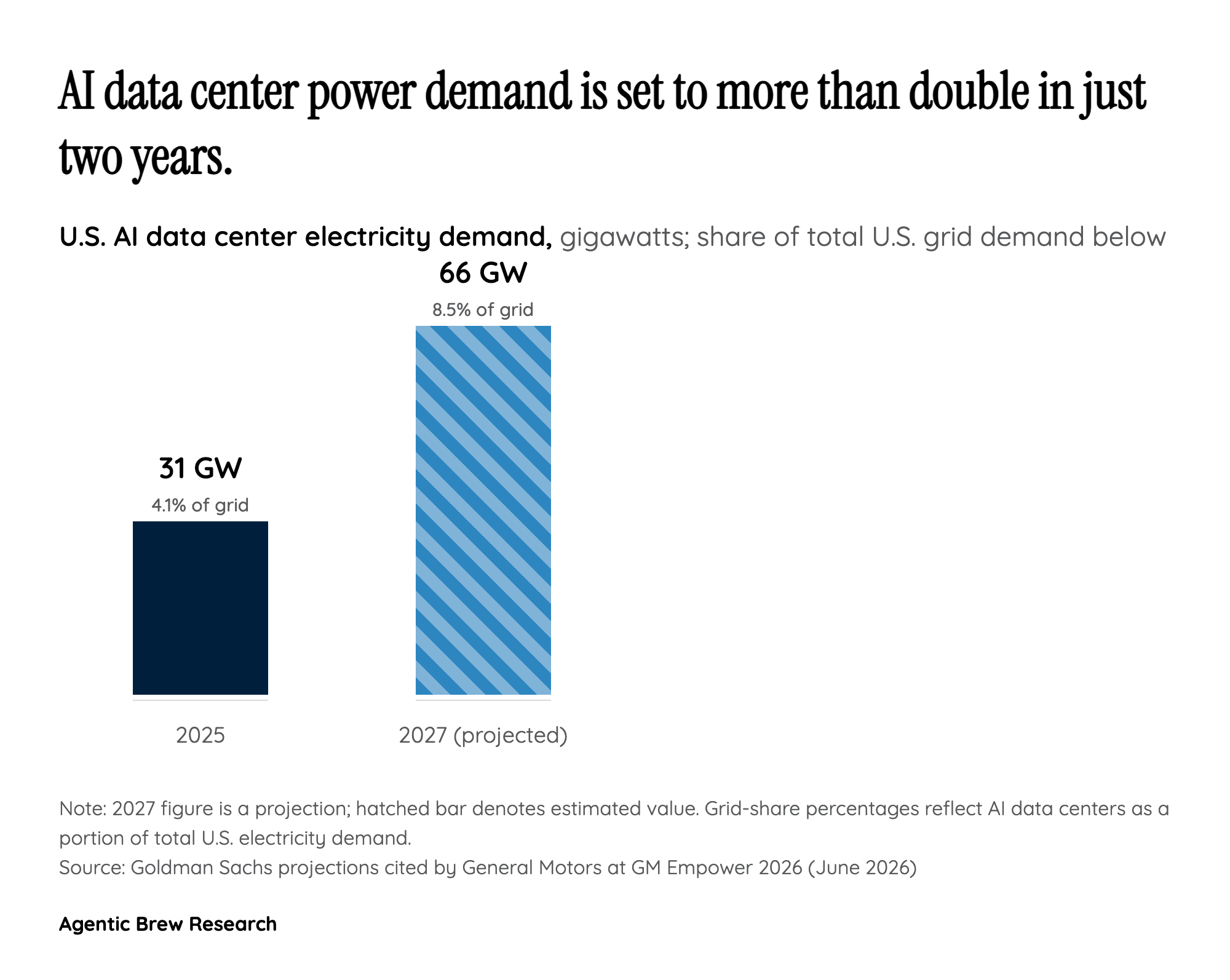
U.S. AI data center electricity demand is projected to more than double from 31 GW in 2025 to 66 GW in 2027, the surge GM is positioning its EV fleet and storage business to absorb.

The timing is not a coincidence; GM is selling into an electricity market that has suddenly gone short. Goldman Sachs projections cited by GM put U.S. AI data center power demand rising from 31 gigawatts in 2025 to 66 gigawatts by 2027, climbing from 4.1% to 8.5% of total grid demand [3]. A January 2026 NERC report found demand surging faster than the grid can adapt, projecting summer peak load to rise roughly 224 gigawatts over the next decade — about 70% higher than the prior year's forecast — with data centers a primary driver [1]. GM Chief Product Officer Sterling Anderson distilled the entire strategy into four words: the real bottleneck is energy [1].

There is a self-interested logic underneath the public-good framing. EV sales have softened, leaving automakers holding battery-factory capacity built for demand that hasn't fully arrived — and stationary grid storage is a way to monetize those cells regardless of how many cars sell. GM has agreed to route both new U.S.-built packs and second-life EV batteries to Redwood Materials, whose 63 MWh Nevada microgrid already powers data centers for AI-infrastructure firm Crusoe [2]. The grid crisis, in other words, doubles as a demand-side rescue for an over-built supply chain.

The Sodium Bet: Copying China's Cheapest Battery

The flashier long-term play is chemistry. GM is partnering with startup Peak Energy to develop a purpose-built sodium-ion battery for grid-scale storage — a first for any automaker outside China [2]. The appeal is structural: sodium is roughly 1,000 times more abundant than lithium [4], which sidesteps both the lithium supply squeeze and China's grip on critical minerals. GM developed the cell in its Michigan labs, retains exclusive manufacturing rights, and made a GM Ventures investment in Peak [5]; cells are expected for customers after 2028, backed by a $900 million commitment to commercialize new chemistries [2].

The design philosophy here is subtraction. Peak's systems are passively cooled — no active cooling loops, no fire-suppression hardware — which GM's Kurt Kelty argues is precisely why sodium-ion suits stationary storage: make the cell safer and more robust, and you can remove complexity elsewhere in the system [4]. GM's energy-storage commercialization lead Paul Menson reduced it to a slogan: eliminate the part, eliminate the problem [2]. Peak claims the approach cuts system cost about 20% while sustaining 99%-plus uptime [5]. Tellingly, GM built this chemistry specifically for grid-scale stationary storage — slotting into Peak's passively cooled racks — rather than for its vehicles, which keep their lithium-based cells. The sodium bet is aimed squarely at the data-center-adjacent grid, not the driveway.

What the Skeptics See: A Carmaker Is Not a Utility

The hard part isn't the technology; it's that GM is not a utility and cannot simply declare its cars to be grid capacity. Turning 250,000 scattered EVs into dependable, dispatchable power requires states to streamline interconnection, redesign electricity rates, and simplify enrollment — the software-and-regulation layer that is the actual bottleneck [6]. Utilities are dangling incentives to recruit drivers: PG&E's pilot offers up to $4,500 toward bidirectional-charging equipment [7], but participation still depends on owners signing up and staying plugged in at the moments the grid needs them.

Enthusiast communities are watching with earned skepticism. On Reddit's EV forums the dominant reaction to GM battery announcements is fatigue with stage-managed breakthroughs, alongside a recurring argument that GM's headline cost savings are manufacturing margin it will pocket rather than pass to buyers. Tellingly, a self-identified GM employee lent the chemistry work credibility, noting the advances are real and that Ford announced similar progress just weeks earlier — a reminder that GM is not operating alone. Ford is chasing the same grid-storage prize with a deliberately simpler bet: selling LFP 'DC Block' systems straight to utilities and data centers instead of orchestrating millions of consumer cars [1]. Whether GM's ambitious car-as-grid model or Ford's sell-the-box pragmatism wins may decide who actually captures the AI-era storage market.

Historical Context

2024
Material and component development for GM's sodium-ion effort began, with prototyping at GM's Michigan battery lab and GM Ventures backing Peak Energy.
2025-03-13
GM Energy joined PG&E's Vehicle-to-Everything (V2X) pilot in California, offering eligible owners up to $4,500 in bidirectional-charging incentives.
2026-01
A NERC report found U.S. electricity demand surging faster than the grid can adapt, with data centers a primary driver of a worsening resource-adequacy outlook.
2026-06-09
At GM Empower 2026, GM announced its sodium-ion partnership with Peak Energy and expanded V2G plans, positioning itself as a distributed utility.

Power Map

Key Players
Subject

GM's V2G and sodium-ion battery push for AI power demand

GE

General Motors

Driving the strategy: activating V2G across 250,000+ EVs via firmware, developing sodium-ion cells, and building an energy-services business. If GM succeeds, parked EVs become a national distributed-storage layer; if it stalls, the car-as-grid model loses its biggest backer.

PE

Peak Energy

Sodium-ion grid-storage startup that integrates GM-built sodium-ion cells into its passively cooled energy-storage systems; received a strategic investment from GM Ventures and gives GM a path to grid-scale deployment.

PG

PG&E (Pacific Gas and Electric)

California utility partner in GM's V2X pilot offering EV owners up to $4,500 in bidirectional-charging incentives; its enrollment terms and rate design determine whether V2G scales in its territory.

DT

DTE Energy

Michigan utility running a real-world V2G pilot with 30 GM employee households, an early proof point for whether scattered EVs can deliver dependable grid capacity.

RE

Redwood Materials

Battery-recycling partner deploying second-life GM EV packs into microgrids, including a 63 MWh system powering Crusoe's data center in Nevada; turns GM's used batteries into data-center-adjacent storage.

FO

Ford Energy

Chief rival pursuing a simpler approach: selling LFP 'DC Block' storage systems directly to utilities and data centers rather than orchestrating V2G across consumer cars.

Fact Check

7 cited
  1. [1] America's grid is reeling. General Motors offers itself as a distributed utility in disguise
  2. [2] GM bets big on energy storage for data centers and the grid
  3. [3] GM's pitch: EVs aren't the grid's problem, they're a distributed power asset
  4. [4] General Motors to produce sodium-ion batteries for grid storage
  5. [5] Peak Energy and General Motors Partner to Scale Next-Generation Energy Storage Technology for the Grid
  6. [6] GM lays out its energy company and sodium-ion battery roadmap
  7. [7] GM Energy, PG&E launch bidirectional charging pilot

Source Articles

Top 5

THE SIGNAL.

Analysts

"Argues sodium-ion is the right chemistry for grid-scale stationary storage: 'In grid-scale stationary storage systems, if we can make the cell safer and more robust, we can remove complexity elsewhere in the system.'"

Kurt Kelty
VP of Battery and Sustainability, GM

"Reframes idle EVs as grid infrastructure: 'It's time for us to look at parking lots and driveways across our communities as a massive, distributed power asset.'"

Wade Sheffer
Vice President, GM Energy

"Frames energy availability, not vehicles or compute, as the central constraint of the AI era: 'The real bottleneck is energy.'"

Sterling Anderson
Chief Product Officer, GM

"Captures the passive-cooling design philosophy of removing components to remove failure points: 'Eliminate the part, eliminate the problem.'"

Paul Menson
Director of Energy-Storage Commercialization, GM

"Bets the category on cost and domestic manufacturing: 'The future of grid storage will be defined by affordability, reliability and American innovation.'"

Landon Mossburg
CEO and Co-Founder, Peak Energy
The Crowd

"GENERAL MOTORS $GM AND REDWOOD MATERIALS TO PURSUE USE OF U.S.-BUILT BATTERIES FOR ENERGY STORAGE https://t.co/Q5i0NR15EJ"

@@StockMKTNewz69

"Two battery companies are joining forces with a plan to deploy energy storage systems in the US that rely on sodium-ion technology https://t.co/buZ1V7DT2E"

@@business24

"Peak Energy launches world’s largest sodium-ion battery system, offering $1M annual savings and 90% reduction in auxiliary power use. https://t.co/x7lrt0eD7J https://t.co/I1DiXXa9YF"

@@IntEngineering41

"GM's electric future depends on a new battery — and this facility"

@u/OofItsSpencer213
Broadcast
How Used EV Batteries Are Being Turned Into Data Centers To Power AI

How Used EV Batteries Are Being Turned Into Data Centers To Power AI

Why Automakers Want To Power AI Data Centers

Why Automakers Want To Power AI Data Centers

Power Your Home With Your GM Electric Vehicle: GM Energy's Home Energy System With PowerBank

Power Your Home With Your GM Electric Vehicle: GM Energy's Home Energy System With PowerBank