The Confidence Gap: A CFO's 'Good Place' and a Raise 18 Days Later
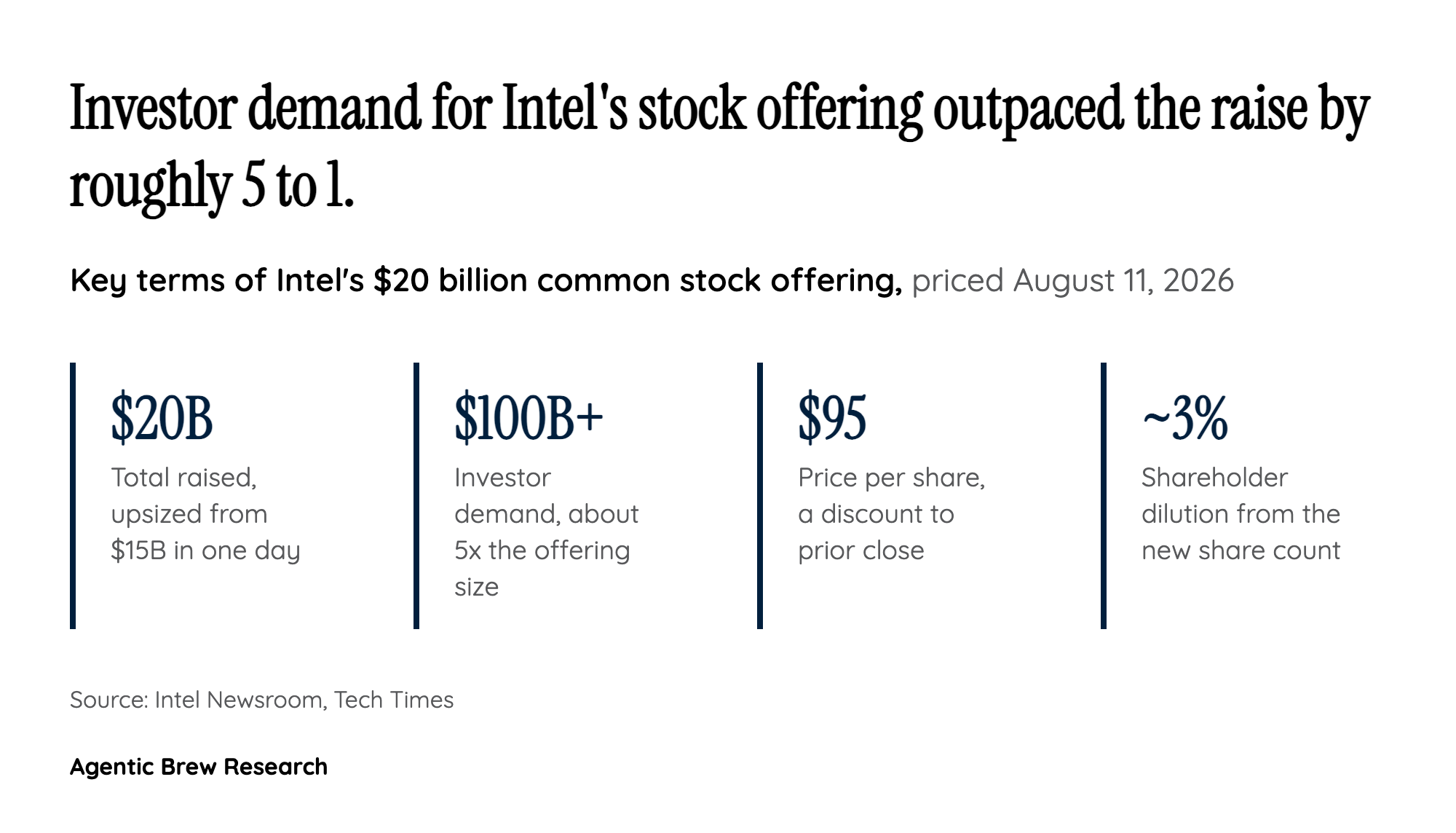
Intel's telling of its own capital needs shifted fast. On the company's July 23 earnings call, one widely shared investor post recalls the CFO waving off questions about a capital raise by saying Intel felt "in a really good place" - a line that aged awkwardly once the company spent the following weeks doing precisely what it had just downplayed. On August 10, 2026, Intel put out a proposed $15 billion common stock offering to fund AI chip development and foundry expansion [1], and the stock fell roughly 5% that same day as investors absorbed the dilution math [2]. Rather than retreat, Intel doubled down: by August 11 it had upsized the deal to $20 billion and priced 210,526,315 shares at $95 apiece [3], a price that still landed at a discount to where the stock had been trading before the announcement [4].
The whiplash matters because it reframes the raise from opportunistic to urgent. A company that insists it doesn't need money rarely goes from a $15 billion ask to a $20 billion print in about 24 hours unless the calculus behind the scenes changed quickly - or was more pressing than the public messaging let on. That tension, more than the dollar figure itself, is what the widely shared investor post referenced above zeroed in on: not whether Intel needed the cash, but why its CFO seemed to say otherwise so recently.