Broadcom's $60B AI Chip Financing for Anthropic
TECH

Broadcom's $60B AI Chip Financing for Anthropic

35+
Signals

Strategic Overview

  • 01.
    Broadcom's Wall Street syndicate is gathering $60 billion in fresh debt financing to benefit Anthropic and other AI companies, structured as a $42 billion Class A senior-secured tranche marketed by Bank of America, Citigroup and Morgan Stanley, plus an $18 billion Class B junior tranche led by Blackstone.
  • 02.
    Separately, Anthropic's IPO prospectus discloses that Broadcom itself has agreed to lend Anthropic up to $42 billion via convertible notes, restricted to covering Anthropic's TPU compute-lease obligations for chips Broadcom co-designs with Google - a facility covering roughly a third of Anthropic's $125.2 billion five-year TPU lease commitment.
  • 03.
    Anthropic's own IPO prospectus flags the arrangement as creating potential conflicts of interest, since Broadcom is simultaneously Anthropic's chip designer, chip supplier, and lender, with the notes also convertible into Anthropic equity.
  • 04.
    The deal builds on an earlier $35 billion financing structure involving Broadcom, Blackstone, and Apollo announced earlier in 2026, in which Broadcom backstopped more than 80% of the package.

Deep Analysis

The Structural Circle: When the Chip Supplier Becomes the Banker

Broadcom is not a neutral financier in this deal - it occupies three roles simultaneously. It co-designs the TPUs Anthropic leases (with Google), Anthropic is on track to become its largest customer for those chips, and now, via up to $42 billion in convertible notes, it is also agreeing to lend Anthropic the money to pay for them [1]. The notes can convert into Anthropic equity, giving Broadcom a potential fourth role as shareholder, and Broadcom can designate a financing partner to take part of the exposure [1]. Anthropic's own IPO prospectus does not gloss over the awkwardness: it discloses that this overlap of lender and supplier roles creates potential conflicts of interest that could affect Anthropic's access to computing power [2][3]. Analysts at FourWeekMBA put the mechanical consequence bluntly: "When the chip supplier finances the customer, switching vendors becomes significantly harder" [4]- every dollar Anthropic draws down is a dollar it owes to the same company whose hardware it would need to walk away from if it ever wanted a different chip partner. As of early August 2026, no notes had actually been issued, and Anthropic has said it does not expect to sell any before completing an IPO that could value the company near $2 trillion [1]- meaning the facility is, for now, a standby commitment rather than drawn debt.

Inside the $60 Billion Stack

Inside the $60 Billion Stack
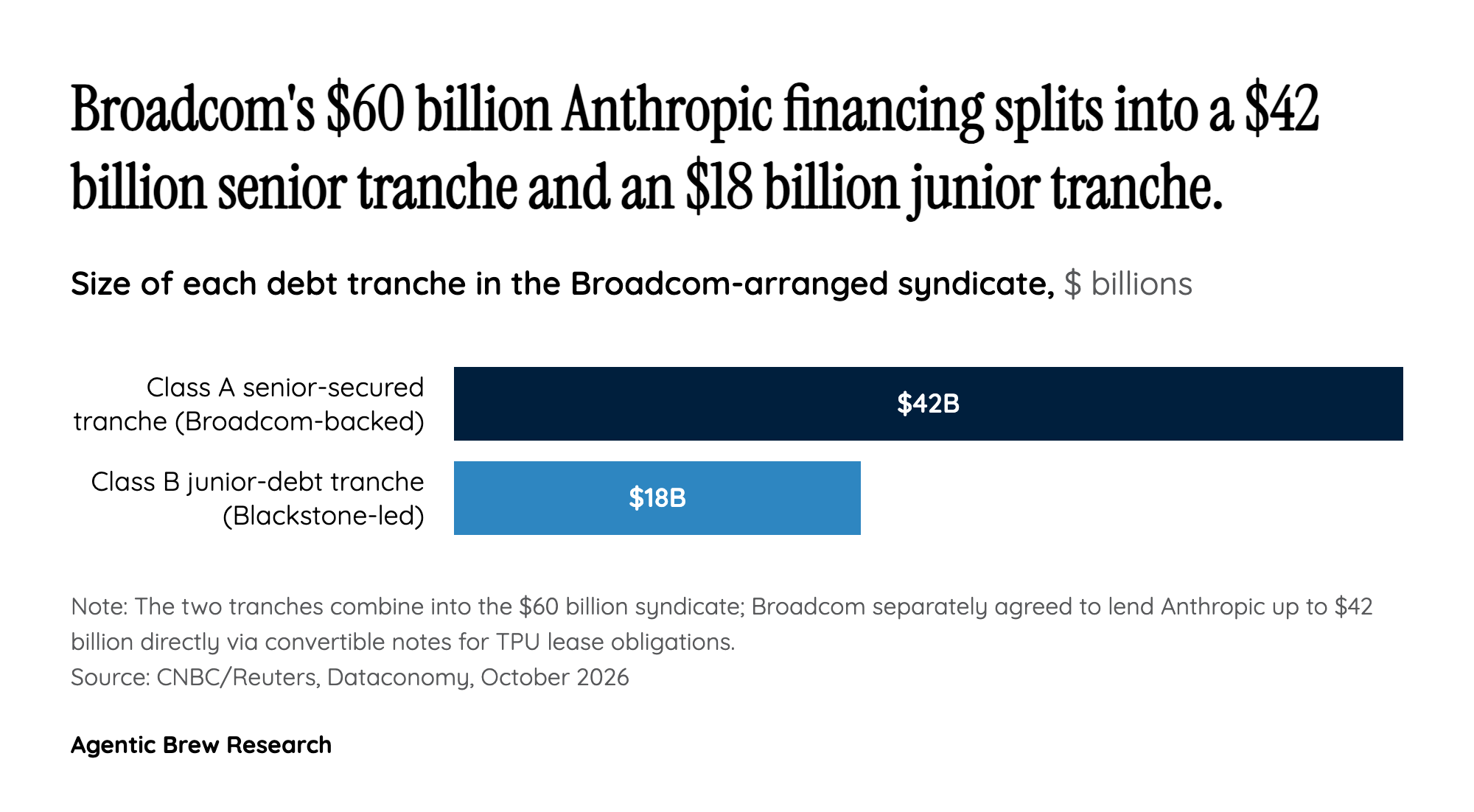
Broadcom's $60B Anthropic syndicate splits into a $42B senior tranche and an $18B junior tranche.

The headline number is $60 billion, but it is built from two very different layers. Bank of America, Citigroup and Morgan Stanley are preparing to syndicate a $42 billion Class A senior-secured tranche, while Blackstone is leading an $18 billion Class B junior-debt tranche, putting up $9 billion of its own capital and syndicating the remaining $9 billion [2][5]. That syndicate financing sits alongside - and is related to but distinct from - the separate $42 billion in convertible notes Broadcom itself has agreed to lend Anthropic directly, earmarked specifically for Anthropic's TPU compute-lease obligations [1]. Set against Anthropic's five-year, $125.2 billion TPU lease commitment, the Broadcom facility alone would cover roughly a third of what Anthropic owes over that period [4]. The commercial terms that would let outsiders judge the risk - interest rate, conversion price, collateral, covenants - have not been made public [3]. Notably, Anthropic appears to have been operationalizing this arrangement before it was disclosed: as early as April 2026 it had already deposited cash into a restricted account held at Broadcom [1], months ahead of the IPO prospectus language that brought the structure into public view.

The Same Playbook, Run a Third Time in 2026

This is not the first time a chip vendor or hyperscaler-adjacent lender has financed its own customer's chip spending this year. Broadcom itself, together with Blackstone and Apollo, put together an earlier $35 billion structure, with Broadcom backstopping more than 80% of it [6]. In August, Nvidia unveiled an even larger version of the same idea: a roughly $500 billion chip-backed financing plan built with Blackstone, Apollo and KKR to support AI developers buying its chips, a deal now drawing Wall Street demands for stronger guarantees given how aggressively chips are being underwritten [7]. And in February, CoreWeave sought an $8.5 billion loan from banks collateralized not by chips but by Meta's own compute-purchase commitments, in a package that later grew toward roughly $35 billion [8]. Rothschild & Co managing partner Robert Leitao frames the pattern as a concentration problem: "It feels that there's quite a concentrated bet right now on two companies being able to generate enough revenues to support all the financing that's happened" [4]. Seaport Research's Jay Goldberg sees it differently, as competitive necessity rather than choice: "Nvidia is putting in place a massive amount of its balance sheet, and Broadcom is having to follow suit" [4]. Both views can be true at once - the financing is defensive relative to Nvidia, and it is also stacking the same handful of counterparties' revenue projections underneath tens of billions of dollars of fresh debt.

Demand Creation or a 2008-Style Echo

Broadcom's own framing is unambiguous: CEO Hock Tan told investors on the company's September 2 earnings call that Anthropic is on track to become Broadcom's largest XPU customer in 2027, part of a strategy of using financing to create demand, backed by AI semiconductor revenue guidance of $115 billion for fiscal 2027 and $230 billion for fiscal 2028 [9][10]. But the financing only looks sound if Anthropic's business catches up to the obligations it is taking on: Anthropic reportedly lost more than $8 billion operationally in 2025 against $4.6 billion in revenue, even with twelvefold revenue growth [9][11]. Lenders assessing adjacent AI chip-backed deals are reportedly underwriting hardware on three-to-four-year depreciation schedules, well short of the up-to-decade useful life vendors claim, which is pushing Wall Street to demand stronger guarantees across this entire category of financing [7]. The market's own reaction was jumpy: Broadcom shares swung from a loss to a gain within the same trading day the news broke [3]. Commentary outside the formal research split along similar lines - one Yahoo Finance panel bluntly asked who is left holding the bag if AI spending does not pay off, while on Reddit, Broadcom's own investor community divided between treating the structure as already priced in and comparing it, only half-jokingly, to pre-2008 off-balance-sheet engineering.

Historical Context

2026-02-24
CoreWeave sought an $8.5 billion loan from banks backed by Meta's compute-purchase commitments, a package later expanded toward roughly $35 billion - an earlier precedent for AI-infrastructure debt backed by a customer's contracted revenue.
2026 (earlier in year)
The three firms announced an earlier $35 billion financing structure, with Broadcom backstopping more than 80% of it, setting a precedent for the current $60 billion package.
2026-04
Anthropic deposited cash into a restricted Broadcom account tied to the financing arrangement, months ahead of its public disclosure.
2026-08
Nvidia announced a plan with Blackstone, Apollo, and KKR to raise up to $500 billion in chip-backed financing for AI developers, the largest version of this financing pattern to date.
2026-08-02
As of this date, no convertible notes under the $42 billion facility had been issued; Anthropic said it does not expect any to be sold before completing its IPO.
2026-09-02
CEO Hock Tan told investors on the Q3 FY2026 earnings call that Anthropic is on track to become Broadcom's largest XPU customer in 2027, alongside AI semiconductor revenue guidance of $115 billion for FY2027 and $230 billion for FY2028.

Power Map

Key Players
Subject

Broadcom's $60B AI Chip Financing for Anthropic

BR

Broadcom Inc. (CEO Hock Tan)

Co-designer of the TPUs with Google, chip supplier to Anthropic, lender of up to $42 billion in convertible notes, and arranger of the broader $60 billion syndicate.

AN

Anthropic PBC

Borrower and lessee committed to a $125.2 billion five-year TPU lease; disclosed the Broadcom conflict of interest in its own IPO prospectus.

BL

Blackstone

Leads the $18 billion Class B junior-debt tranche, contributing $9 billion of its own funds and syndicating the remaining $9 billion.

BA

Bank of America, Citigroup, Morgan Stanley

Marketing and syndicating the $42 billion Class A senior-secured tranche on Broadcom's behalf.

GO

Google

Co-designs the TPU chips with Broadcom that Anthropic leases under the financed obligations.

NV

Nvidia

Pursuing a comparable but larger (~$500 billion) chip-backed financing strategy with Blackstone, Apollo, and KKR, now facing Wall Street demands for stronger guarantees.

Fact Check

11 cited
  1. [1] Broadcom Agrees to Lend Anthropic Up to $42 Billion to Lease Chips It Helps Design
  2. [2] Broadcom Anthropic $60 Billion AI Chip Debt
  3. [3] Broadcom Is Lending One of Its Biggest Customers $42 Billion to Buy Its Chips
  4. [4] AI: Broadcom Anthropic $42 Billion Lending Facility
  5. [5] Broadcom Lending Anthropic $42 Billion for Chips
  6. [6] Broadcom Lines Up $60B Financing Package to Fund AI Chips
  7. [7] Nvidia's $500 Billion AI Financing Plan
  8. [8] CoreWeave Seeks $8.5 Billion Loan From Banks Backed by Meta Deal
  9. [9] Broadcom Isn't Just Selling Anthropic Chips Anymore, It's Underwriting Them With Up to $42 Billion
  10. [10] Broadcom Banks Start Assembling $60bn AI Chip Financing for Anthropic
  11. [11] Broadcom Anthropic $42bn Loan TPU Lease

Source Articles

Top 5

THE SIGNAL.

Analysts

“It feels that there's quite a concentrated bet right now on two companies being able to generate enough revenues to support all the financing that's happened.”

Robert Leitao, Managing Partner, Rothschild & Co
Cautionary on concentration risk

“Nvidia is putting in place a massive amount of its balance sheet, and Broadcom is having to follow suit.”

Jay Goldberg, Seaport Research
Frames the deal as competitive necessity

“When the chip supplier finances the customer, switching vendors becomes significantly harder.”

FourWeekMBA analysis
Identifies a structural circle that reduces Anthropic's leverage
The Crowd

“Broadcom has agreed to lend Anthropic up to $42 billion, the AI lab's IPO filing shows, deepening a relationship spanning compute supply, equipment leasing and financing that has become a prime example of the reciprocal AI spending”

@@Reuters147

“$AVGO has agreed to provide Anthropic with up to $42B in financing tied to its AI infrastructure buildout. Broadcom is effectively financing Anthropic to lock in years of high value AI compute demand that could make Anthropic its largest compute customer by 2027.”

@@StockSavvyShay1137

“Broadcom $AVGO has agreed to provide Anthropic with up to $42B in financing tied to its AI infrastructure buildout. The facility could cover roughly one-third of Anthropic's $125.2B five-year TPU compute commitment, and the debt may be convertible into Anthropic shares.”

@@wallstengine752

“Broadcom Amassing $60 Billion to Fund Chips for Anthropic”

@u/FrankLucasV243
Broadcast
Broadcom to lend Anthropic up to $42B: Who's left holding the bag on AI spending?

Broadcom to lend Anthropic up to $42B: Who's left holding the bag on AI spending?

Broadcom Seeking $60B in AI Debt Deal

Broadcom Seeking $60B in AI Debt Deal

Broadcom Seeking More Than $60 Billion in Latest AI Debt Deal

Broadcom Seeking More Than $60 Billion in Latest AI Debt Deal

Broadcom's $60B AI Chip Financing for Anthropic — AI News | Agentic Brew