Google launches EmbeddingGemma 2 multimodal embedding model
TECH

Google launches EmbeddingGemma 2 multimodal embedding model

30+
Signals

Strategic Overview

  • 01.
    Google DeepMind released EmbeddingGemma 2 on October 6, 2026, its first open, natively multimodal embedding model, mapping text, code, images, video, and audio into one shared vector space under an Apache 2.0 license.
  • 02.
    The 740M-parameter model uses modular encoders - a 270M text/code core plus optional 170M vision and 300M audio towers - and runs with as little as roughly 191MB of RAM for text-only use or about 567MB for the full multimodal build on a Pixel 11 Pro.
  • 03.
    Its context window quadrupled to 8,000 tokens, and its 768-dimensional embeddings can be truncated to 512, 256, or 128 dimensions via Matryoshka Representation Learning, cutting local vector-database storage by up to 6x.
  • 04.
    Google is already shipping the model inside its own products, including a Video Moments Finder demo in the AI Edge Gallery app and the fully local Google AI Edge Foresight meeting-notes app for Mac.

Modular Encoders and Matryoshka Truncation: Squeezing Four Modalities Into Half a Gigabyte
Modular Encoders and Matryoshka Truncation: Squeezing Four Modalities Into Half a Gigabyte
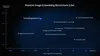
Massive Image Embedding Benchmark results cited in Google's release materials.

EmbeddingGemma 2's trick isn't one giant network - it's a 270M-parameter text/code core that can load an optional 170M-parameter vision encoder or a 300M-parameter audio encoder on demand [2]. That modularity is why a phone can run the text-only configuration in roughly 191MB of active RAM, while the full multimodal stack with all encoders loaded costs about 567MB on a Pixel 11 Pro [3]. On top of that, every embedding it produces starts at 768 dimensions but can be truncated down to 512, 256, or 128 dimensions using Matryoshka Representation Learning, cutting local vector-database storage by up to 6x [2]. In practice, that works because the technique trains the vector so its first N dimensions carry the most meaning on their own, letting you cut the tail off without starting over. The context window also grew 4x to 8,000 tokens, enough to process about 5.5 minutes of audio, 29 images, or 58 video frames in a single pass [7]- in practice, that's what makes whole-meeting or whole-video search on a phone feasible instead of theoretical.
Open Weights, Same-Day Runtimes: Why This Spread Faster Than a Closed API Ever Could

Google released EmbeddingGemma 2 under Apache 2.0 with runtime support already wired up across MediaPipe, LiteRT, transformers, sentence-transformers, MLX, vLLM, llama.cpp, SGLang, Ollama, and LMStudio, plus ecosystem partners like Qdrant and Unsloth, and it's slated to land in the Gemini Enterprise Agent Platform's Model Garden too [1]. That breadth is the real differentiator versus a closed, hosted-only embedding API: a developer isn't locked into one vendor's inference stack or pricing, and tooling projects can ship day-one quantized builds (GGUF, MLX) without waiting on the vendor. It's also a deliberate echo of what happened with the first EmbeddingGemma - Google DeepMind's own engineers said uptake 'blew past expectations' [4], and the sequel reads as a deliberate attempt to extend that same open-weight playbook into images, audio, and video rather than keep multimodal embedding behind an API paywall.

The Benchmark Gap: What 'Up to 6x Smaller' Doesn't Fully Promise

The Benchmark Gap: What 'Up to 6x Smaller' Doesn't Fully Promise
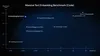
Massive Text Embedding Benchmark comparison from Google's release materials.

Google's published numbers are specific: truncating to 256 dimensions via Matryoshka Representation Learning retains roughly 95% of full-width quality for image, video, and speech embeddings, while truncating further to 128 dimensions keeps about 90% for text and code and about 75% for multimodal embeddings, alongside an MTEB Code score that climbed from 68.76 to 78.68 - a roughly 14% jump over the original EmbeddingGemma [2][3]. Those figures come from Google's own benchmark suite, and benchmark suites are proxies, not guarantees. Because Matryoshka truncation is lossy by construction, how much quality survives compression depends heavily on how similar a developer's own corpus is to what the model was benchmarked on - a product-catalog or meeting-transcript dataset can behave quite differently from the retrieval sets MTEB was built around. The gap between a headline compression ratio and what actually happens on a specific, messy, real-world dataset is the detail most launch coverage skips.

Not a Universal Upgrade: Where Dedicated Text Embedders Still Win

EmbeddingGemma 2's pitch is efficiency and modality coverage, not raw text-retrieval supremacy. Google's own framing is that it leads among sub-1B-parameter multimodal embedding models and can beat some specialist models more than twice its size on image, video, and audio tasks [4]- a claim scoped specifically to that weight class and those modalities. A model that devotes its full parameter budget to text alone, rather than splitting capacity across four modalities, can still out-rank EmbeddingGemma 2 on pure text-embedding quality when run on capable hardware. The honest positioning for EmbeddingGemma 2 is as the best option when the constraint is on-device footprint and you need text, code, images, audio, and video handled by one small model - not as a drop-in replacement for the largest dedicated text-embedding models when compute isn't the bottleneck.

From Research Demo to Shipped Product: Google Is Already Eating Its Own Dog Food

Unlike many model-card releases, EmbeddingGemma 2 is already running inside Google's own shipped features - a Video Moments Finder demo in the AI Edge Gallery app that lets someone find a specific clip from a voice memo, and the Google AI Edge Foresight app for Mac, which processes all meeting transcript and audio data locally rather than sending it to a server [5]. That matters for the privacy-first framing Google is using: offline multimodal search isn't a hypothetical use case here, it's the same pipeline powering a product already in users' hands. Market coverage of the launch also noted, separately from the technical story, that GuruFocus flagged Alphabet shares trading roughly 35.5% above its own GF Value estimate alongside mixed insider and guru trading activity [6]. That's a reminder that launch-day stock commentary and a model's actual technical merits are tracked by largely different audiences.

Historical Context

2025-09-04
Released the original EmbeddingGemma, a 300M-parameter, text-only, Gemma 3-based embedding model trained on 100+ languages that ran in under 200MB of RAM; it went on to be downloaded more than 20 million times.
2026-03-31
Released Gemma 4 in E2B, E4B, 31B, and 26B A4B sizes, the architecture that EmbeddingGemma 2 is later built on.
2026-10-06
Announced EmbeddingGemma 2: 740M parameters, native multimodal support, an 8,000-token context window (4x the original), and an MTEB Code score of 78.68 versus 68.76 for the first EmbeddingGemma.

Power Map

Key Players
Subject

Google launches EmbeddingGemma 2 multimodal embedding model

GO

Google / Alphabet Inc (NASDAQ: GOOGL)

Parent company and commercial beneficiary of the release

GO

Google DeepMind

Research division that built and announced EmbeddingGemma 2

SA

Sahil Dua

Research Engineer, Google DeepMind; credited announcer of EmbeddingGemma 2

HE

Henrique Schechter Vera

Research Engineer, Google DeepMind; co-author quoted on the model's development

HU

Hugging Face / Kaggle

Hosting and distribution platforms for the model weights

UN

Unsloth and the wider runtime ecosystem (Qdrant, Ollama, vLLM, llama.cpp, MLX)

Day-one integration partners enabling local deployment across devices

Fact Check

7 cited
  1. [1] Introducing EmbeddingGemma 2
  2. [2] EmbeddingGemma 2: The Developer Guide
  3. [3] Google claims EmbeddingGemma 2 outperforms rival embedding models twice its size
  4. [4] Google expands EmbeddingGemma beyond text to images, audio and video
  5. [5] Google AI Edge Foresight brings on-device meeting notes to Mac
  6. [6] Google DeepMind Launches EmbeddingGemma 2 AI Model, Boosting On-Device Search
  7. [7] Google Launches EmbeddingGemma 2 for On-Device Multimodal Search

Source Articles

Top 5

THE SIGNAL.

Analysts

“The pair said developer reception to the original text-only EmbeddingGemma motivated the multimodal sequel, noting that 'the response to the original blew past our expectations.'”

Sahil Dua and Henrique Schechter Vera (Research Engineers, Google DeepMind)
EmbeddingGemma 2 development team

“Commenters argued open licensing matters especially for embedding models, writing that 'for embedding models in particular, it doesn't make sense to use a closed, proprietary, hosted-only model.'”

Hacker News developer community
Independent developers evaluating the open-weight release
The Crowd

“Introducing EmbeddingGemma 2, a new open multimodal model that sets the standard for on-device efficiency. - our first open, natively multimodal embedding model - handles text, code, image, video, and audio tasks within a lightweight, modular 740M parameter form factor - ideal”

@@sundarpichai8384

“Meet EmbeddingGemma 2, our first natively multimodal open model for on-device embeddings. It expands beyond text to unify code, images, audio, and video in a shared space.”

@@GoogleDeepMind4291

“Introducing EmbeddingGemma 2! Our lightweight, multimodal embedding model maps text, code, images, video, and audio into a single, unified embedding space. Optimized for on-device use cases, it features: - 740M parameter form factor with modular encoders - Flexible dimension”

@@googlegemma3384

“Google releases EmbeddingGemma 2”

@u/yoracale939
Broadcast
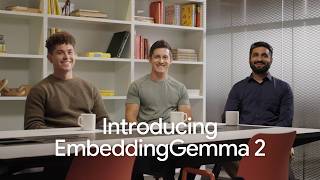
Introducing EmbeddingGemma 2: An open model for natively multimodal embeddings

Introducing EmbeddingGemma 2: An open model for natively multimodal embeddings

Embedding Gemma 2: On-Device Multimodal RAG Made Easy

Embedding Gemma 2: On-Device Multimodal RAG Made Easy

Google EmbeddingGemma 2: Multimodal Open Model for on-Device Embeddings

Google EmbeddingGemma 2: Multimodal Open Model for on-Device Embeddings

Google launches EmbeddingGemma 2 multimodal embedding model — AI News | Agentic Brew