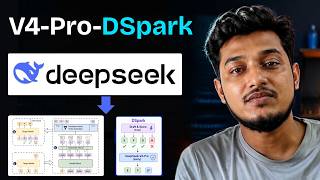
DeepSeek open-sources DSpark speculative decoding
TECH

DeepSeek open-sources DSpark speculative decoding

21+
Signals

Strategic Overview

  • 01.
    DeepSeek released DSpark on June 27, 2026, a speculative decoding framework that accelerates per-user generation for DeepSeek-V4 by roughly 60-85% over the MTP-1 production baseline; it is an engineering optimization layered on existing V4 checkpoints, not a new model.
  • 02.
    DSpark is already deployed in DeepSeek-V4's live production traffic across both the Flash and Pro tiers, not merely benchmarked in a lab.
  • 03.
    DeepSeek also open-sourced DeepSpec, an MIT-licensed full-stack codebase for training and evaluating speculative decoding draft models, bundling three drafters (DSpark, DFlash, Eagle3) with data preparation, training, and evaluation workflows.
  • 04.
    DeepSpec natively supports open-source models such as Qwen3 and Gemma, shipping released checkpoints for Eagle3, DFlash, and DSpark across multiple Qwen3 sizes.

Under the Hood: Two-Stage Drafting With a Confidence-Scheduled Verifier

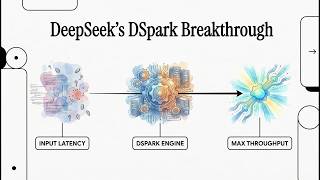
Speculative decoding works by letting a cheap drafter guess several tokens ahead, then having the full model verify them in a single parallel pass - accepting whatever survives the check. The catch is that pure parallel drafting decays fast: a backbone that emits logits for every future position at once cannot see the tokens it just proposed, so each successive guess drifts further from what the real model would have produced, and acceptance collapses a few tokens out. DSpark's design answers this directly. It splits drafting into two stages: a heavy parallel backbone (DFlash in their setup) produces base logits for every position, then a lightweight sequential head adds a prefix-dependent bias before sampling each token [1]. That sequential head is the fix for the decay problem - it reintroduces the dependence on already-drafted tokens that the parallel backbone throws away, sharpening each guess against the actual prefix without paying for a full autoregressive draft pass. On top of that sits the scheduling layer: a confidence head scores each draft position, and a hardware- and load-aware prefix scheduler sets the verification length per request using a profiled throughput curve [1]. The trade-off it manages is concrete - verify more tokens per step when GPUs are idle and fewer when they are busy, which raises per-user speed while holding overall system throughput constant under strict latency constraints [1]. The full method name, 'Confidence-Scheduled Speculative Decoding with Semi-Autoregressive Generation,' is the whole architecture in one phrase: semi-autoregressive because of the parallel-backbone-plus-sequential-head split, confidence-scheduled because verification depth is chosen dynamically rather than fixed.
The 51%-to-400% Sleight of Hand: Why One Release Has Two Headline Numbers

The 51%-to-400% Sleight of Hand: Why One Release Has Two Headline Numbers
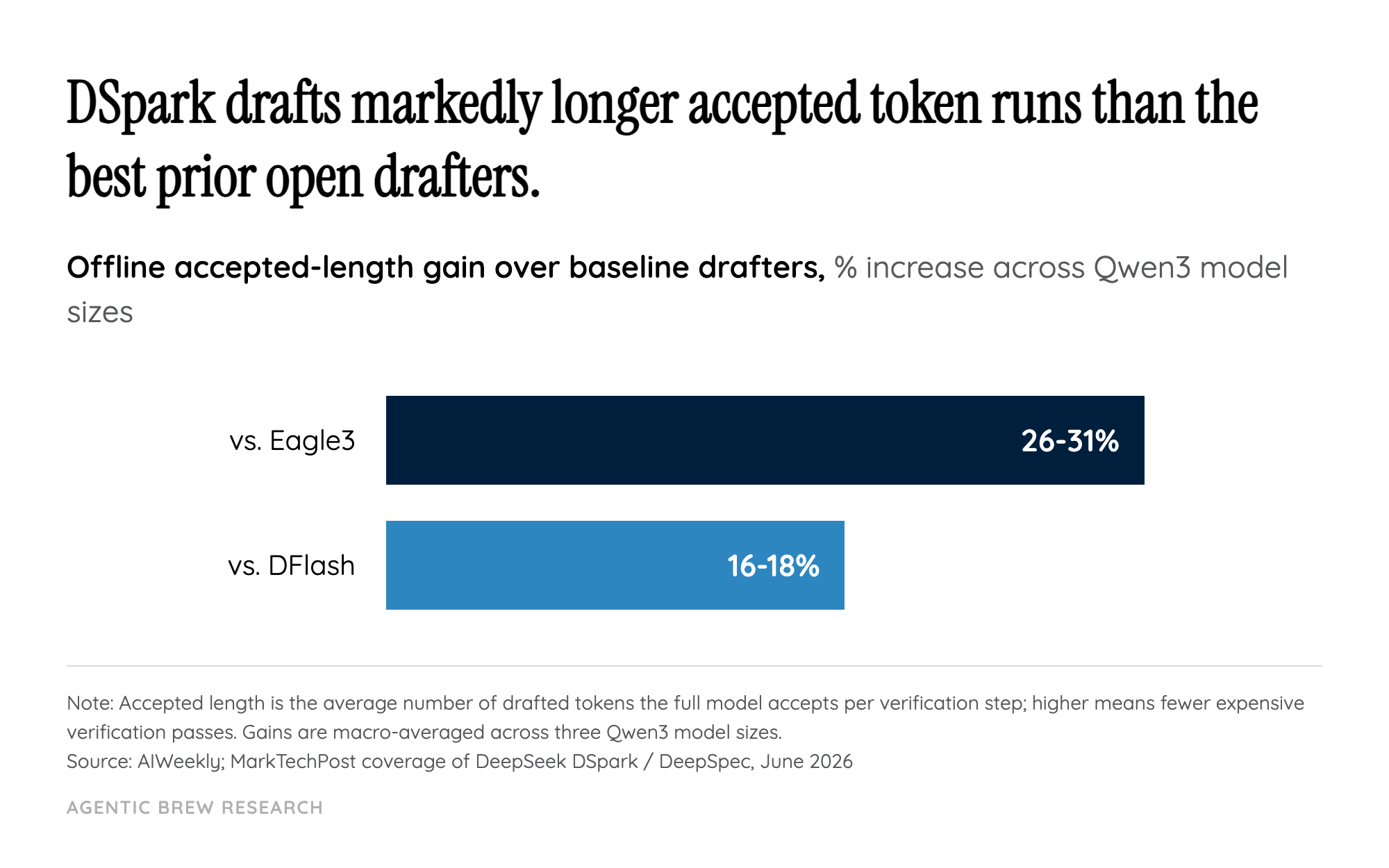
DSpark accepts 26-31% longer token runs than Eagle3 and 16-18% longer than DFlash across Qwen3 model sizes.

The same launch is being reported with wildly different gains, and the gap is not hype - it is a measurement choice. The web coverage anchors on per-user latency: generation runs 60-85% faster on DeepSeek-V4-Flash and 57-78% faster on DeepSeek-V4-Pro than the MTP-1 baseline, measured at equal overall throughput [1]. Practitioner threads, meanwhile, quote throughput multipliers running from 51% to several hundred percent. Both are true; they answer different questions. Per-user latency is what a single user feels - how fast their answer streams. Throughput is what an operator counts - how many tokens a server pushes across all users. The two diverge because speculative decoding's payoff depends on the latency target you commit to. A community analysis circulating in the discussion threads worked the math: pinned to an aggressive service-level target of around 120 tokens per second, the charts imply on the order of 761% more throughput, roughly 6.61x the tokens per server; but at a more realistic target near 80 tokens per second the same system yields about 51% more throughput, which pencils out to roughly a 33% cost reduction. The lesson for anyone reading a headline: a number this elastic is meaningless without the SLA it was measured against. For a user, DSpark means a snappier V4. For an operator, it means fewer servers for the same load - but how many fewer depends entirely on how fast you promised to be.

Open-Sourcing the Factory, Not Just the Product

The strategically loaded move here is not DSpark itself but DeepSpec, the MIT-licensed codebase DeepSeek shipped alongside it. DeepSpec is a full-stack codebase for training and evaluating draft models for speculative decoding, bundling three drafters - DSpark, DFlash, and Eagle3 - together with data preparation, training, and evaluation workflows [2]. Critically, it natively supports open-source large models such as Qwen3 and Gemma, with released checkpoints for Eagle3, DFlash, and DSpark across multiple Qwen3 sizes [4]. That is a different kind of open release. Most labs that open-weight a model hand you a fast artifact; DeepSeek handed over the method of making models fast, including the reference baselines it claims to beat. The evaluation harness is shipped too, spanning nine benchmark datasets - GSM8K, MATH500, AIME25, HumanEval, MBPP, LiveCodeBench, MT-Bench, Alpaca, and Arena-Hard-V2 [2]- so third parties can reproduce the comparisons rather than take them on faith. The ecosystem read is that DeepSeek is competing on the efficiency layer of inference and trying to set the open standard there. By making DSpark's drafter trainable on Qwen3 and Gemma out of the box, it positions its own technique as the default tool others reach for when they need to accelerate someone else's open model - a quieter form of leverage than topping a benchmark.

Why Now, and What the Skeptics Flag

The timing fits a broader pivot from scaling to serving efficiency, and DSpark arrives with production proof rather than just slides: it is running in DeepSeek-V4's live Flash and Pro traffic, not only benchmarked in a lab [3]. Offline, the gains hold up against the field - accepted length rises 26-31% over Eagle3 and 16-18% over DFlash [5]- which is what lets DeepSeek pitch DSpark as a new open baseline rather than a one-off tuning trick. Community sentiment has been overwhelmingly positive across X, YouTube, and Reddit, with practitioners framing the release as an efficiency-over-scaling statement and a marker of a genuinely open frontier lab; a recurring observation in those threads is that DeepSeek's API became the fastest DeepSeek provider on a major model-routing marketplace. But the same threads carry honest caveats worth keeping in view. Speculative decoding is not free: it can be more compute-expensive overall, the drafter adds VRAM overhead (community estimates put it near 20B extra parameters), and per-server cost is not automatically reduced - you save by needing fewer servers, not by spending less on each one. Training a drafter also demands substantial disk for data. And the single most-requested next step across discussions is vLLM support, which is still pending - meaning that for now the easiest path to DSpark-style speed is through DeepSeek's own serving or the DeepSpec training stack, not a drop-in into the most popular open inference engine.

Historical Context

2024-12
DeepSeek-V3 shipped a built-in Multi-Token Prediction (MTP) capability predicting the next 2 tokens, achieving roughly 1.8x speedups at over 80% acceptance rates - the lineage that the MTP-1 production baseline comes from.
2026-06-27
DeepSeek released DSpark and open-sourced the DeepSpec training and evaluation codebase, superseding the MTP-1 single-token production baseline.

Power Map

Key Players
Subject

DeepSeek open-sources DSpark speculative decoding

DE

DeepSeek

Released and open-sourced DSpark and the DeepSpec codebase, and deploys DSpark in its V4 production serving to speed up per-user generation.

OP

Open-source LLM ecosystem (Qwen3, Gemma users)

Beneficiaries - DeepSpec natively supports these models, letting third parties train and evaluate their own speculative-decoding drafters.

CO

Competing speculative-decoding methods (Eagle3, DFlash)

Baselines that DSpark outperforms; both are also bundled inside the DeepSpec codebase as reference drafters.

Fact Check

5 cited
  1. [1] DeepSeek Releases DSpark, a Speculative Decoding Framework That Accelerates DeepSeek-V4 Per-User Generation 60-85% Over MTP-1
  2. [2] deepseek-ai/DeepSpec
  3. [3] DeepSeek DSpark: Faster Inference
  4. [4] DeepSeek Open-Sources DeepSpec Framework, Boosts V4 Model Speed by Up to 85%
  5. [5] DeepSeek Open-Sources DeepSpec Speculative Decoding Stack

Source Articles

Top 3

THE SIGNAL.

Analysts

"Frames DSpark as a major open speculative-decoding release for V4 Flash and Pro, citing throughput gains of 51% to 400% and noting it also works well for other open models like Gemma and Qwen."

Daniel Han
Co-founder, Unsloth

"Reads the release as a statement of genuine open AI - emphasizing that DeepSeek open-sourced DeepSpec, the training framework behind DSpark, not just a fast model."

Yuchen Jin
Co-founder, Hyperbolic

"Describes DSpark as a semi-parallel speculative decoding system that gave DeepSeek-V4 about 60% to 85% faster per-user generation at matched throughput."

Rohan Paul
AI writer and engineer
The Crowd

"DeepSeek just released DSpark for V4 Flash & Pro, a new speculative decoding method boosting throughput by 51% to 400%! DS also showed DSpark works well for other models like Gemma & Qwen Github: github.com/deepseek-ai/De Paper: github.com/deepseek-ai/De HF: huggingface.co/deepseek-ai/De"

@@danielhanchen3223

"DeepSeek is the GOAT. 🐳 They just published DSpark, a new speculative decoding method that boosts throughput by 51% to 400%. They also open-sourced DeepSpec, the training framework behind it. This is the real open AI."

@@Yuchenj_UW2556

"Fantastic, @deepseek_ai just published their new inference optimization method. Proposes DSpark, a semi-parallel speculative decoding system that gave DeepSeek-V4 about 60% to 85% faster per-user generation at matched throughput. The biggest idea in DSpark is that faster"

@@rohanpaul_ai121

"DeepSeek releases DSpark - 50%-600% faster spec decoding vs MTP"

@u/danielhanchen750
Broadcast
DSpark - DeepSeek Just Made Inference 85% Faster

DSpark - DeepSeek Just Made Inference 85% Faster

DeepSeek introduced DSpark : This Made DeepSeek 85% Faster

DeepSeek introduced DSpark : This Made DeepSeek 85% Faster

DeepSeek's DSpark: Resolving LLM Friction

DeepSeek's DSpark: Resolving LLM Friction