Nolla Health's AI-Issued Prescriptions for Acne Care
TECH

Nolla Health's AI-Issued Prescriptions for Acne Care

38+
Signals

Strategic Overview

  • 01.
    Nolla Health's Nolla Derm app began issuing AI-generated initial prescriptions for topical acne treatment to Utah residents on October 5, 2026, making it the first organization in the US authorized by a state regulator for AI to issue an initial prescription rather than just a refill.
  • 02.
    The pilot is open to Utah residents 18 and older for $4.99 a month; patients verify identity, give informed consent, complete an intake questionnaire, and take a five-angle face scan in about 10-15 minutes before receiving a personalized treatment plan and, if appropriate, a prescription.
  • 03.
    The AI can only prescribe from a pre-approved formulary of eight topical treatments for mild-to-moderate acne and is barred from oral medications, isotretinoin, or severe acne cases.
  • 04.
    The program runs under a signed regulatory agreement between Utah's Office of Artificial Intelligence Policy, the Division of Professional Licensing, and Nolla Health's operating entities, executed around September 21-22, 2026, for an initial 12-month term renewable for up to two additional 12-month periods.

Deep Analysis

From Refill to Diagnosis: Why This Crosses a Line Doctronic Didn't

Every prior AI-prescribing pilot in the US, including an earlier Utah program from a company called Doctronic, only let AI approve refills of medication a human doctor had already prescribed [5]. Nolla Health's Utah pilot does something categorically different: its Nolla Derm app can generate a brand-new, initial prescription for acne treatment without a doctor ever signing off first, making it the first organization in the US authorized by a state regulator to do so [1]. That earlier Doctronic refill pilot had already triggered friction: Utah's own Medical Licensing Board publicly called for the program's suspension in 2026, saying it had not been consulted and that it put patients at risk [5]. Nolla's team has said it proactively engaged that same licensing board ahead of its launch, suggesting the company treated the earlier clash as a lesson rather than a one-off [6]. Utah also waived its normal requirement that a prescriber hold a medical license specifically to allow this pilot to proceed [6].
The Shrinking Safety Net: How Physician Oversight Ramps Down as Trust Builds

The AI's autonomy is explicitly temporary and conditional, following a step-down schedule written into the pilot. For the program's first 100 patients, two separate Utah-licensed physicians must independently review and approve every single AI-generated prescription before it reaches a pharmacy [4]. Once the program scales past 100 and up to 500 patients, the AI is allowed to issue prescriptions directly, with physicians only auditing them retrospectively on a weekly basis [4]. Beyond 500 patients, human review drops further still, to a monthly spot-check of at least 10 percent of prescriptions plus a mandatory review of every escalation or adverse-event case [4]. That three-stage ramp-down is formalized in the signed agreement between Nolla's operating entities and Utah's Office of Artificial Intelligence Policy and Division of Professional Licensing, which runs for an initial 12-month term and can be renewed for up to two additional 12-month periods [3]. Utah has been careful to frame this as experimentation, not endorsement: the state's own sandbox language states that participation 'does not mean the State of Utah has approved, endorsed, certified, or vouched for the product' [8].

The Access Math Behind the Policy Risk

The Access Math Behind the Policy Risk
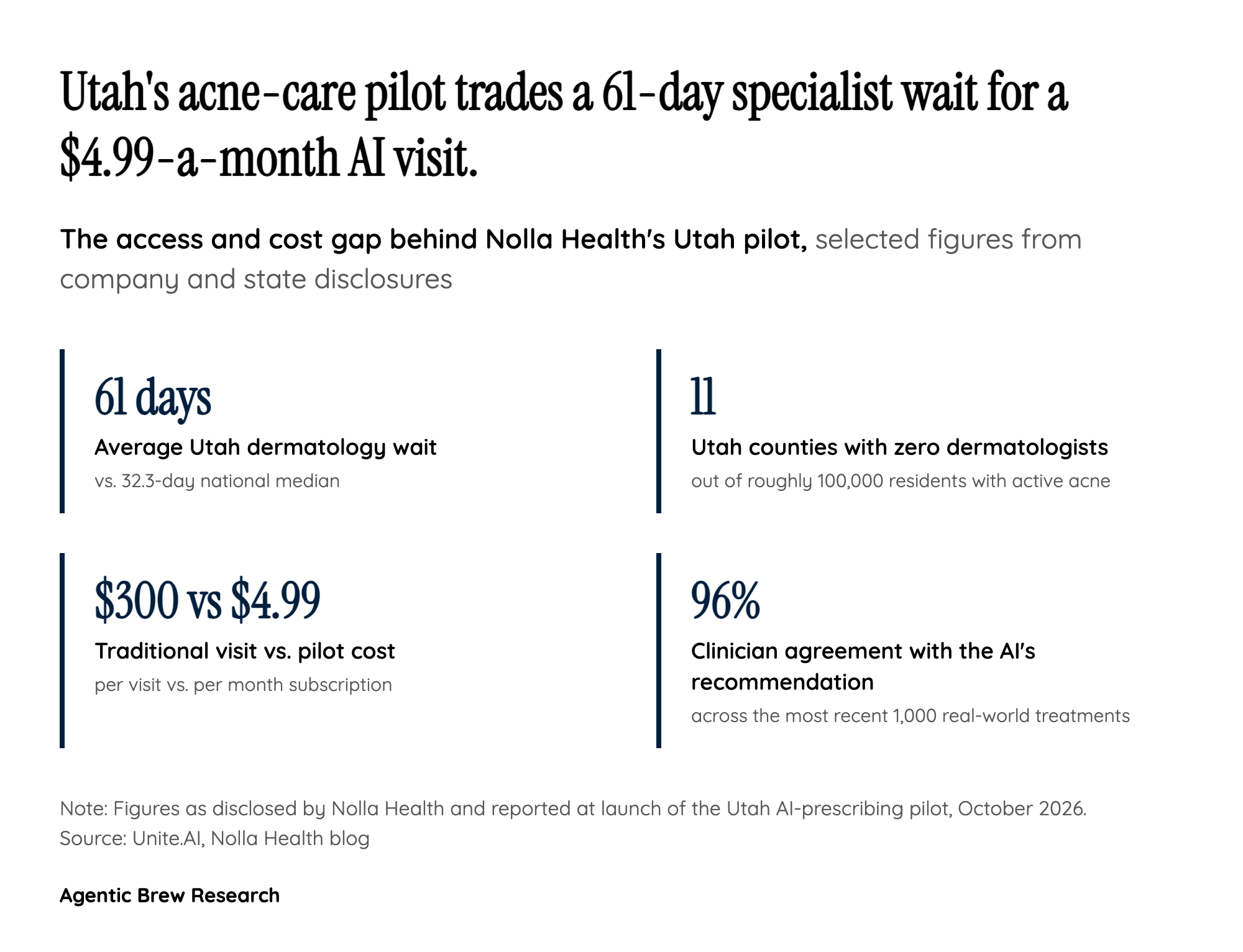
Utah dermatology access and cost gaps versus Nolla Derm pilot pricing and clinician agreement rate.

The pilot's economics are explicit by design. A traditional in-person dermatology visit can cost up to $300, while the Nolla Derm pilot costs $4.99 a month, itself a discount off a $9.99 normal price, plus $10 to $50 for the medication itself [1]. That price gap is aimed at a documented care gap: more than 80 percent of US counties are classified as healthcare deserts, affecting over 120 million people [7]. In Utah specifically, roughly 100,000 residents have active acne, but only about 10 percent ever see a dermatologist, the average wait time for an appointment is 61 days, nearly double the 32.3-day national median, and 11 of the state's counties have no dermatologist at all [1][7]. Those numbers are the explicit justification Nolla and Utah regulators have pointed to for allowing an AI system to do something no software had been permitted to do in the US before this launch.

A Fault Line Opens in Medicine: AMA, State Board, and the Rush to Regulate AI

The launch has reopened a fight that didn't start with Nolla. After the earlier Doctronic refill pilot, Utah's Medical Licensing Board had already accused the state's AI office of moving without proper consultation [5]. Now the American Medical Association has weighed in directly: its CEO, John Whyte, has publicly said AI tools should not autonomously practice medicine [6]. That institutional alarm is spreading beyond Utah: the Federation of State Medical Boards has formed a national workgroup specifically to help other state medical boards figure out how to regulate AI tools performing clinician functions, a response directly prompted by Utah's clash [9]. Utah's AI office, its medical board, the FSMB, and the FDA are now in direct conversation about next steps, which means this single acne pilot could end up shaping how every state handles autonomous AI prescribing going forward [10].

Built-In Guardrails and Their Limits

Nolla's AI does not have free rein even within its narrow lane. It can only select from a pre-approved formulary of eight topical treatments, including tretinoin, adapalene, and clindamycin with benzoyl peroxide, and only for mild-to-moderate acne [2]. The system is built to hard-stop and hand off to a human physician for severe acne, pregnancy or breastfeeding, immunosuppression, serious kidney or liver disease, prior adverse medication reactions, minors, failed identity verification, or any address outside Utah [1]. Nolla's chief medical advisor, Dr. Zaid Fadul, frames this as the core safety argument: 'The AI can't improvise. It can only choose from a short list of physician-approved topical treatments.' [2]Even so, the guardrails don't erase every risk cited around the launch: reporting alongside the pilot has flagged that image-based AI diagnostic systems can misread skin conditions on darker skin tones with substantially lower accuracy, raising concern that a visual-first triage tool could widen, rather than close, existing healthcare disparities even as it expands access on paper [11].

Historical Context

2024-11
Launched in Norway with a skin-cancer screening app, before pivoting to acne care.
2025-05
Launched its acne-treatment app in the US, succeeding its earlier skin-cancer screening product.
2026-04
An earlier Utah pilot let a different AI company approve prescription refills; the Utah Medical Licensing Board publicly objected and called for its suspension.
2026-09-21
Executives and state officials signed the regulatory agreement authorizing the AI initial-prescription pilot.
2026-10-05
Publicly launched the Utah pilot, issuing its first AI-generated initial acne prescriptions without a doctor's prior sign-off.

Power Map

Key Players
Subject

Nolla Health's AI-Issued Prescriptions for Acne Care

NO

Nolla Health (Magic Health, Inc. / Magic Health Services, LLC)

New York-headquartered AI dermatology startup operating the Nolla Derm app; running the first US AI-issued initial-prescription pilot.

LU

Luis Wenus

Nolla Health co-founder and CEO, former first employee at Worldcoin; public face of the launch and architect of its pricing and access strategy.

DR

Dr. Zaid Fadul

Nolla Health's chief medical advisor, publicly frames the AI as constrained to a fixed, physician-approved protocol list.

UT

Utah Office of Artificial Intelligence Policy / Division of Professional Licensing

State regulators that signed the agreement enabling the pilot through Utah's AI Learning Lab sandbox, requiring monthly reporting and phased physician oversight.

UT

Utah Medical Licensing Board

State physician licensing body that had already clashed with the state over an earlier AI prescription-refill pilot, demanding its suspension, framing current skepticism of Nolla's pilot.

AM

American Medical Association (AMA)

National physician trade group voicing institutional opposition to autonomous AI prescribing, represented publicly by CEO John Whyte.

Fact Check

11 cited
  1. [1] Nolla Health Launches AI-Issued Initial Acne Prescriptions in Utah
  2. [2] Utah Autonomous Acne Prescriptions
  3. [3] Regulatory Mitigation Agreement - Nolla Health
  4. [4] Nolla Health Launches Utah Pilot AI Acne Prescriptions
  5. [5] Utah Medical Licensing Board Urges State to Shut Down Doctronic AI Prescribing
  6. [6] Utah Lets AI Prescribe Acne Drugs With No Doctor Signing Off
  7. [7] AI Prescriptions Utah (Nolla Health Blog)
  8. [8] A US State Just Approved an AI Doctor
  9. [9] Medical Board Federation Forms Group to Guide States on AI Practicing
  10. [10] Utah's AI Office, Medical Board, FSMB Converse With FDA Amid AI Prescribing
  11. [11] AI Prescriptions Utah Nolla Health Acne

Source Articles

Top 5

THE SIGNAL.

Analysts

“Argues autonomous AI prescribing crosses a line physicians' trade group sees as unsafe, citing lack of transparency and unproven long-term patient outcomes.”

John Whyte
CEO, American Medical Association

“Frames the pilot as removing cost and access barriers to dermatologic care and positions Nolla as having built a system that now makes a prescribing decision autonomously for the first time.”

Luis Wenus
Co-founder and CEO, Nolla Health

“Emphasizes that the AI's operation is bounded to a fixed, physician-approved protocol list rather than open-ended clinical judgment, as the core safety rationale.”

Dr. Zaid Fadul
Chief medical advisor, Nolla Health
The Crowd

“Today, Nolla Health became the first organization in the U.S. (and possibly the world) to receive regulatory approval for an AI to issue initial prescriptions. This makes Nolla the first ever actual end-to-end AI doctor.”

@@luiswenus2978

“Introducing Nolla Health - we're building personal doctors for everyone. We're excited to announce our $4.5M seed round led by General Catalyst. There's a lot happening in the AI healthcare space, but most of what is out there today are chatbots with no real clinical”

@@nollahealth155

“we're the #1 Prescription Skin Treatment app on the App Store, and with 7k+ reviews and a 4.9 star rating the data speaks for itself. (1/3)”

@@nollahealth9

“The World's First AI Doctor Is Now Writing Real Prescriptions”

@u/EuphoricTomorrow2440161
Broadcast
The First AI Approved to Write New Prescriptions

The First AI Approved to Write New Prescriptions

NollaDerm Review: How I Manage Rosacea and Acne From My Phone

NollaDerm Review: How I Manage Rosacea and Acne From My Phone

Nolla Health's AI-Issued Prescriptions for Acne Care — AI News | Agentic Brew