The Minus-122% Margin Nobody Has Taken Public Before
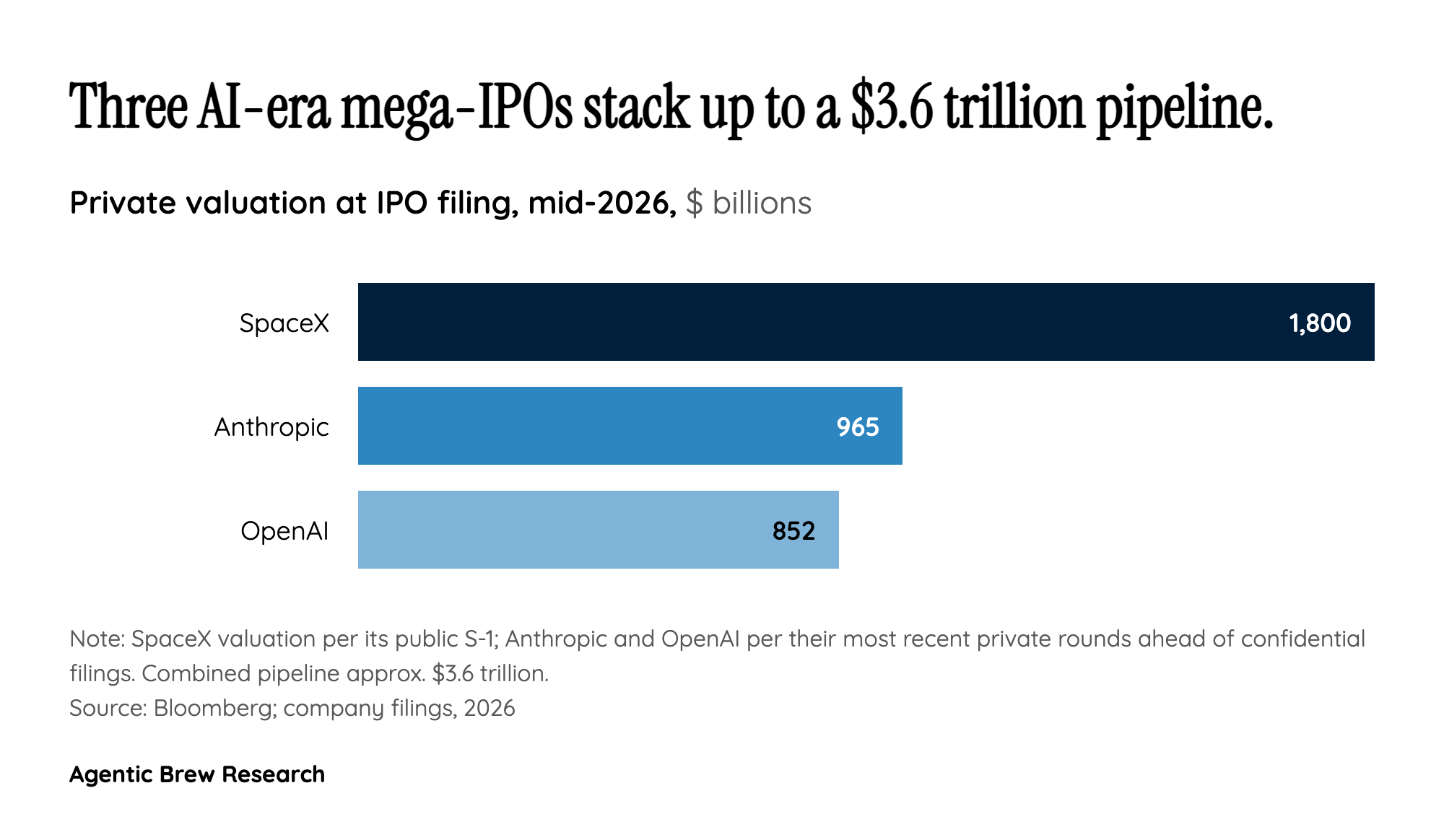
Strip away the AI mystique and OpenAI is asking Wall Street to price something the public markets have essentially never seen at this scale: a company with a roughly negative 122% non-GAAP operating margin, meaning it loses about $1.22 for every dollar of revenue it books [1]. That is not a young startup burning seed money — it sits on top of an estimated $20-25 billion in annualized 2025 revenue, yet is projected to lose roughly $14 billion in 2026, with cumulative losses possibly reaching $44 billion before any path to profitability around 2029 [1]. "Confidential filing" here simply means OpenAI handed the SEC a draft S-1 (the prospectus every company must file before selling shares) privately, so regulators can give feedback before the full financials become public ahead of the roadshow — it buys time, not solvency.
The deeper problem is the trajectory of the cost base. Gross margin reportedly fell from about 40% in 2024 to roughly 33% in 2025, while inference costs — the price of actually running the models to answer queries — are projected near $14.1 billion for 2026, up about 68% year over year [1]. OpenAI is burning roughly $25 billion in cash in 2026, and HSBC analysts estimate it may need more than $207 billion in additional capital by 2030 even under optimistic projections [1]. That is the real reason the IPO exists: private rounds, even $122 billion ones, cannot reliably refill a tank that empties this fast, and only public markets offer funding at the scale the compute bill demands [3]. The bet embedded in the filing is that GPU and inference costs fall faster than revenue growth slows — a race against the company's own electricity bill.