H3-Metal: antirez's native C/Metal port of MiniMax's H3 video model for Apple Silicon
TECH

H3-Metal: antirez's native C/Metal port of MiniMax's H3 video model for Apple Silicon

20+
Signals

Strategic Overview

  • 01.
    Salvatore Sanfilippo (antirez), creator of Redis, released h3.c, a native C/Metal inference engine that runs MiniMax's H3 multimodal video/audio model on Apple Silicon Macs, MIT licensed.
  • 02.
    The project supports text-prompt-to-video/audio generation plus multiple conditioning modes: first/last-frame anchoring, image references, silent video, embedded video+audio, and standalone audio, wrapped in an interactive Iris-style CLI with persistent model state.
  • 03.
    antirez announced the release on X, noting the code incorporates contributions from liuliu (creator of the Draw Things app), which he invited liuliu to fold back into his own project.
  • 04.
    MiniMax's own official X account publicly praised antirez for building the Mac inference engine, framing it as proof that open weights let anyone bring a model to new hardware.
  • 05.
    The engine ships three memory/performance optimizations: reducing active transformer layers (45 or 40 of 50), denoising-step reuse (2x or 3x), and SSD streaming that keeps only two DiT blocks resident in memory at a time.
  • 06.
    MiniMax H3, a 33-billion-parameter omni-modal model generating 4-15 second clips up to 2K/24fps with native stereo audio, had its open weights released August 3, 2026; antirez's h3.c followed a week later on August 10, 2026.

One Programmer, an Industry's Model, and MiniMax's Own Applause

The most striking part of h3.c's launch isn't the code itself, it's who's cheering for it. MiniMax, the company that trained and owns the underlying H3 model, used its own official X account to publicly praise antirez's unofficial port, calling him one of the best programmers on Earth and framing the whole episode as proof that open weights mean 'anyone can bring H3 to any hardware.' That's not a routine developer-relations post, it's a model vendor conceding that a single outside contributor built the Apple Silicon story it hadn't built itself.

The reaction on X reinforced that framing. The dominant narrative among commentators, especially in Chinese-language posts responding to the release, was that h3.c is 'not a wrapper, written from scratch' - pure C plus Metal shaders, with no Python, no PyTorch, and no ComfyUI dependency chain. That distinction matters to the audience it's aimed at: people who had been running H3 through heavier Python/ComfyUI stacks on Mac hardware and hitting friction. The project also incorporated code from liuliu, creator of the Draw Things app, with antirez explicitly inviting him to take back whatever pieces are useful for Draw Things's own H3 plans - a small but telling sign of how thin and informally connected the pool of people building serious native Apple Silicon AI tooling actually is.
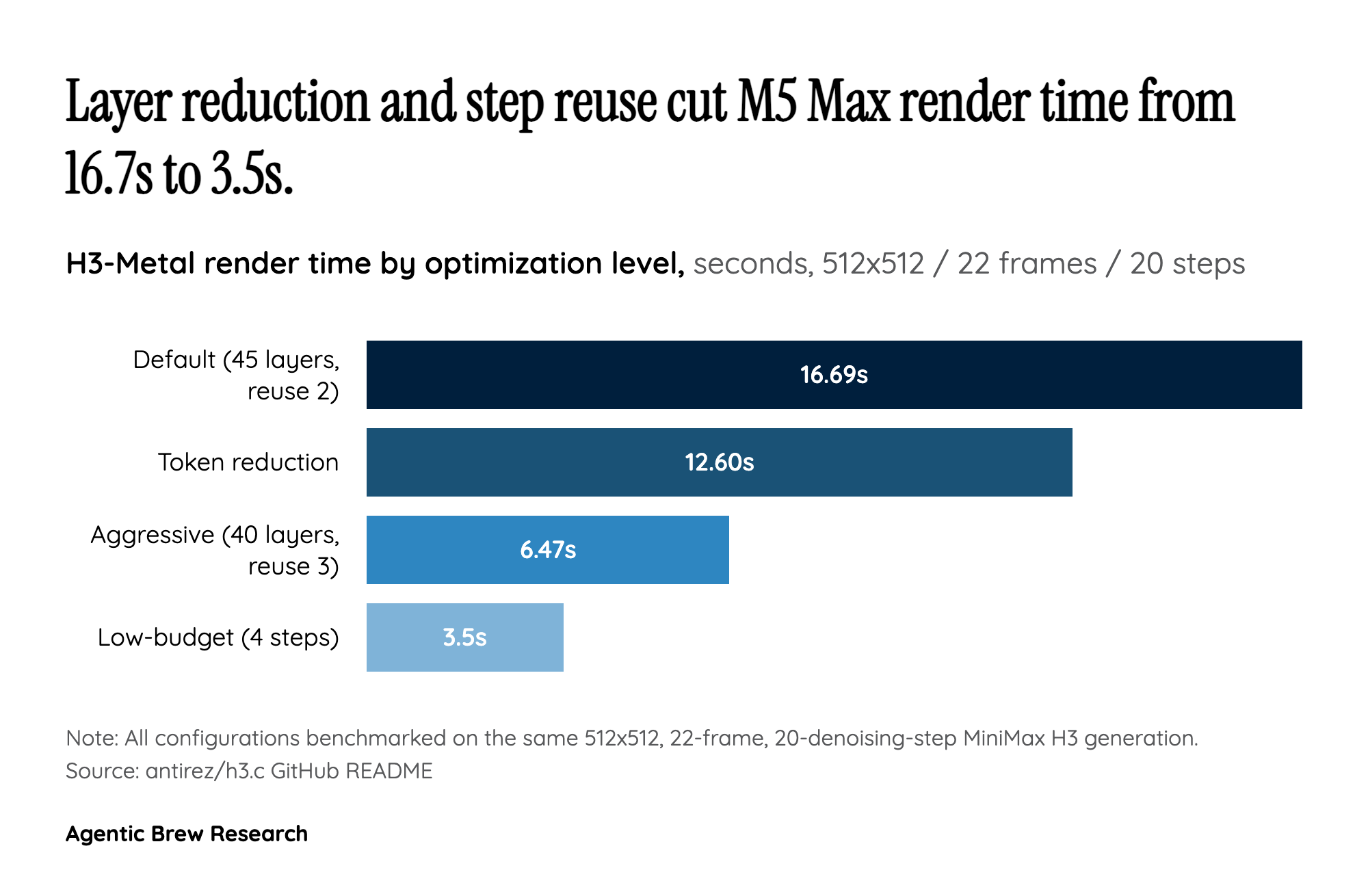
The Optimization Stack: Trading Quality and Fidelity for Speed and Memory

The Optimization Stack: Trading Quality and Fidelity for Speed and Memory
H3-Metal render time on an M5 Max drops from 16.69 seconds to 3.5 seconds as optimization settings escalate, for a fixed 512x512, 22-frame, 20-step MiniMax H3 generation.

h3.c's real engineering contribution is a set of three tunable tradeoffs layered on top of the base H3 architecture. Layer reduction drops the number of active transformer blocks from the model's full 50 down to 45 or 40, denoising-step reuse cuts the number of fresh DiT (diffusion transformer) evaluations from 20 steps down to 11 or 8, and SSD streaming keeps just two DiT blocks resident in memory while reading the rest from disk, shrinking the model's storage footprint from roughly 36.5 GiB down to 2.0-2.1 GiB at 512x512 resolution [1].

Each lever has a documented cost. SSD streaming's memory savings come with a 26-84% performance overhead, and on an M5 Max the same 512x512/22-frame/20-step generation ranges from about 16.69 seconds by default down to roughly 6.47 seconds under the aggressive 40-layer/3x-reuse configuration, or as fast as 3.5 seconds for a stripped-down 4-step render [1]. That spread turns h3.c into less a single benchmark number and more a dial: users on memory-constrained Macs can trade fidelity and time for the ability to run a 33-billion-parameter omni-modal model at all, while users with more headroom can push for speed.

The License Irony: MIT Code, Restricted Territory

There's a real tension buried in this release that the enthusiasm mostly glossed over. MiniMax's H3 license reportedly excludes local deployment in the United States, the European Union, the United Kingdom, and South Korea, and separately imposes attribution requirements, a $20 million yearly revenue ceiling before separate authorization is required, and a ban on distillation [3]. antirez's h3.c, by contrast, is released under a permissive MIT license with no such geographic gate, meaning the tool that makes local, cloud-free H3 execution trivial is now freely available in exactly the markets where running the underlying model locally is restricted by MiniMax's own terms [3].

That gap isn't a bug in h3.c so much as a structural mismatch between how open-weights releases are licensed and how independent tooling built on top of those weights actually gets distributed. Nothing in a permissively licensed inference engine enforces a model vendor's separate usage restrictions, and h3.c's popularity is itself evidence of how little practical friction that mismatch creates for end users.

The Reality Check: Apple Silicon Still Loses to Dedicated GPUs

For all the excitement, Hacker News skeptics pushed back on treating h3.c as a genuine leapfrog over dedicated GPU hardware. embedding-shape argued that diffusion-model video generation is fundamentally compute-bound, which structurally disadvantages Macs relative to NVIDIA GPUs no matter how well-optimized the software layer is [2]. Real-world numbers backed that up: one commenter reported a 128GB M4 Max Mac Studio taking roughly 90 minutes to generate a 15-second 480p video via MiniMax H3 in ComfyUI, versus 2-3 minutes on an RTX Pro 6000 [2].

Other commenters flagged rougher edges beyond raw speed - thehamkercat wanted clearer benchmark methodology given how many variables (mode, resolution, duration) shift the numbers, and separate community reports describe model load failures on 8-16GB Macs due to unified memory limits, Metal shader compile failures on older Xcode/macOS Sonoma builds, and segfaults when the binary runs under Rosetta 2 rather than natively [4]. h3.c narrows the gap for Mac users who have no GPU alternative and closes the Python/ComfyUI tooling gap specifically, but it doesn't erase the underlying hardware disadvantage for compute-bound diffusion workloads.

Historical Context

2026-08-03
Published open weights for the H3 omni-modal (33B parameter) video/audio generation model.
2026-08-10
Released h3.c, the native C/Metal H3 inference engine for Apple Silicon, MIT licensed.

Power Map

Key Players
Subject

H3-Metal: antirez's native C/Metal port of MiniMax's H3 video model for Apple Silicon

SA

Salvatore Sanfilippo (antirez)

Independently built and released h3.c under an MIT license, giving Mac users a cloud-free, Python-free path to run H3; his standing as Redis's creator lent the release outsized visibility and credibility.

MI

MiniMax

Original creator of the H3 model; released weights openly (which structurally enabled the port) and then publicly endorsed antirez's unofficial engine on its own account, effectively outsourcing platform support it never built itself.

LI

liuliu / Draw Things app

Contributed code that antirez incorporated into h3.c, and was explicitly invited to reclaim any parts useful for Draw Things's own H3 support, illustrating informal cross-pollination between independent Apple Silicon AI tool builders.

AP

appautomaton/mlx-h3 (community project)

A separate pre-alpha pure-MLX Python runtime for H3 on Apple Silicon requiring roughly 70 GiB unified memory, offering a competing (heavier, less mature) approach to the same problem h3.c solves natively.

Fact Check

4 cited
  1. [1] antirez/h3.c GitHub repository
  2. [2] H3-metal - Native MiniMax-H3 inference for Apple Silicon | Hacker News
  3. [3] MiniMax H3 Open Video Model (Hailuo) - July 2026
  4. [4] H3-Metal MiniMax H3 Apple Silicon Fixes

Source Articles

Top 3

THE SIGNAL.

Analysts

Argued that diffusion-model video generation is fundamentally compute-bound, meaning Macs remain structurally disadvantaged versus NVIDIA GPUs for this workload regardless of software optimization.

embedding-shape
Hacker News commenter

Praised the project but pushed back on the initial benchmark disclosures for being unclear about which variables (mode, resolution, duration) were actually measured.

thehamkercat
Hacker News commenter

Framed the release within antirez's broader track record of prolific, high-impact open-source output beyond Redis, including dump1090 and Kilo, as context for why the project drew attention.

punnerud
Hacker News commenter

Reported that on his own M5 Max, video generation that reportedly takes much longer on other setups completes in just a few minutes.

antirez (Salvatore Sanfilippo)
Creator, h3.c
The Crowd

Fast H3 implementation for Metal. Enjoy, modify, and so forth: github.com/antirez/h3.c Contains code from @liuliu which is welcomed in taking back whatever parts he likes for @drawthingsapp in case there are H3 plans there.

@@antirez2098

MiniMax H3 本地爆火,可教程清一色 NVIDIA + ComfyUI,Mac 用户只能干登眼。现在 Redis 之父 antirez 看不下去了,自己用纯 C + Metal 手写了一个 H3 推理引擎,Apple Silicon 原生跑。不是套壳,是从零写:纯 C + Metal shader,没有 Python、没有 PyTorch、没有 ComfyUI;文生视频 + ...

@@eternityspring265

the creator of redis just built a native minimax h3 inference engine for mac and its FREE antirez (salvatore sanfilippo) built h3-metal a single c file that runs minimax h3 locally on apple silicon. generates video and audio from text prompts on your own machine no cloud, no api key, no $40/mo sub. just a make and a prompt what you get for free: - native metal inference for minimax h3 on any mac with apple silicon - text to video with first/last frame conditioning - image, video, and audio reference injection - interactive iris-style session with live terminal preview - speed presets from 4 step (~3.5s on m5 max) to 50 step reference quality - full mit license, 549 stars in 2 days setup (3 min): step 1: clone and get the weights - git clone github.com/antirez/h3.c - download minimax h3 from huggingface into ./MiniMax-H3 - make -j8 step 2: run the interactive session - ./h3 -d ./MiniMax-H3 --width 512 --height 512 --steps 6 - type any prompt and it generates a numbered video step 3: render your first clip - ./h3 -d ./MiniMax-H3 -p "a red fox walks through snow, photorealistic tracking shot" --width 512 --height 512 --frames 22 --steps 20 -o outputs/fox.mp4 use it for prototyping video concepts, animating ideas, generating consistent character motion, or building visual agents that need local video generation this is the same minimax h3 architecture used by premium video platforms, running on your desk with zero api overhead

@@Alan_Earn41

Antirez/h3.c: MiniMax H3 inference engine for Mac computers

@u/TheStartupChime1
Broadcast
H3-Metal: antirez's native C/Metal port of MiniMax's H3 video model for Apple Silicon — AI News | Agentic Brew