Circular Financing Web Tightens Just Before Earnings
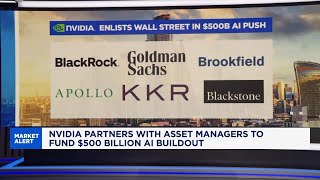
Nvidia's dealmaking in the two weeks before its Q2 FY2027 print reads like a closed loop that manufactures its own demand. On August 10, Nvidia signed MOUs with Apollo, BlackRock, Blackstone, Brookfield, Goldman Sachs and KKR to mobilize more than $500 billion in third-party capital for AI compute infrastructure, with CEO Jensen Huang arguing that Nvidia compute is 'uniquely suited' to sit at the center of that financing because it is fungible and transferable across customers and operators [1]. Two weeks later Nvidia struck a $6 billion licensing deal plus a $1 billion equity investment in Poolside at a $12 billion pre-money valuation, with more than 100 Poolside engineers moving to Nvidia to build the open-weight Nemotron model [2]. At the same time, Nvidia is discussing a $30 billion-plus funding round for Perplexity, more than 50% above its roughly $20 billion valuation from a year earlier [3].
Not everyone reads the pattern as bullish. Commentator Ed Zitron argued the moves amount to Nvidia effectively bailing out AI companies to keep them buying its compute, calling Perplexity's implied valuation a product of what he termed the industry's circular financing rather than fundamentals. On YouTube, analyst Nate B Jones made a related but narrower point about the $500 billion figure specifically: the financing platforms are memoranda of understanding rather than committed cash, and he mapped a circular loop running from Nvidia through CoreWeave and Microsoft to OpenAI and back to Nvidia. Reddit's r/pcmasterrace discussion of the Poolside earmark went further, framing it as Nvidia positioning itself as a buyer of last resort for its own GPUs - a hedge that would let it redirect chips to internal workloads if outside demand ever softened.