World Labs Atlas multimodal world model
TECH

World Labs Atlas multimodal world model

25+
Signals

Strategic Overview

  • 01.
    World Labs, co-founded by Fei-Fei Li, unveiled Atlas on September 1, 2026: an omni multimodal autoregressive diffusion transformer pretrained from scratch to natively process text, images, video, and 3D data within a single spatial context.
  • 02.
    Atlas generates up to one minute of 1440p video with pixel-perfect camera control and can also output explicit 3D representations such as point clouds and Gaussian splats, reconstructing scenes from as few as two to three images up to 100-plus.
  • 03.
    The launch demo showed engineers filming a scene with three to five ordinary smartphones on tripods and backpack-portable clamps, then having Atlas reconstruct and re-render it from camera angles none of the phones ever captured, producing a 'bullet time' effect.
  • 04.
    Atlas is entering early access with select partners rather than shipping as a standalone consumer product; World Labs says it will power future versions of its Marble product.

Deep Analysis

One Model Now Does What Used to Take a Pipeline

World Labs built Atlas as a single multimodal autoregressive diffusion transformer, pretrained from scratch to natively process text, images, video, and 3D within one spatial context, collapsing what used to require separate photogrammetry, splat-training, and camera-solving pipelines into one model [1]. The model generates up to a minute of 1440p video with pixel-perfect camera control and can output explicit 3D point clouds and Gaussian splats alongside standard video frames [1]. On sparse-view 3D reconstruction, World Labs reports Atlas hits a 25.3 mean absolute-relative pointmap error versus 28.7 for the next-best specialist model, and industry analysis has framed the result as evidence that generation and reconstruction are fundamentally the same task [2]. That framing is the real news here: Atlas is not pitched as a better video generator so much as a bet that one sufficiently large model can absorb an entire category of specialist 3D tools.

Bullet Time From a Backpack: What Sparse-View Capture Unlocks

The demo that anchored the launch was deliberately unglamorous: engineers filmed a scene with three to five ordinary smartphones mounted on tripods and backpack-portable clamps, then let Atlas reconstruct the scene and regenerate it from camera angles none of the phones ever captured, producing a 'bullet time' effect associated with dedicated multi-camera rigs [1]. Reaction online was immediate and unusually broad, spanning the official demo reel, Fei-Fei Li's own framing of it as the best camera-conditioned world model yet, and independent commentary crossing into Chinese-language AI circles, all converging on the same detail: the shot no longer requires a camera array. Beyond creative reframing, World Labs also positions the same sparse-to-dense reconstruction as a tool for Real-to-Sim robotics workflows, generating simulated environments for robot training [3].

The Trust Gap: No Paper, No Code, Self-Reported Numbers

The Trust Gap: No Paper, No Code, Self-Reported Numbers
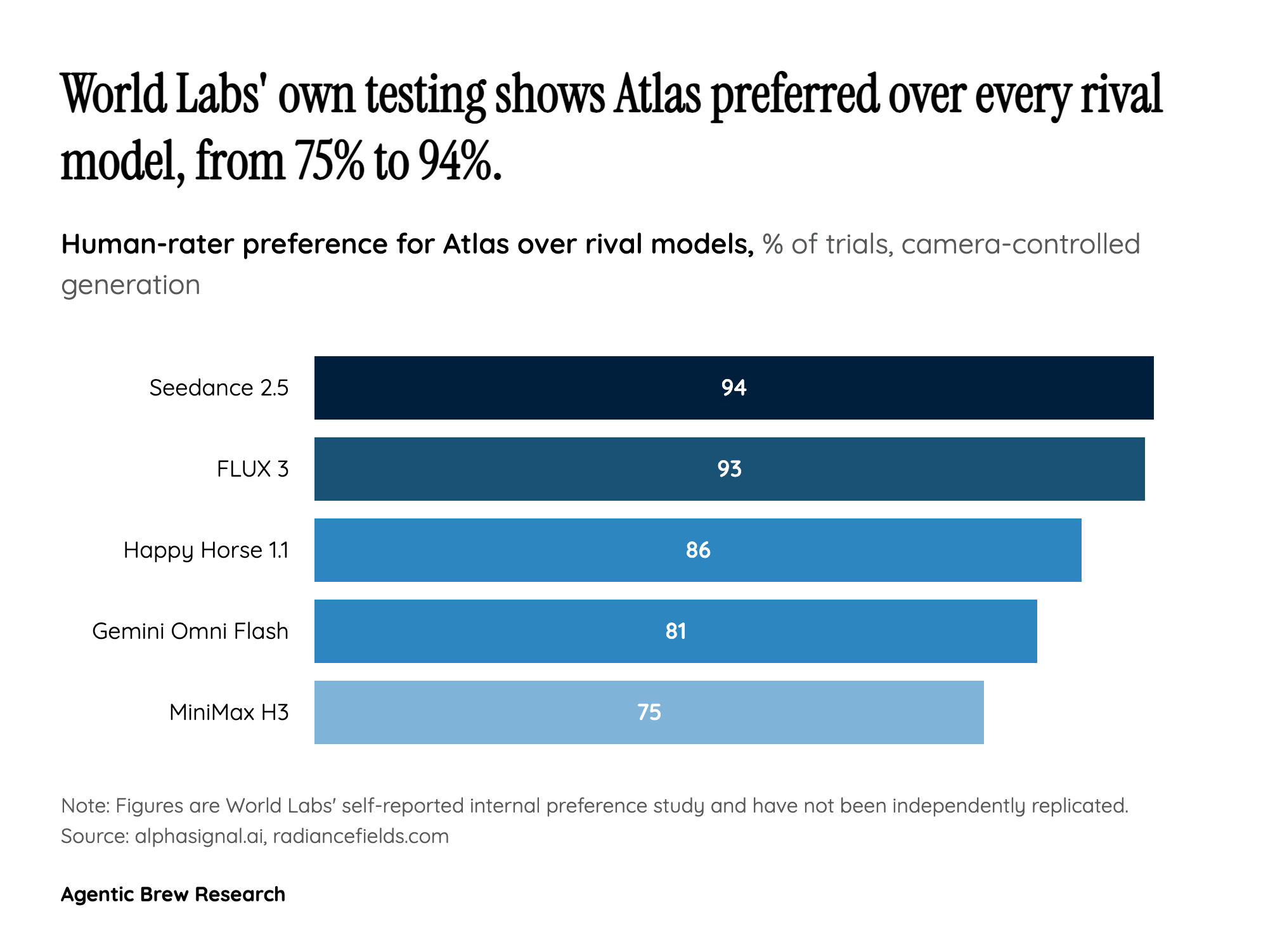
World Labs' self-reported human-rater preference for Atlas over rival models, by percentage of trials.

For all the polish of the launch reel, World Labs has not published a paper, arXiv entry, model card, or code for Atlas, leaving the architecture and training data essentially unverifiable from the outside [3]. Every headline number, including the 75-94% human-rater preference margins over MiniMax H3, Gemini Omni Flash, FLUX 3, and Seedance 2.5, comes from World Labs' own internal testing and has not been independently replicated [2]. That gap between polish and proof is exactly where the online reaction split: alongside widespread excitement, a vocal minority described the demos as 'smoke and mirrors,' pointed out that static paused frames 'look bad,' and noted a tell that independent analysis, including a YouTube breakdown of the launch, identified as a sparse-view hallucination failure mode - sparse input views being filled with generated rather than captured geometry. Reddit skeptics summed up the mood bluntly, dismissing Atlas as 'just a small step ahead of photogrammetry.'

A Billion-Dollar Bet, Three Products Deep

Atlas is World Labs' third public release in under two years, and each step has been a bigger claim on the same thesis. The company emerged from stealth in September 2024 with $230 million behind Fei-Fei Li's argument that AI needs to natively reason about 3D space and time to understand the physical world [6]. It shipped its first commercial product, Marble, in November 2025, turning text, photo, video, or panorama input into editable 3D environments [5]. Total funding has since grown to roughly $1.2-1.23 billion, backed by Nvidia, AMD, Autodesk, a16z, Intel Capital, Eric Schmidt, and Ashton Kutcher [4]. Atlas is now entering early access with select partners, and World Labs has said it will fold the model into future versions of Marble rather than ship it as a standalone product [1], which reads as a company still monetizing through one consumer-facing surface while using each new model to widen the moat underneath it.

Historical Context

2024-09
World Labs emerged from stealth with $230 million in funding, led by Fei-Fei Li, to build 'spatial intelligence' AI models.
2024-12-02
World Labs previewed its first AI system generating interactive, explorable 3D scenes from a single image, the precursor concept later commercialized as Marble.
2025-11-12
World Labs launched Marble, its first commercial multimodal world model, converting text, photo, video, or panorama input into editable, downloadable 3D environments.
2026-01
World Labs launched a World API, expanding programmatic access to its spatial-intelligence models ahead of the Atlas release.
2026-09-01
World Labs unveiled Atlas, its omni multimodal world model, entering early access with select partners.

Power Map

Key Players
Subject

World Labs Atlas multimodal world model

WO

World Labs

Spatial-intelligence startup that built and released Atlas, following its Marble product (Nov 2025) and World API (Jan 2026); controls the early-access rollout and integration roadmap.

FE

Fei-Fei Li

Co-founder of World Labs; sets the company's public 'spatial intelligence' thesis that Atlas is framed as fulfilling.

JU

Justin Johnson

Co-founder of World Labs who has publicly framed world models as tools for full interactive 3D simulation rather than static image or video output.

BE

Ben Mildenhall

Co-founder of World Labs and NeRF/Gaussian-splatting pioneer whose research background underpins Atlas's 3D-reconstruction and splat-output capabilities.

WO

World Labs investors (Nvidia, AMD, Autodesk, a16z, Intel Capital, Eric Schmidt, Ashton Kutcher)

Backers across roughly $1.2-1.23 billion in funding rounds that underwrote the compute and research behind Atlas.

Fact Check

6 cited
  1. [1] Atlas: A World Model for Spatial Intelligence
  2. [2] World Labs Atlas Beats Specialized 3D Models With One Omni Model
  3. [3] World Labs Announces New World Model: Atlas
  4. [4] Fei-Fei Li's World Labs Debuts Atlas, a World Model Showcase for Advanced Spatial Intelligence
  5. [5] Fei-Fei Li's World Labs Speeds Up the World Model Race With Marble, Its First Commercial Product
  6. [6] World Labs AI Can Generate Interactive 3D Environments

Source Articles

Top 1

THE SIGNAL.

Analysts

Described Atlas as a major milestone fulfilling her spatial intelligence thesis, calling it the best camera-conditioned world model yet and pointing to use cases spanning VFX to robotics.

Fei-Fei Li
Co-founder, World Labs

Positioned world models as tools for full interactive 3D simulation rather than static image or video generation.

Justin Johnson
Co-founder, World Labs
The Crowd

Introducing Atlas: The world's first multimodal world model that generates image and video frames with pixel-perfect camera control and reconstructs them in 3D. Model the world, move the camera, and simulate space & time.

@@theworldlabs29027

I'm so excited that our @theworldlabs team has achieved a major milestone today! Introducing Atlas - a first of its kind multimodal world model trained from scratch! 🚀 Atlas is capable of generating frames with pixel-perfect camera control, reconstructing large scenes from as few as one single input image, simulating space-time by reframing videos, natively outputting 3D spaces from one or more input images, composing multiple posed images into a consistent 3d world, and more! This is the best camera conditioned world model ever, opening doors to many possible use cases from VFX to robotics. I'm so so so proud of our team!♥️

@@drfeifei8922

wtf!?视频拍完以后,居然还能重新选机位。 早上写过李飞飞 World Labs 新发布的世界模型 Atlas,这个是刚放出来的一个具体玩法。 现场只用 3-5 台普通手机/运动相机,从几个角度拍下砊西瓜的过程。 Atlas

@@MaxForAI389

World Labs' new Atlas model: Space-time simulation, "bullet time" from 3 cell phones, and scalable Real-to-Sim

@u/jasteinerman413
Broadcast
Introducing Atlas; A Foundation Model for Spatial Intelligence

Introducing Atlas; A Foundation Model for Spatial Intelligence

World Labs Atlas Is INSANE: AI Can Generate 3D Worlds From ONE Image

World Labs Atlas Is INSANE: AI Can Generate 3D Worlds From ONE Image

World Labs Atlas: Just Changed AI Video Forever With 3D Worlds

World Labs Atlas: Just Changed AI Video Forever With 3D Worlds

World Labs Atlas multimodal world model — AI News | Agentic Brew