NVIDIA Stops Selling Chips and Starts Selling the Whole PC
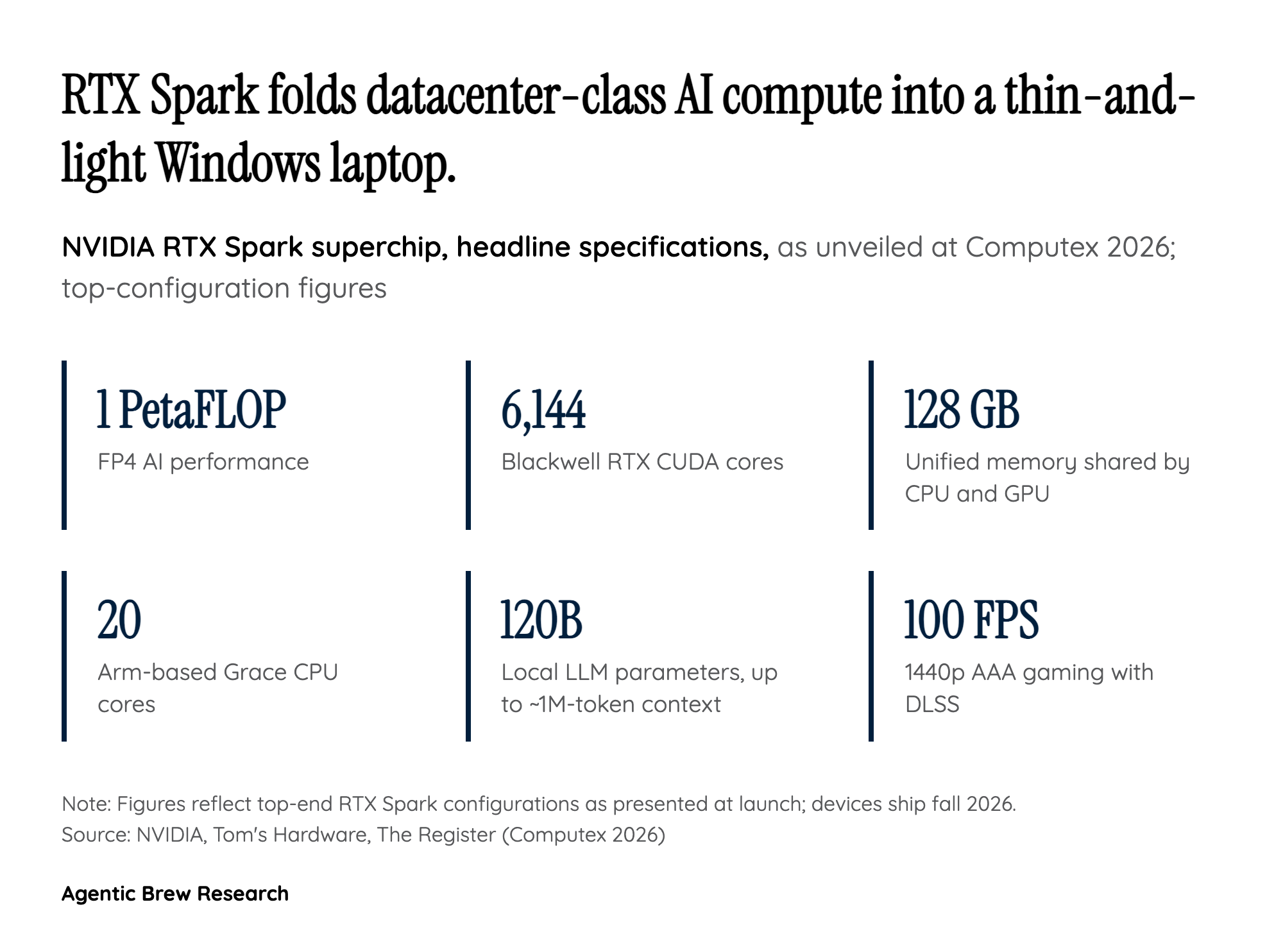
For three decades NVIDIA sold a component — the GPU you dropped into someone else's machine. RTX Spark is the first time the company has architected an entire PC platform, fusing a 20-core ARM-based Grace CPU with a Blackwell RTX GPU over a high-speed NVLink-C2C link and a shared pool of up to 128GB unified memory [1]. That vertical move matters more than any single spec. By owning the CPU, the GPU, the interconnect, and the memory architecture, NVIDIA controls the full stack that on-device AI runs on, and it ties that stack to Microsoft's Windows-on-Arm rather than to Intel or AMD's x86. The chip is co-designed with MediaTek for the Arm system-on-a-chip [1], and it folds in roughly 30 years of NVIDIA software — CUDA, RTX, DLSS, FP4, TensorRT, OptiX, Reflex and G-SYNC — as a moat that a pure silicon competitor cannot quickly replicate [2]. The strategic read is that NVIDIA is no longer content to be the GPU inside the PC; it wants to be the PC.