Instinct's $1B Series C Funding
TECH

Instinct's $1B Series C Funding

30+
Signals

Strategic Overview

  • 01.
    Instinct raised $1 billion in a Series C funding round led by Sequoia Capital, Benchmark Capital, and Coatue, valuing the company at $10 billion.
  • 02.
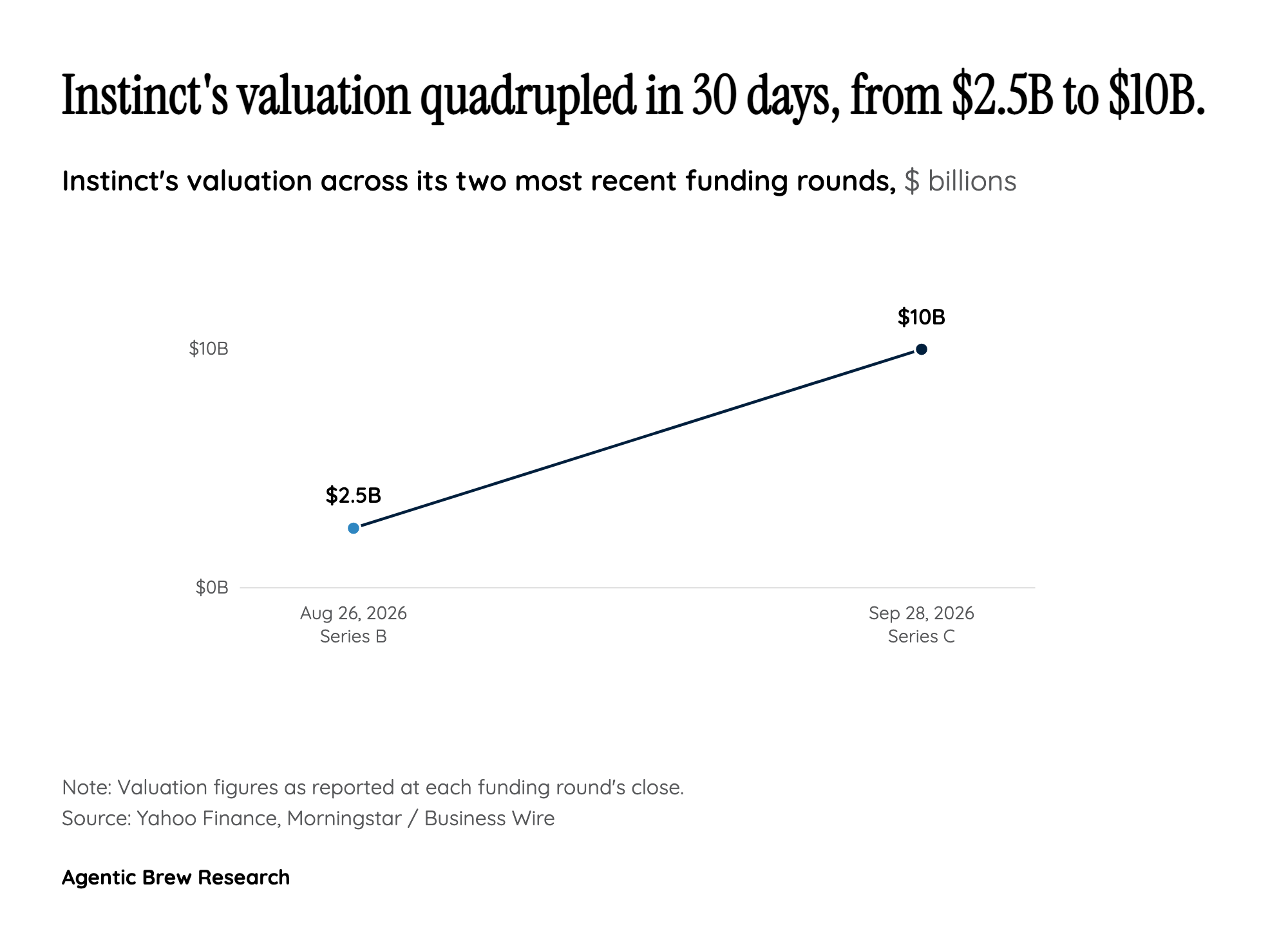
    The $10 billion valuation is roughly 4x the $2.5 billion valuation Instinct reached just one month earlier via a $250 million Series B round.
  • 03.
    Instinct is a personal AI agent reached via text or phone call that autonomously performs tasks like trip planning, grocery ordering, and subscription cancellation by connecting to a user's email, messaging apps, calendar, and device features.
  • 04.
    Alongside the funding, Instinct launched three new features: Instinct Concierge (white-glove phone-call and booking service), Trusted Person Network (an agent-to-agent coordination protocol), and Location Sharing (iMessage-based location awareness).

Deep Analysis

Four Weeks, 4x: What's Actually Driving the Valuation Spike
Four Weeks, 4x: What's Actually Driving the Valuation Spike
Instinct's valuation quadrupled in 30 days, from $2.5B (Series B, Aug 26, 2026) to $10B (Series C, Sep 28, 2026).

Instinct's new $10 billion valuation is roughly four times the $2.5 billion mark the company hit just a month earlier, when it closed a $250 million Series B [1]. That earlier round followed a period of rapid viral adoption - the assistant's user base reportedly crossed 100,000 by mid-September, having started as a private beta only in February 2026 [2]. Investors are effectively racing to lock in position in the personal AI-agent category before OpenAI, Apple, Meta's Muse, and a cluster of smaller entrants like Wajo, Ollie, and Poke can consolidate it [3]. On X, the raise split reaction: attention to founder Noah Shinn's claims that Instinct's compute demand is doubling weekly sat alongside pointed skepticism about how a company with no disclosed revenue justifies quadrupling its price tag in thirty days. That tension - explosive top-line growth versus a business model nobody outside the company has actually seen - is the real story behind the number.


The Trust Deficit Investors Didn't Wait For

A month before the Series C closed, TechCrunch had already reported that Instinct's terms of service grant it a perpetual and irrevocable license to user content, including for AI training, and that a controlled test showed the assistant could be redirected by instructions buried in an email sent to a connected inbox - a textbook prompt-injection risk for a product built around broad account access [4]. Privacy researchers interviewed for that piece framed the stakes starkly: every successful action builds trust incrementally, but a single unauthorized one can erase it entirely, and normalizing this level of third-party access to passwords and personal data changes consumer security expectations more broadly [4]. None of that scrutiny appears to have slowed the raise. If anything, Reddit threads from Instinct testers in the weeks since have added more concrete specifics to the same worry: an email sent without the user's approval, an inbox still being summarized after access was supposedly revoked, and a phishing demo convincing enough that the tester deleted their account afterward. Investors wrote a check anyway, which says as much about the pressure to not miss this category as it does about how much the market is willing to look past.

Instinct vs. Muse: A Feature Race With a Distribution Gap

Instinct and Meta's Muse shipped outbound phone-calling on the same day in mid-September, closing what had been the last major functional gap between the two assistants [5]. But functional parity hasn't translated into equal traction: Muse has pulled ahead in early consumer downloads and climbed to the No. 2 app position in the period compared, outpacing even Meta's own Meta AI app [5]. Founder Noah Shinn has publicly downplayed the threat, framing Instinct's bet on simplicity - text or a phone call, no new interface to learn - against Muse's more interface-driven approach [3]. Outside commentary is less convinced: YouTube coverage comparing the two products argues Meta simply has the financial resources and free distribution through its existing apps to win the category, while a hands-on test running both assistants through the same real-world tasks found neither has a clean execution edge yet. The rivalry is now less about who builds the better agent and more about who owns the distribution.

The Stealth-Launch Playbook That Outran Its Own Privacy Story

Instinct's rise has been deliberately opaque - no team page, no traditional launch, invite-only access building off a private beta that began in February 2026 [2]. On Reddit, a rival startup founder described that opacity as a calculated FOMO playbook, and the framing landed - the observation post itself drew far more engagement than the funding announcement did. But the pushback in the same thread is worth noting: a branding professional argued the 'genius stealth launch' story likely involved paid PR and influencer seeding rather than organic virality, and pointed out that the top Google results for 'Instinct AI' are still dominated not by the funding news but by TechCrunch's privacy and security investigation from a month earlier [4]. In other words, the marketing strategy generated buzz and, now, a $10 billion valuation - but it hasn't managed to outrun the story about what the product actually does with your inbox once you invite it in.

Historical Context

2025
Instinct is founded by Noah Shinn.
2026-02-01
Instinct begins private beta testing of its personal AI assistant.
2026-08-24
TechCrunch reports Instinct's AI assistant is raising privacy and security concerns over broad data access, a perpetual and irrevocable content license, and unauthorized actions taken by the assistant.
2026-08-26
Instinct raises $250 million in a Series B round co-led by Index Ventures and Benchmark, reaching a $2.5 billion valuation.
2026-09-16
Both Instinct (via its new Concierge feature) and Meta's Muse ship outbound phone-calling capability on the same day, closing the last major functional gap between the two agents.
2026-09-28
Instinct announces a $1 billion Series C led by Sequoia, Benchmark, and Coatue at a $10 billion valuation, alongside new Trusted Person Network and Location Sharing features.

Power Map

Key Players
Subject

Instinct's $1B Series C Funding

SE

Sequoia Capital

Lead investor in the $1B Series C, providing capital that quadrupled Instinct's valuation to $10B in one month; signals top-tier VC conviction in the consumer AI-agent category.

BE

Benchmark Capital

Co-led both the August 2026 Series B ($250M at $2.5B) and the September 2026 Series C ($1B at $10B), giving it sustained influence over Instinct's growth trajectory.

CO

Coatue

Series C investor - a growth-stage fund entering at the $10B valuation mark, adding late-stage capital firepower.

IN

Index Ventures

Co-led Instinct's prior $250M Series B at $2.5B valuation in August 2026, an early institutional backer before the Series C jump.

ME

Meta (Muse)

Direct competitor whose AI assistant Muse matches many Instinct features - including phone calling, launched the same week - and adds deep integration with Meta's social products; Muse has outpaced Instinct in early consumer downloads.

NO

Noah Shinn (Founder/CEO)

Sets product direction and downplays the competitive threat from Meta's Muse, framing Instinct's bet as simplicity versus Muse's interface-driven approach; says the new funding will scale access to the product.

Fact Check

5 cited
  1. [1] Instinct Raises $1 Billion In Series C Funding At $10 Billion Valuation
  2. [2] Personal AI Agent Instinct Quadruples Valuation To $10 Billion In 1 Month
  3. [3] Everyday Personal AI Assistant Startup Instinct Raises $1B At $10B Valuation
  4. [4] Instinct's Powerful AI Assistant Is Raising Privacy And Security Concerns
  5. [5] Rival AI Agents Instinct And Meta's Muse Both Add The Ability To Make Calls

Source Articles

Top 5

THE SIGNAL.

Analysts

“Frames the core trade-off of Instinct's model as users exchanging privacy and control for personalization, and stresses that trust is fragile - built incrementally but destroyed instantly by a single unauthorized action.”

Katie Jacobs Stanton
Founder, Moxxie Ventures

“Warns that agentic AI products like Instinct will normalize a riskier security posture among consumers, as people hand over passwords and credentials to third-party apps without understanding how their data is stored.”

Michael Mignano
General Partner, Union Square Ventures
The Crowd

“Noah Shinn reveals Instinct's compute needs are doubling every week, with months of lead time to buy more. "What does it mean when the amount of compute that you need access to is now doubling effectively every week — do we buy compute 2x of what we have right now? Well, we're..."”

@@firesidealpha9

“Instinct has raised a $1 billion Series at a $10 billion valuation, TechCrunch reports. Investors include Sequoia Capital, Benchmark Capital and Coatue.”

@@digg2

“Instinct raises $1.000M at $10.000M. A month ago it was worth $2.500M. Aggressive valuation? Yes. The heaviest we've seen in this AI feast when there's still no trace of monetization. Risk for those entering? Less than it seems. With a standard 1x preference, the Series C...”

@@jesusmargon9

“Meta Muse, "Instinct", "Town", "Wajo", "Ollie", and Other "AI Assistant" Valuations”

@u/SPAC_Time42
Broadcast
Instinct AI: The New Viral Sensation in AI

Instinct AI: The New Viral Sensation in AI

Instinct & Muse AI Agents Can Run Your Life. We Let One Try.

Instinct & Muse AI Agents Can Run Your Life. We Let One Try.

Instinct: A Free AI Assistant That Actually Gets Things Done

Instinct: A Free AI Assistant That Actually Gets Things Done