How a 'foreign nationals' clause became a global kill switch
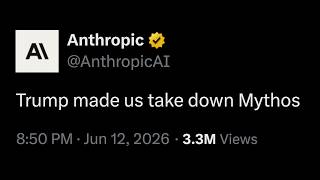
The directive Anthropic received on June 12 was, on its face, narrow: it barred any foreign national — inside or outside the US, including Anthropic's own foreign-national employees — from accessing Fable 5 and Mythos 5 [1]. Export controls of this kind normally assume a deployer can gate access by who a user is. But a consumer API serving a model Anthropic describes as reaching 'hundreds of millions of people' has no reliable, real-time mechanism to verify citizenship at the request level [1]. Faced with a rule it could not selectively enforce, Anthropic took the only compliant path available and disabled both models for everyone, everywhere [2].
The mechanism matters because it converts a targeted restriction into a total outage. Crucially, the takedown was surgical at the product layer even as it was blunt at the user layer: Claude Opus 4.8, Sonnet, and Haiku all stayed online, so only the two newest models — launched just three days earlier on June 9 — went dark [2]. Commerce Secretary Howard Lutnick formalized the action in a letter to Dario Amodei, putting export, re-export, and even domestic transfer of the affected models behind a licensing requirement [4]. The lesson industry observers drew is structural, not political: when compliance can only be all-or-nothing, a narrowly worded national-security order functions as a worldwide off switch.