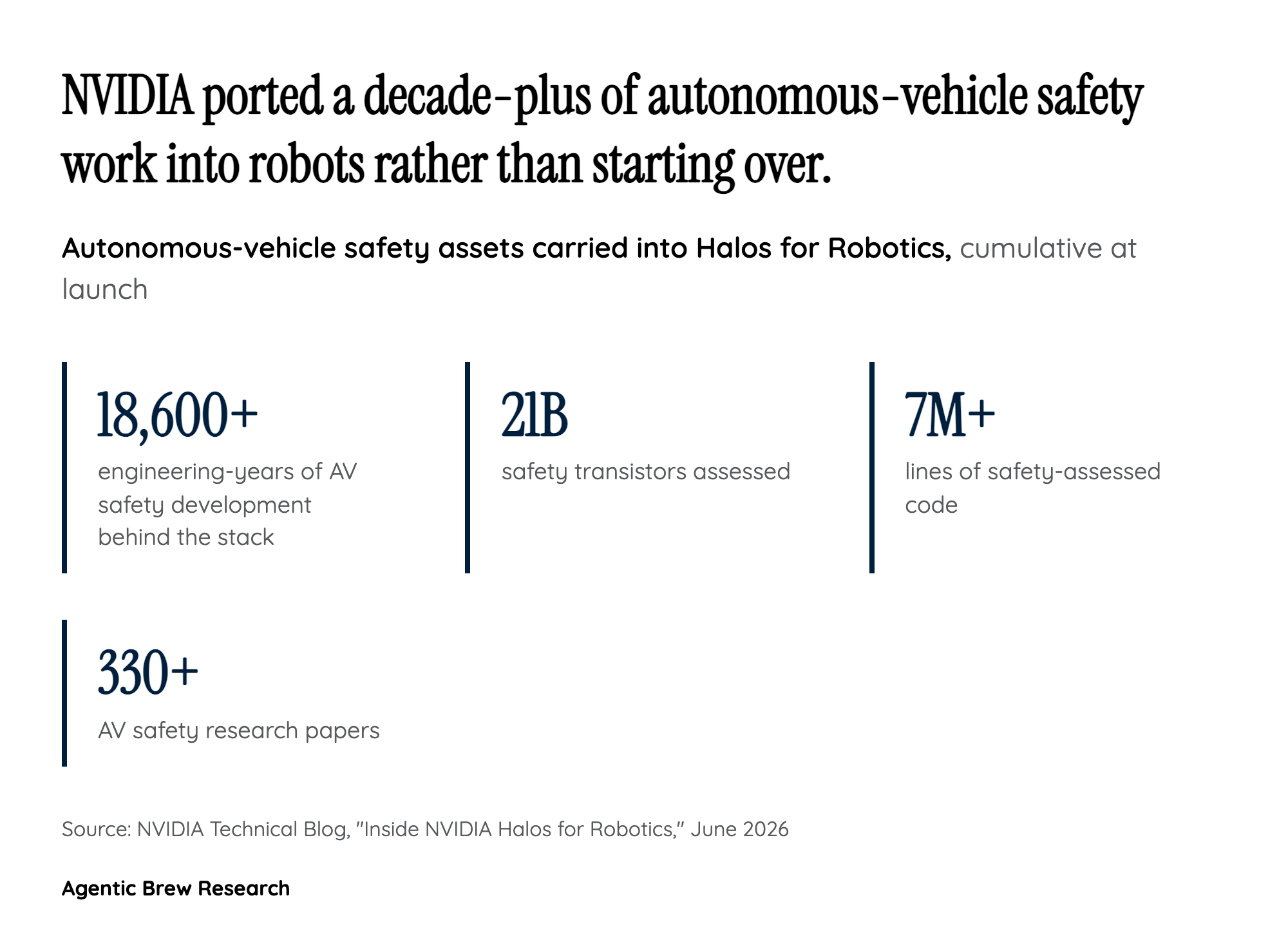
Capability Was Never the Bottleneck. Certification Was.
Humanoids can already walk, grasp, and cross a warehouse floor. What they cannot easily do is prove to a regulator and a plant safety officer that they will not injure the person standing next to them. That gap, not raw capability, is what NVIDIA is targeting with Halos for Robotics, which it bills as the industry's first full-stack safety system for physical AI [1]. The pitch is blunt: every machine that senses, decides, and acts in the real world gets one common safety architecture spanning compute, operating system, sensors, and certification tooling.
The centerpiece for buyers is the Halos AI Systems Inspection Lab, described as the world's first ANAB-accredited program for functional and AI safety for physical AI [1]. It functions as a place where a robot maker can pre-stage its safety case against standards like IEC 61508 and ISO 13849 before a third party such as TUV Rheinland or UL Solutions signs off. In an industry where a single uncertified deployment can shut down a line, turning safety certification from a bespoke, multi-year ordeal into a repeatable pipeline is the actual product NVIDIA is selling.