OpenAI acquires Ona (Gitpod) to strengthen Codex coding agent for enterprise
TECH

OpenAI acquires Ona (Gitpod) to strengthen Codex coding agent for enterprise

34+
Signals

Strategic Overview

  • 01.
    OpenAI announced on June 11, 2026 that it will acquire Ona, the Kiel, Germany startup formerly known as Gitpod, to give its Codex coding agent persistent, secure cloud environments; financial terms were undisclosed and the deal awaits regulatory approval.
  • 02.
    After integration, Codex agents will run multi-step tasks over hours or days, continuing even after the user's laptop is closed, executing inside each customer's own cloud while OpenAI provides the models and orchestration.
  • 03.
    Ona's roughly 80 employees, led by co-founder and CEO Johannes Landgraf, will join OpenAI's Codex group once the transaction closes.
  • 04.
    The acquisition is OpenAI's second enterprise-focused deal after Promptfoo in March 2026 and is widely framed as a competitive response to Anthropic, whose Claude Code added self-hosted sandboxes in May 2026.

Deep Analysis

The battle moved from the model to the runtime

The most revealing thing about OpenAI's June 11, 2026 agreement to acquire Ona [4]is what it is not buying: a smarter model. Codex already serves more than 5 million people a week, a 400% jump since the start of the year [1]. What it lacked was a place for those agents to actually live and work. Ona supplies that — persistent, secure cloud sandboxes where a Codex agent can run multi-step tasks over hours or days, continuing even after the developer closes their laptop [1]. The agents execute inside each company's own cloud while OpenAI provides the models and orchestration, so data, credentials and the audit trail stay with the customer [1]. IDC's Arnal Dayaratna put the gap plainly: 'This is outside of what OpenAI has now. These are secure environments where agents can have memory and operate securely' [2]. Conifers.ai CEO Tom Findling framed it as the missing 'plumbing' [2], and Ona CEO Johannes Landgraf distilled the thesis to a sentence: 'Agents need more than intelligence; they need a trusted workspace' [3]. For a tech press that spent two years measuring frontier labs by benchmark scores, the message is that the next phase of competition is about execution infrastructure, not raw reasoning. Coverage on YouTube extended the point, reading the deal as part of OpenAI's broader move to fold Codex into ChatGPT as a platform rather than a feature.

A direct counter-move to Anthropic — and a pattern of buying, not building

The timing is not coincidental. Anthropic's Claude Code is widely considered the leader for long-running coding tasks, and it began supporting self-hosted sandboxes in Claude Managed Agents in May 2026 [2]. One outlet titled its coverage bluntly: 'As Anthropic claims the enterprise, OpenAI fights back with Ona deal' [5]. Ona is OpenAI's second enterprise-infrastructure acquisition in three months. In March 2026 it bought AI-security platform Promptfoo — trusted by over a quarter of the Fortune 500 and 150,000-plus open-source users — and shipped Codex Security the same day [6]. The through-line is an acquisition-led platform build-out: rather than grow secure-execution and security tooling internally, OpenAI is buying startups with proven enterprise footholds to compress time-to-production [7]. Ona's existing customer roster — America's largest banks, European financial and pharmaceutical companies, and Asian sovereign wealth funds — is itself part of the asset, a credibility shortcut into exactly the risk-averse accounts where Anthropic has been gaining ground [8]. Both YouTube and finance-focused commentary on X framed the deal inside this OpenAI-versus-Anthropic rivalry, alongside a brewing API price war.

Small revenue, big multiple: what OpenAI is actually paying for

Small revenue, big multiple: what OpenAI is actually paying for
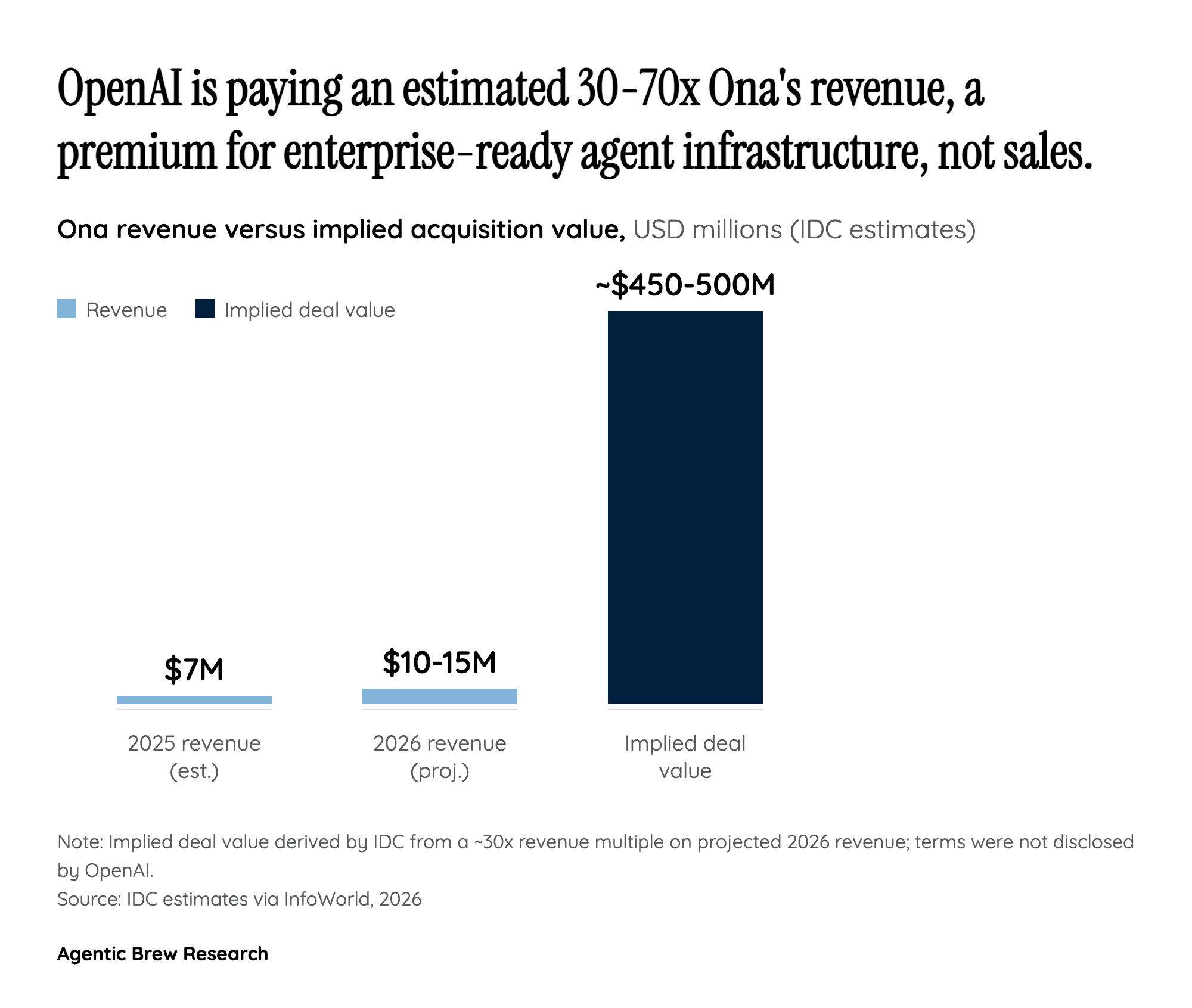
IDC pegs Ona near a 30x revenue multiple, implying a roughly $450-500M price against just $7M in 2025 revenue.

The economics underline that this is a talent-and-capability buy, not a revenue buy. IDC estimated Ona's 2025 revenue at roughly $7 million, with 2026 revenue projected at $10M to $15M; at a roughly 30x revenue multiple that implies an acquisition price near $450M to $500M [2]. That is a steep premium for a company whose top line is a rounding error against OpenAI's scale — which is precisely the point. Ona quadrupled its enterprise ARR year-over-year last quarter and landed a near-eight-figure contract [9], signals of product-market fit in the enterprise segment OpenAI most needs to win. The roughly 80-person team, the secure-execution platform, and the customer relationships are the asset; the revenue is almost incidental. It also fits a broader Codex demand curve: knowledge workers, not just developers, now make up about 20% of Codex's user base and are growing at triple the developer rate [10], expanding the population that will eventually need governed, long-running agent environments. Info-Tech's Jeremy Roberts described what that buys in operational terms — 'It is a bucket for the agents to operate in' [2].

The unanswered question: governance, or shadow AI in a nicer UI

The sharpest skepticism is not about strategy but about whether persistent agent workspaces are safe at scale. Ona's platform brings real enterprise-grade controls — cryptographic hash-based application blocking that catches a program even if it is renamed or moved, file-system path restrictions to protect credentials, and outbound connection filtering [5]. But developer-community discussion zeroed in on the harder problem underneath: a persistent cloud workspace only scales safely with governance around who can spawn an environment, which credentials mount, where logs go, and where data resides — otherwise it risks becoming, as one commenter put it, shadow AI in a nicer interface. A separate organic thread asked the obvious counterfactual: why buy rather than use Codex itself to build Ona's platform — a fair question that the disclosed rationale, proven security tooling, an enterprise customer base, and an 80-person team that already solved it, largely answers [1]. There are also concrete deal-level risks: terms were undisclosed, the acquisition is subject to regulatory approval, and integrating a German team and platform into the Codex group is still pending [11].

Historical Context

2020
Gitpod founded in Kiel, Germany as a one-click online IDE for GitHub, eventually serving roughly 2 million developers.
2025-09
Gitpod rebranded as Ona, pivoting from cloud IDEs to an AI agent platform positioned as mission control for a personal team of software engineering agents.
2026-03
OpenAI acquired AI-security platform Promptfoo, trusted by over 25% of the Fortune 500, and launched Codex Security the same day.
2026-06-11
OpenAI announced the acquisition of Ona to give Codex persistent, secure cloud environments for long-running enterprise agent tasks.

Power Map

Key Players
Subject

OpenAI acquires Ona (Gitpod) to strengthen Codex coding agent for enterprise

OP

OpenAI

Acquirer integrating Ona's secure cloud execution and orchestration into the Codex ecosystem to make Codex enterprise-ready for long-running agent tasks.

ON

Ona (formerly Gitpod)

Target; Kiel, Germany cloud-development-environment startup (~80 employees) that pivoted to an AI agent platform, providing secure, persistent self-hosted sandboxes where agents run continuously.

JO

Johannes Landgraf

Co-founder and CEO of Ona, leading the team joining OpenAI's Codex group; framed the deal as expanding the company's mission rather than ending it.

AN

Anthropic

Chief rival; its Claude Code dominates enterprise long-running coding workflows and added self-hosted sandboxes in May 2026, prompting OpenAI's competitive response.

EN

Enterprise customers

Ona's existing clients span America's largest banks, European financial and pharmaceutical firms, and Asian sovereign wealth funds; they retain data, credentials and audit trail under the customer-controlled model.

Fact Check

11 cited
  1. [1] OpenAI buys Ona to push Codex toward long-running autonomous coding tasks
  2. [2] OpenAI buys Ona to help rein in AI agents
  3. [3] OpenAI acquires Ona to make Codex agents run longer
  4. [4] OpenAI to acquire Ona to support its AI coding assistant Codex
  5. [5] As Anthropic claims the enterprise, OpenAI fights back with Ona deal
  6. [6] OpenAI acquires Promptfoo, gaining 25% foothold in Fortune 500 enterprises
  7. [7] OpenAI acquires AI agent orchestration startup Ona
  8. [8] Gitpod is now Ona
  9. [9] Gitpod rebrands as Ona
  10. [10] OpenAI acquires German cloud startup Ona to power longer-running Codex agent tasks
  11. [11] OpenAI acquires startup to boost Codex

Source Articles

Top 3

THE SIGNAL.

Analysts

"Ona's secure, memory-equipped environments sit outside OpenAI's current offering, filling a genuine capability gap."

Arnal Dayaratna
Research VP for Software Development, IDC

"Ona supplies the secure-operation infrastructure OpenAI was missing."

Tom Findling
CEO, Conifers.ai

"Ona gives IT a controlled, credentialed container for agents to operate within."

Jeremy Roberts
Senior Director, Info-Tech Research Group

"Agents need a trusted workspace, not just raw intelligence; selling the company feels like the mission expanding rather than ending."

Johannes Landgraf
Co-founder & CEO, Ona
The Crowd

"We’ve reached an agreement to acquire @ona_hq. Its secure cloud execution technology will help Codex take on longer-running work, even when laptops are closed, and help more organizations deploy agents securely in production. After closing, Ona will join OpenAI’s Codex team."

@@OpenAINewsroom3891

"OpenAI agreed to acquire Ona which is a cloud startup that builds secure persistent environments for AI agents. The team will fold into Codex which now has more than 5M weekly users as OpenAI moves faster to turn coding agents into long-running workflows."

@@StockSavvyShay138

"OpenAI is buying Ona to give Codex agents a secure cloud desk that stays open after humans leave. Codex already has 5M weekly users, up 400%, but harder work breaks the old chat pattern because agents need tools, files, credentials, logs, and time. Ona adds persistent cloud"

@@rohanpaul_ai43

"OpenAI to acquire Ona to support its AI coding assistant, Codex"

@u/BuildwithVignesh39
Broadcast
ChatGPT And Codex Are Merging (This Changes Everything)

ChatGPT And Codex Are Merging (This Changes Everything)

[Tea House AI Morning Reading] 0612 | OpenAI Acquires Ona, Price War Begins, Google Makes Three Moves - 9 AI News Items

[Tea House AI Morning Reading] 0612 | OpenAI Acquires Ona, Price War Begins, Google Makes Three Moves - 9 AI News Items

EP 528: OpenAI rolls out Codex coder, Google goes full AI multimedia & more AI News That Matters

EP 528: OpenAI rolls out Codex coder, Google goes full AI multimedia & more AI News That Matters